Bid/No-Bid Checklist for Federal Contracts: 20 Questions to Ask Before You Write a Word
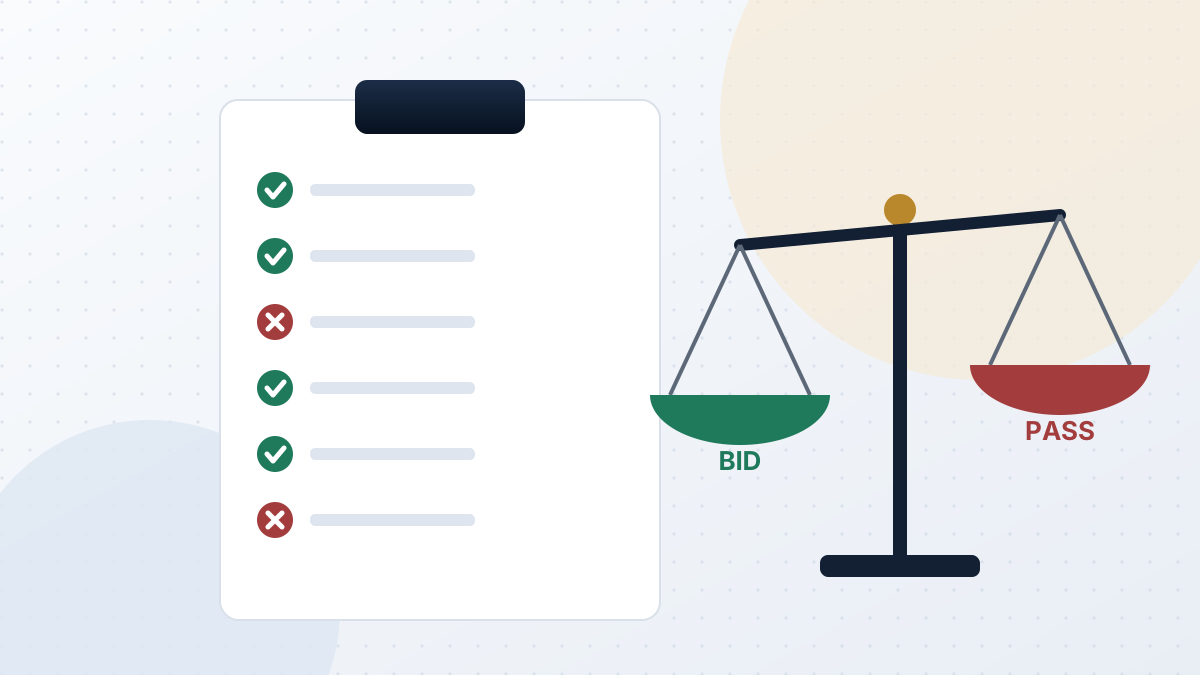
A bid/no-bid checklist is a 10-minute gut check that saves you a 40-hour proposal you were never going to win. Answer 20 questions on fit, proof and competition for any SAM.gov notice: 16 or more yes answers means bid, 11 to 15 means team up or get answers first, and 10 or fewer means pass.
Rule of thumb: 16 or more yes = bid. 11 to 15 = team up or get answers first. 10 or fewer = pass. Passing is a skill, not a failure.
What are the 20 questions to ask before you bid?
Fit: is this really your work?
Proof: will an evaluator believe you?
Competition: can you actually win?
Capacity and compliance: can you deliver the proposal and the work?
Money: is it worth it?
Yes answers: 0 of 20
What tips do most small businesses learn the hard way?
- Decide before you read the whole RFP. Skim Sections L and M (instructions and evaluation) first. If the evaluation factors don't play to your strengths, you just saved a weekend.
- Look up the incumbent before anything else. If the same company has held the work for years and the agency is happy, your odds are poor unless something changed.
- "Team" is a real answer. If you have the certification but not the proof, partner with a firm that has the past performance. You learn the agency and earn your own reference.
- Price the proposal itself. Multiply the hours by what your time is worth. A $50,000 job that takes 60 proposal hours at a 10% win rate is a bad trade.
- Write down why you passed. Two lines per pass. In six months you'll see the pattern of what you should stop chasing.
What red flags mean pass?
- The requirement reads like one company's brochure (brand names, oddly specific experience).
- Questions are due before you could realistically read the documents.
- You'd need to subcontract most of the work to a large business to perform it.
- You're hoping the evaluator will overlook a missing license or clearance.
Bid/no-bid questions
What is a bid/no-bid decision?
It's the go-or-pass call you make before writing a proposal. You check fit, proof, competition, capacity, and money, then decide to bid, team with someone, or pass. Making it early saves proposal hours for work you can actually win.
How many yes answers do I need to bid?
Use this as a rule of thumb: 16 or more yes answers out of 20 is a bid. 11 to 15 means team with a partner or get your open questions answered first. 10 or fewer, pass and save the hours.
Should a small business bid on everything to get noticed?
No. Losing proposals don't build a reputation, and contracting officers remember sloppy ones. Bid on fewer jobs that fit, and answer sources sought notices to get noticed before the RFP.
What's the difference between this checklist and the bid/no-bid scorecard?
The checklist is 20 yes-or-no questions you can print and run through in 10 minutes. The free scorecard tool weighs the same factors and gives you a GO, TEAM, or PASS verdict with next steps.
Next step: score a live notice with the bid/no-bid scorecard, find better-fit notices with the SAM.gov bid search guide, and answer early with the sources sought guide.
Check this contract lane with GovScout Pro
Paste a notice into Marcus and he runs these checks against your business profile, then gives you GO, TEAM, or PASS with the reasons.
Start with Marcus