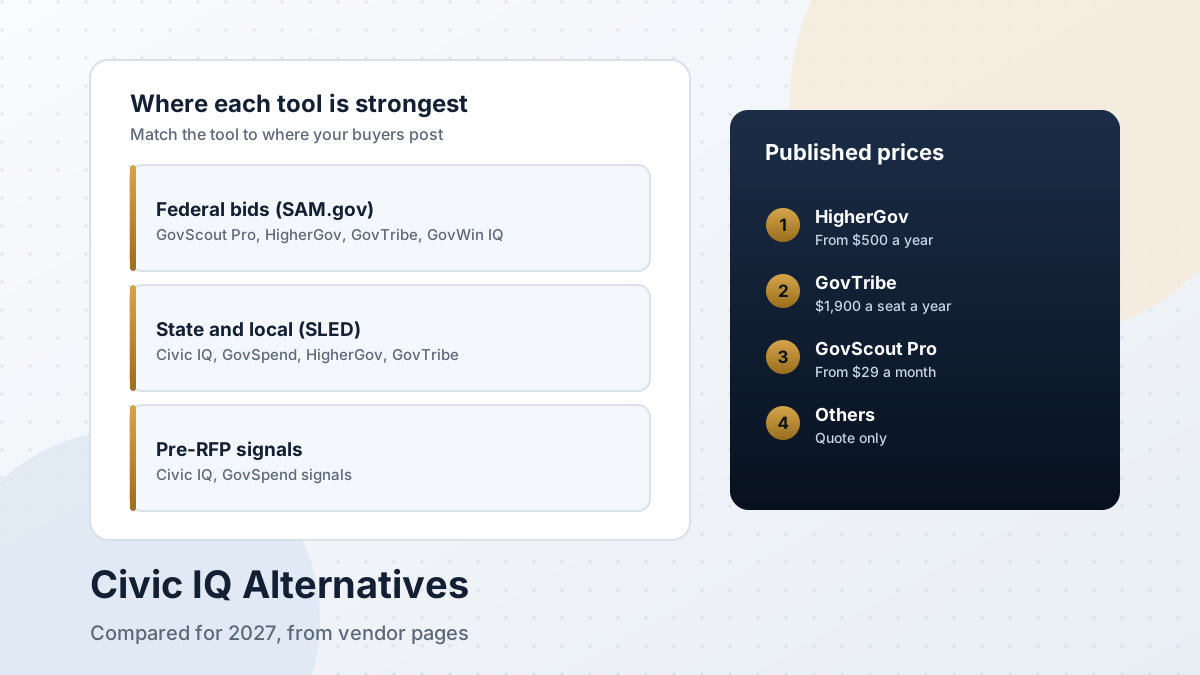
- Civic IQ says it is built for state and local sellers, finding buying signals in board meetings and budgets before an RFP exists. It says it is not built for federal work.
- HigherGov and GovTribe both say they cover federal and state and local data on every plan. HigherGov lists Starter at $500 a year for one user. GovTribe lists $1,900 per seat per year.
- Civic IQ, GovSpend, GovWin IQ and GovEagle do not publish prices. Expect a demo call before you see a number.
- For a first federal bid under the $350,000 simplified acquisition threshold, SAM.gov is free and already has set-aside filters and sources sought notices. A paid tool buys you time, not access.
- Run two tools side by side for 30 days on the same 10 SAM.gov opportunities before you pay for a year.
- Tip: before any demo, ask one question: what does seat three cost, and what does it cost to leave? Per-seat pricing and cancellation terms are where the real bill hides.
People type "Civic IQ alternatives" for two different reasons. Some sell to cities, counties and school districts and want a different tool. Others are new to government contracting, landed on Civic IQ by accident, and want to know what fits a first federal bid. The answer is different for each, so the first job is sorting out which one you are.
What is Civic IQ, and who looks for alternatives?
Civic IQ describes itself as a sales intelligence platform for companies selling to state and local government. According to its own pages, it watches board meetings, budget discussions and public records and flags buying signals months before a formal RFP exists. Its own comparison page says it is "purpose-built for SLED, not federal." SLED means state, local and education buyers. Pricing is quoted on request, and the company offers a demo.
That is a real product for a real need. It is also why a federal beginner gets frustrated. A federal first bid lives on SAM.gov: NAICS codes, set-aside flags, sources sought notices and a response clock. A tool tuned for county board agendas is solving a different problem.
The one question that sorts every tool
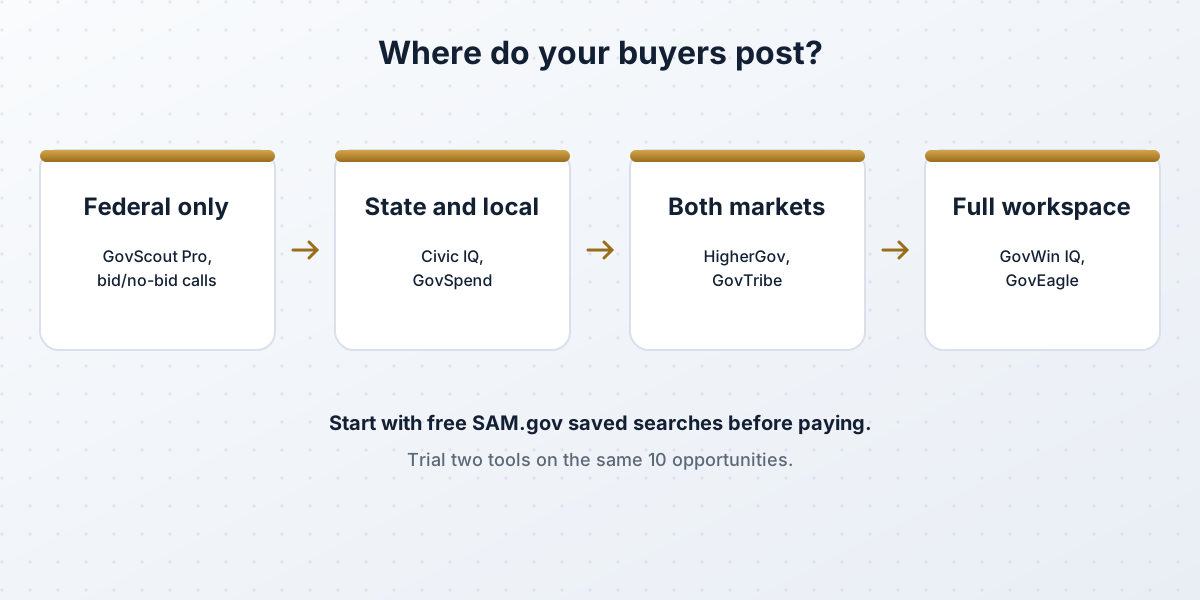
Ask where your buyers actually post. If the answer is "SAM.gov," start with federal-first tools. If it is "county and school district portals," start with SLED tools. If it is both, you need a tool that covers both, or two tools. Every other feature is secondary.
Which Civic IQ alternatives cover federal and which cover state and local?
Here is how the main options describe themselves. These are vendor claims, so treat the coverage column as "what they say," and confirm with a trial before you pay.
| Tool | What it says it does best | Published price |
|---|---|---|
| Civic IQ | State and local pre-RFP signals from board meetings and budgets | Quote only, demo offered |
| GovSpend | State, local and education spend data and bids; federal through its Fedmine product, which it says pulls 19 federal sources | Quote only; no free trial listed |
| HigherGov | Federal and state and local opportunities on every plan, with saved searches and alerts | Starter $500 a year (1 user), Standard $2,500 a year (up to 10 users) |
| GovTribe | Federal and state and local opportunities on every plan, plus awards data | $1,900 per seat per year, falling to $1,200 at six or more seats |
| GovWin IQ | Federal forecasting, capture and teaming intelligence for larger teams | Quote only |
| GovEagle | A workspace for tracking pursuits, capture planning and drafting proposals | No public price; demo only |
| GovScout Pro | Federal bid/no-bid decisions: GO, TEAM or PASS against your NAICS codes and set-asides | $29, $79 or $199 a month |
What does each Civic IQ alternative cost in 2026, including per-seat fees?
Only three of the seven publish a number. HigherGov lists $500 a year for Starter, which works out to about $42 a month for one user, and $2,500 a year for up to 10 users. GovTribe lists $1,900 per seat per year, and our GovTribe pricing breakdown shows how three seats climb to roughly $4,800 a year. GovScout Pro runs $29, $79 or $199 a month, billed through Stripe, with a 3-day limited trial.
The rest are quote-only. Public purchase data gives a rough picture: Vendr reports a median of about $11,576 a year for GovSpend, with deals from about $7,900 to $49,500. For GovWin IQ, our GovWin IQ pricing guide walks through what buyers actually pay. For a side-by-side of the published numbers, see the GovCon software price comparison.
Trials worth using
HigherGov offers a two-week trial that needs a business email. GovTribe offers a 7-day trial with no credit card. GovSpend, GovEagle, Civic IQ and GovWin IQ route you to a demo instead. If a vendor will not show you a real opportunity from your own NAICS codes before checkout, take that as information about the paid experience.
Which Civic IQ alternative fits a first bid under $350,000?
Two thresholds matter for beginners. The micro-purchase limit is $15,000, and the simplified acquisition threshold is $350,000, both in effect since October 1, 2025. Most first wins land under those lines, where the paperwork is lighter and past performance counts for less. Our first federal contract checklist covers the steps in order.
Here is the honest part. SAM.gov is free, and it already has set-aside filters and sources sought notices. What it does not give you is a score, a calendar, or the agency forecasts that live on other sites. So a paid tool buys time, not access. Set up saved searches on SAM.gov first (our SAM.gov search and API guide shows how), and pay for a tool only when you are losing hours to noise.
When you are ready to pay, the choice follows your stage. HigherGov and GovTribe cover both federal and state and local, so they suit a firm that might bid either way. GovScout Pro is narrower on purpose: it reads a federal opportunity against your profile and returns GO, TEAM or PASS with the reasons attached, which suits a solo owner who needs to skip bids they would lose. If you are still choosing codes, the NAICS Code Goldmine ($17) walks through the ones that pay.
Where does GovScout Pro fall short against these alternatives?
You should hear this from us before you buy. GovScout Pro is federal-only. If you sell to counties, cities or school districts, GovSpend, HigherGov, GovTribe or Civic IQ cover far more of that ground than we do.
We are a decision tool, not a full business development suite. You will still want a separate place for pipeline, teammates and proposals. GovEagle and GovWin IQ are built for that, and our dataset is smaller than GovWin IQ's, so you get less historical award context. Where we compete is narrow: a certified small business deciding whether a federal solicitation is worth the week.
When is Civic IQ still the better choice?
If your pipeline is genuinely state and local, Civic IQ is the one tool in this list designed around it. Think facilities, construction, software or services bought by counties and school districts, where deals are shaped in board meetings long before an RFP posts. Federal-first tools index SAM.gov, not your county procurement portal, so you would pay for coverage you cannot use. If you never touch SAM.gov, NAICS codes or set-asides, skip the federal tools entirely.
How should you trial and switch between tools?
Run a 30-day parallel trial. Pick 10 real SAM.gov opportunities that fit your NAICS codes and certifications, run the same list through two tools, and score each one every few days.
- Alert timing: how many hours after a solicitation or sources sought notice posted did each tool tell you?
- Noise: how many alerts were irrelevant to your NAICS codes or set-aside status?
- Decision value: did the tool give you enough to write a real bid/no-bid call?
Before you leave any tool, export your saved searches, alert settings and capability statement. Rebuild what will not export, and cancel only after the new tool has delivered a full week of on-time alerts. Check the contract first, because some platforms require written notice to cancel.
What changed in 2026 that affects your choice?
- Thresholds went up. Micro-purchases are $15,000 and the simplified acquisition threshold is $350,000 as of October 1, 2025, so more small-dollar work is open to first-time bidders.
- SAM.gov changed. Modernized representations and certifications arrived March 24, 2026, and FPDS and eSRS reporting moved into SAM.gov in early 2026. Tools that pull SAM.gov data had to adapt.
- The FAR is being rewritten. The FAR Council released a second round of overhaul proposed rules on September 18, 2026. Ask any vendor how fast they update to new rules.
- Everyone is adding AI. GovTribe includes AI credits in its trial, and Civic IQ advertises a connector for AI assistants. Those are vendor claims, so test them on your own opportunities.
Frequently Asked Questions
Is there a free alternative to Civic IQ for finding government contracts?
For federal work, SAM.gov is free and includes set-aside filters and sources sought notices. Neither HigherGov nor GovTribe lists a permanent free plan on its own pricing pages. HigherGov offers a two-week trial and GovTribe a 7-day trial. GovScout Pro has free tools, including a readiness assessment, a NAICS lookup and a capability statement generator, plus a 3-day limited trial of the paid plans.
What is the cheapest tool for a one-person firm?
On published prices, GovScout Pro at $29 a month is about $348 a year, and HigherGov Starter at $500 a year is about $42 a month. GovTribe at $1,900 per seat per year costs more. GovSpend, GovWin IQ and Civic IQ are quote-only. The cheapest option overall is SAM.gov with saved searches, which costs nothing.
Is Civic IQ good for federal government contracts?
Its own materials say it is built for state and local sellers, not federal. If your first bid is a federal set-aside on SAM.gov, a federal-first or both-market tool is a better fit.
Which tool is best for SDVOSB set-aside opportunities?
Any tool that filters on set-aside status can surface SDVOSB work. GovScout Pro reads an opportunity against your certification and returns GO, TEAM or PASS, HigherGov and GovTribe track set-asides alongside their wider data, and SAM.gov itself filters by set-aside for free. Pick based on price and how much deciding you want done for you.
Do I need a paid tool to win my first federal bid?
No. Many first wins come from free sources: SAM.gov, USAspending.gov and a good capability statement. A paid tool saves you time once you are screening many opportunities a week, so try the free route first and pay when the hours add up.