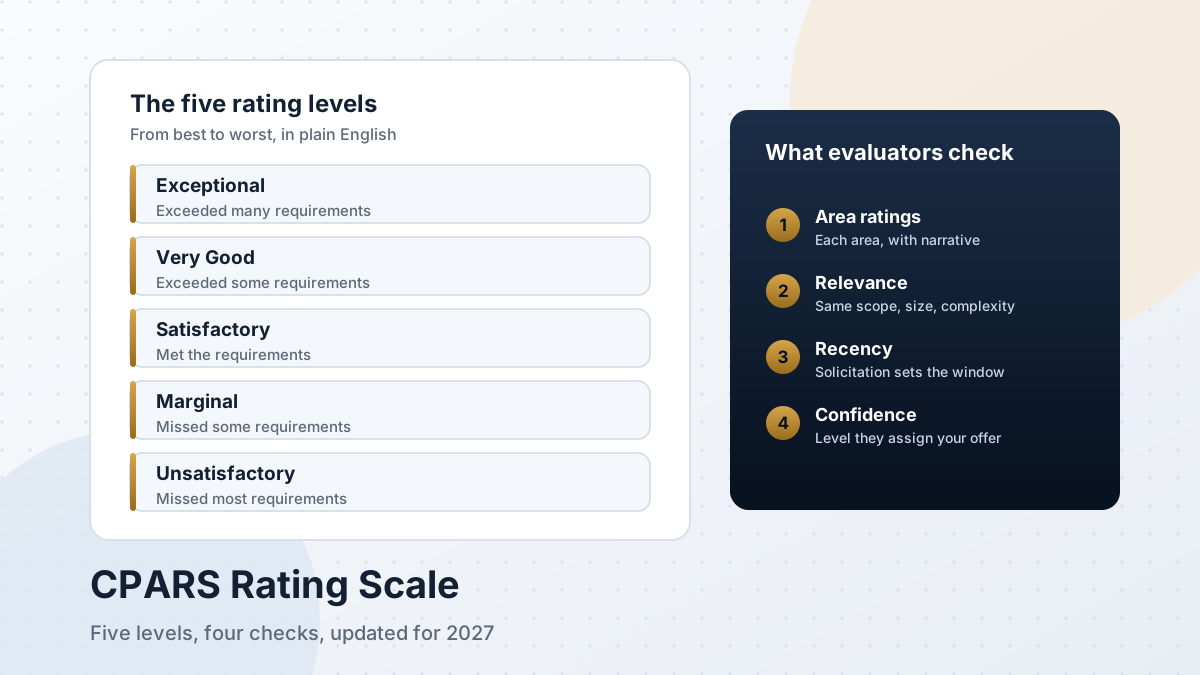
- CPARS uses five adjectival ratings: Exceptional, Very Good, Satisfactory, Marginal and Unsatisfactory. They are words, not numbers.
- Satisfactory means you met the contract requirements. It is not a warning, but it earns fewer points than Very Good or Exceptional when offers are otherwise close.
- Each evaluation area gets its own rating with a narrative. The narrative is what a contracting officer reads later.
- FAR 42.1503(d) gives you up to 14 calendar days to comment before the evaluation goes to source selection officials. CPARS keeps taking comments longer, but the rating is already visible.
- Agencies use a rating for three years after the work is done, or six years for construction and architect-engineer work. Evaluators then judge it for relevance and recency.
- For 2027, the scale and the 14-day window did not change.
- Tip: keep a one-page tracker of every PWS deliverable and update it monthly. When the draft rating shows up, your evidence is already in one folder.
The CPARS rating scale runs from Exceptional down to Unsatisfactory, and contracting officers read those ratings when they decide who wins your next bid. This guide explains each level in plain English, what gets rated, how evaluators turn ratings into confidence, and what to do when you disagree.
What is the CPARS rating scale?
CPARS, the Contractor Performance Assessment Reporting System, is the federal government's system for recording how a contractor performed on a contract. Agencies write the evaluations, and contracting officers can pull them later when they judge your past performance on a new bid. The rules sit in FAR 42.15.
The ratings are adjectival, not numeric. FAR Table 42-1 sets five levels, and the same names appear in FAR 42.1503(b). If you want the difference between one evaluation (a CPAR) and the system that stores it, read CPAR vs CPARS. This guide stays on the scale itself.
What do the five CPARS rating levels mean?
Here is the plain-English version, paraphrased from the FAR table.
| Rating | What it means |
|---|---|
| Exceptional | Exceeded many requirements to the government's benefit, with highly effective fixes for any problems. No significant weaknesses. |
| Very Good | Exceeded some requirements to the government's benefit. Minor problems were corrected well. |
| Satisfactory | Met the requirements. Any problems were minor, or you recovered from them without hurting the contract. |
| Marginal | Did not meet some requirements. A serious problem exists, and the fixes were weak, late or unfinished. |
| Unsatisfactory | Did not meet most requirements. Recovery is unlikely, and the fixes were ineffective or missing. |
What Satisfactory really signals
Satisfactory is not a failing grade. It says you did the job as written. The risk is competitive: when two offers are otherwise close, an evaluator can give more credit to an offeror whose record shows Very Good ratings on similar work. So aim to exceed requirements in ways you can document, but do not panic at Satisfactory. The real warning signs are Marginal and Unsatisfactory.
Which areas does CPARS rate?
CPARS guidance lists six evaluation areas: Quality, Schedule, Cost Control, Management, Utilization of Small Business and Regulatory Compliance. The assessing official can add up to three other areas when they matter to the contract. FAR 42.1503 names similar factors: technical quality, cost control, schedule, management or business relations, small business subcontracting and other.
Each area gets its own rating and its own narrative. Nothing in the FAR table averages them into one score, so one weak area stays visible. That is why you should read every area, not just the summary.
These areas also tell you where to aim. When you write a capability statement, match your examples to the areas an evaluator will care about on the work you are chasing.
Who writes the rating, and when?
The government does. An assessing official representative, often the contracting officer's representative (COR), drafts it, and the assessing official, often the contracting officer, signs it. FAR 42.1502 requires evaluations at least annually and when the work is complete for contracts above the thresholds: the simplified acquisition threshold ($350,000) for most contracts, $900,000 for construction and $45,000 for architect-engineer services. Our guide to how the COR shapes your rating covers that side in detail.
Long contracts get interim evaluations, so a weak first year can be corrected before the final one is written.
How do evaluators use CPARS ratings on your next bid?
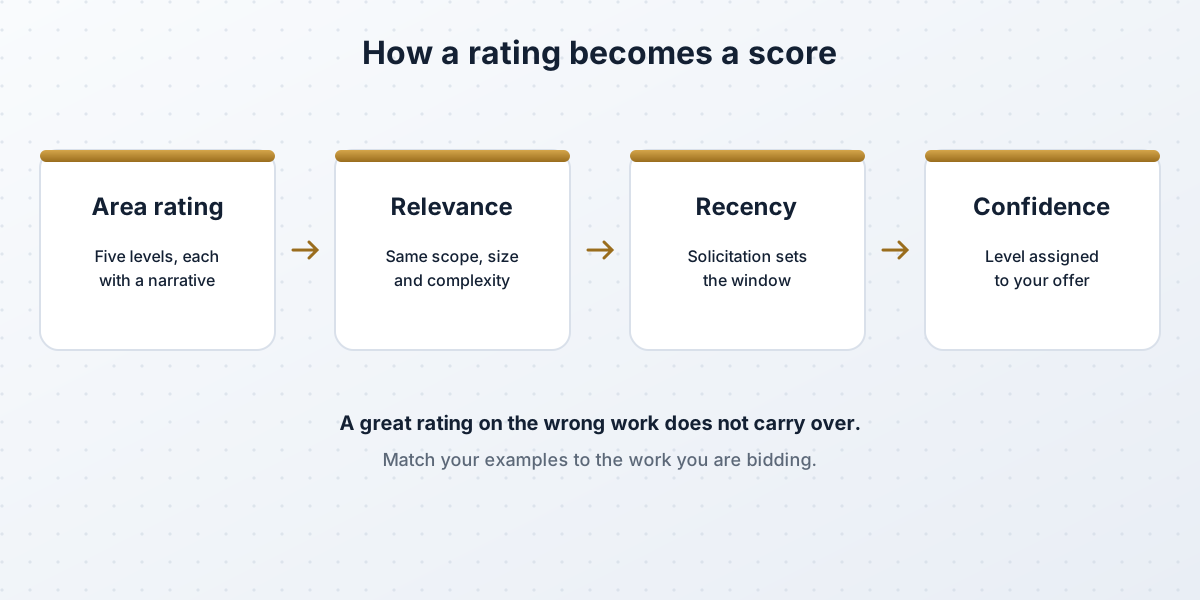
Past performance is a standard factor in competitive buys, and FAR 15.305 tells the evaluator to judge it for relevance to the work being bought. The rating alone does not decide the score. Three things matter beside it:
- Relevance. Similar scope, size and complexity. An Exceptional rating on a small janitorial job does not prove you can run an IT services contract.
- Recency. FAR 42.1503(g) sets a three-year use window (six for construction and architect-engineer work), and each solicitation says how recent the work must be. Read the evaluation section of every solicitation.
- Narrative. Evaluators read the words behind the rating. A strong narrative on Satisfactory can beat a thin one on Very Good.
Confidence ratings
Many evaluators then turn all of that into a confidence rating for your offer. In the Department of Defense, the Source Selection Procedures use Substantial Confidence, Satisfactory Confidence, Neutral, Limited Confidence and No Confidence. Civilian agencies set their own scales, so check the solicitation. Strong, relevant, recent ratings support a higher confidence level, and weak or irrelevant ones can sink a bid even when your price is sharp.
If you have no CPARS record
FAR 15.305 says an offeror with no relevant past performance gets a neutral rating, which is neither a penalty nor a plus. Other evidence can fill the gap: commercial or state work, subcontracts and reference letters. Teaming with an established firm helps too. If you are building from zero, start with how to build past performance from nothing.
What can you do if you disagree with a rating?
Act fast. FAR 42.1503(d) gives you up to 14 calendar days from notice to comment, and after that the evaluation is available to source selection officials. CPARS does not lock at day 14. Its August 2026 user manual (version 9.0.0) says contractor representatives can keep commenting until day 60, and late comments are added to the record. But evaluators can see the rating from day 15, so treat day 14 as your deadline.
- Quote the contract. Put the exact PWS line next to each statement you dispute.
- Attach dated proof. Acceptance emails, delivery receipts and the message where you flagged a risk early.
- Keep it to two or three points. A rebuttal that disputes everything reads as one that proves nothing.
If comments do not settle it, FAR 42.1503(d) requires the agency to offer a review at a level above the contracting officer, and the agency makes the final call. Your written record in the first two weeks matters most. For a deeper look at timing, see the review window in CPAR vs CPARS.
How long does a rating count?
Under FAR 42.1503(g), agencies use past performance information for three years after the contract is complete, and six years for construction and architect-engineer contracts. That is the use window evaluators follow, not a rule that the record vanishes on a set day. Older relevant work can still matter when a solicitation allows it, so read each evaluation section carefully.
How do you improve your ratings over time?
Ratings are earned while you perform. On day one, list every deliverable, deadline and reporting requirement in a simple tracker. Update it monthly, and answer status questions from the tracker.
- Keep a dated file. Acceptance emails, meeting notes and on-time delivery proof are what evaluators write from.
- Raise bad news early, in writing. A delay flagged in week two with a recovery plan reads as good management. A surprise on the due date reads as a problem.
- Send your COR a short self-assessment before each review, with the supporting documents attached.
- Match your NAICS codes to the work. Your past performance is read against what you say you do. Our NAICS code guide explains how, and the NAICS Code Goldmine ($17) shows which codes your target agencies buy under.
Set-aside firms are rated the same way as everyone else. If you pursue 8(a), SDVOSB or HUBZone work, your record is compared against a smaller pool, which makes strong ratings more valuable. Browse federal contract guides by category to see where your record fits, and see how GovScout helps with small business bid decisions, 8(a) and minority-owned work and HUBZone contracting.
What changed for the CPARS rating scale in 2027?
- The scale did not change. Five rating levels in FAR Table 42-1, and up to 14 calendar days to comment under FAR 42.1503(d). The CPARS user manual, version 9.0.0 (August 2026), still gives 60 days to comment with release to source selection at day 15.
- The "negative-only" DoD model was dropped. Draft FY2026 NDAA language would have moved DoD to recording only negative events. The NDAA signed December 18, 2025 did not include it, so positive ratings still count.
- DoD guidance on commercial work is coming. Section 824 of the FY2026 NDAA requires DoD to issue guidance on accepting commercial and other non-federal work as relevant past performance, due around December 2026. That helps firms with thin federal records.
- The FAR rewrite is still moving. A second round of proposed rules under the Revolutionary FAR Overhaul came out September 18, 2026, and agencies apply it through class deviations. Cite the version your contract cites.
Frequently Asked Questions
Is a Satisfactory CPARS rating good enough to win?
It keeps you eligible, and it is not a warning sign. But when offers are otherwise close, an evaluator can give more credit to a record with Very Good or Exceptional ratings on similar work. Aim to exceed requirements in ways you can document, and respond to any narrative that understates what you delivered.
Do CPARS ratings apply to small business set-asides?
Yes. Work on an 8(a), SDVOSB or HUBZone set-aside is evaluated and recorded the same way as any other contract. A smaller pool of competitors makes a strong record more valuable.
Do subcontractors get CPARS ratings?
Not directly. CPARS rates the prime on the contract. Under the SBA rule at 13 CFR 125.11, a first-tier small business subcontractor can request a written rating of its performance from the prime, which the prime must provide within a set time. Ask early and keep your own delivery records.
What happens if I have no CPARS history?
Under FAR 15.305 you receive a neutral rating, which is neither a penalty nor a plus. Evaluators can look at other evidence such as commercial work, subcontracts and references. A small contract finished cleanly, followed by interim reviews, builds a defensible record.
How long do I have to comment on a CPARS rating?
FAR 42.1503(d) gives you up to 14 calendar days from notice before the evaluation goes to source selection officials. CPARS accepts comments until day 60 under its August 2026 user manual, but evaluators can see the rating from day 15, so comment inside the first 14 days.
Who can see my CPARS evaluations?
Authorized government users, such as assessing officials and contracting officers evaluating offers, and your own contractor representatives through your CPARS account. The system is not a public website.
Did the CPARS rating scale change for 2027?
No. The five levels and the 14-day comment period in the FAR did not change. The negative-only DoD change was not in the NDAA signed December 18, 2025.