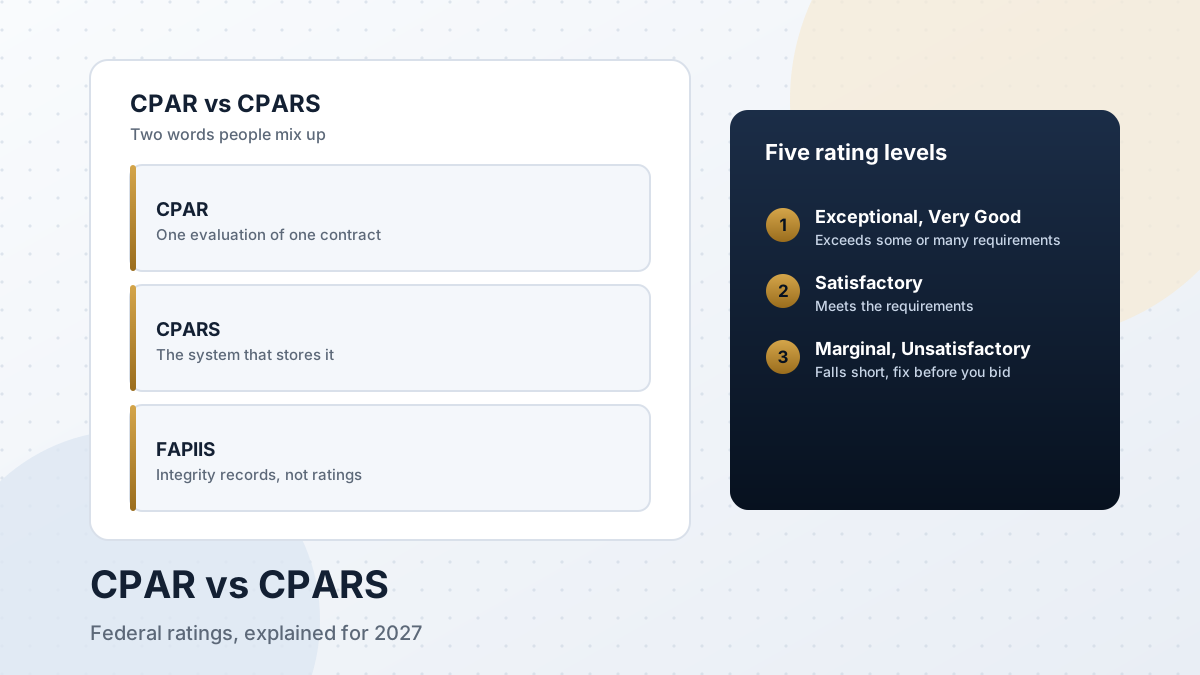
- CPARS is the federal system that stores contractor performance evaluations. Each evaluation inside it is a CPAR. Both words get used for the same thing, but the report is what follows you.
- Ratings run on five levels: Exceptional, Very Good, Satisfactory, Marginal and Unsatisfactory. Satisfactory means you met the requirements. It is not a warning.
- FAR 42.1503 gives you up to 14 calendar days to comment before the evaluation goes to source selection officials. CPARS keeps accepting comments until day 60, but by then the rating is already visible.
- Agencies use a rating for three years after the contract is complete, or six years for construction and architect-engineer work. A weak early rating loses weight, but GAO has said older relevant work can still count.
- For 2027, the five-level scale and 14-day window did not change. The "negative-only" DoD overhaul was dropped from the final 2026 NDAA.
- Tip: send your comment inside the first 14 days, even if you agree with the rating. A two-line "reviewed, no objection, here is one delivery record" reply puts you on the record.
Plenty of new contractors search "CPAR vs CPARS" and find pages that use the two words as if they were the same thing. Mostly they are. But the difference tells you where to look, what to fix and when the clock starts. This guide walks the whole chain, from who writes your rating to how you check it, and ends with what is new going into 2027.
What is the difference between a CPAR and CPARS?
CPARS stands for Contractor Performance Assessment Reporting System. It is the government website where agencies write, store and release performance evaluations. A CPAR is the individual evaluation inside it, covering one contract or order. People say "my CPARS" when they mean "my CPAR," and nobody will correct you at a conference. In writing, the report is the CPAR and the system is CPARS.
There is a third name worth knowing. FAPIIS, the Federal Awardee Performance and Integrity Information System, is a module inside CPARS. It holds integrity records, such as terminations for default, not performance ratings. If someone says a bad FAPIIS entry sank your bid, that is a different problem from a Marginal CPAR, and the fix is different too.
Which contracts get an evaluation?
Under FAR 42.1502, agencies must prepare evaluations at least annually and when the work is complete. The mandatory dollar lines are the simplified acquisition threshold, $350,000, for most contracts, $900,000 for construction and $45,000 for architect-engineer services. Construction and architect-engineer contracts terminated for default get one regardless of value. Below the line, the agency may still write one. If you have a small contract and no evaluation, you can ask for one.
Who writes your CPARS evaluation, and when?
The government does, not you. In CPARS terms, an assessing official representative, often the contracting officer's representative (COR), drafts it, and the assessing official, often the contracting officer, signs it. Some agencies add a reviewing official above that. FAR 42.1503 leaves the exact assignments to each agency. For the full COR side of that chain, read how the COR shapes your CPARS rating.
Typical evaluation areas are quality, schedule, cost control, management and business relations, and agencies can add others. Long contracts get an evaluation every year, so one bad quarter in year one does not have to be your last word.
What do the five CPARS rating levels mean?
The scale in FAR Table 42-1 has five levels. Here is the plain-English version, paraphrased from the table.
| Level | What it means |
|---|---|
| Exceptional | Exceeded many requirements to the government's benefit, with few minor problems and highly effective fixes. No significant weaknesses. |
| Very Good | Exceeded some requirements to the government's benefit, with minor problems that were corrected well. |
| Satisfactory | Met the requirements. Minor problems, or major problems you recovered from without hurting the contract. |
| Marginal | Did not meet some requirements. A serious problem exists and the fixes were missing, weak or unfinished. |
| Unsatisfactory | Did not meet most requirements, timely recovery is unlikely and the fixes were ineffective or absent. |
Every rating should be backed by narrative evidence, not just a box checked. That narrative is what a contracting officer reads later.
Why Satisfactory is not a bad grade
New owners often panic at Satisfactory. It means you did the job as written. The real risk starts at Marginal, which tells the next evaluator the government had to manage around you. A pattern of Satisfactory against competitors with Very Good records can cost points, so aim higher, but do not treat Satisfactory as a failure.
How do CPARS ratings affect your next bid?
Past performance is a standard evaluation factor in competitive buys. The contracting officer can pull your evaluations straight from CPARS and use them to score your offer under FAR 15.305. Strong, recent, relevant ratings help. Weak ones raise questions you will have to answer in writing. We cover how evaluators weigh a record in does past performance predict future performance.
No CPARS record yet
If you have no record, FAR 15.305 says the evaluator cannot hold that against you. You get a neutral rating, which means no penalty and no points. Other evidence can fill the gap: commercial or state work, subcontracts, or a reference letter. Teaming with an established contractor helps too. Our teaming partner fit scorecard tells you whether a partner is worth the TEAM call, and subcontracting tips shows how to build a record from the sub seat. For the full starting path, see how to win your first federal contract.
How do you review, comment on or dispute a CPARS rating?
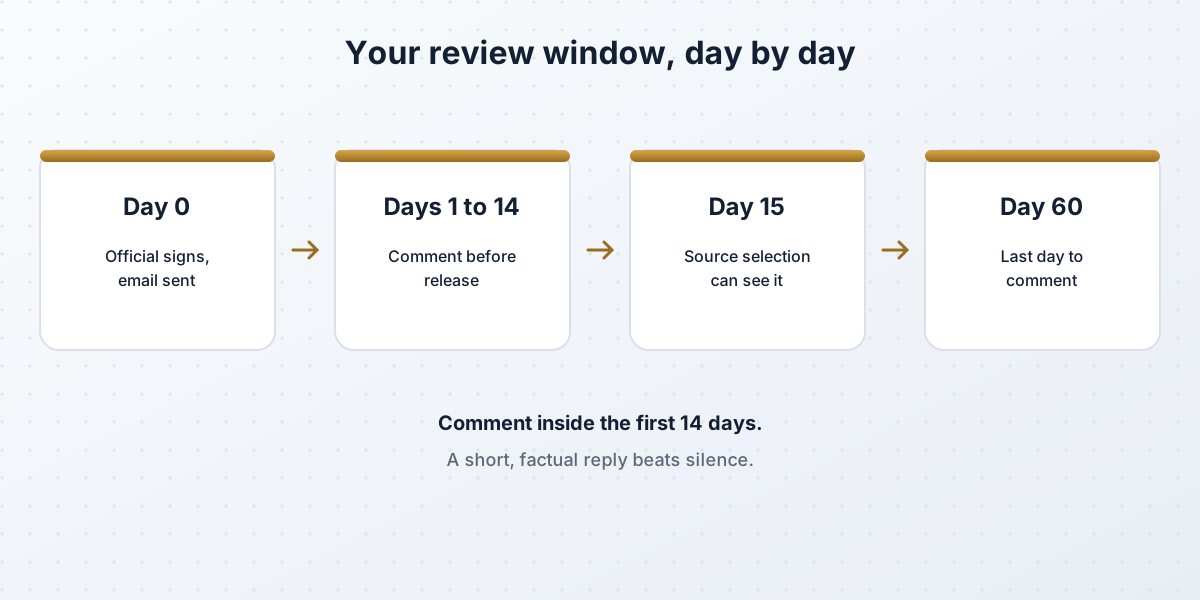
When the assessing official signs the evaluation, CPARS emails the contractor representative on your account. FAR 42.1503(d) then gives you up to 14 calendar days to submit comments, rebuttals or added information. After that the evaluation becomes available to source selection officials, whether or not you commented. That is day 15 in the diagram above.
CPARS does not slam the door at day 14. Its August 2026 user manual says contractor representatives can keep commenting until day 60 after the assessing official signs, and that your late comments are added to the record. But from day 15 on, evaluators can already see the rating. Treat day 14 as your real deadline.
How to write a comment that can move a rating
- Quote the contract. Put the exact PWS or SOW line next to each statement you dispute.
- Attach dated proof. Acceptance notices, delivery receipts, and the email where you flagged a risk weeks early beat any adjective.
- Credit the right party. If a delay came from a government decision or a subcontractor, point to the document that shows it.
- Keep it to two or three points. A rebuttal that disputes everything reads as a rebuttal that proves nothing.
If comments do not settle it
FAR 42.1503 requires the agency to offer a review at a level above the contracting officer. The agency makes the final call. There is no outside appeals board for a rating, so your written record in the first 14 days matters more than anything you do later. A rating can be changed by the agency if the review goes your way, but plan on getting it right the first time.
How long does a CPARS rating count?
Under FAR 42.1503(g), agencies use past performance information for three years after the contract or order is complete, and six years for construction and architect-engineer contracts. That is the window evaluators are told to use. It is not a record-retention rule, so the rating does not vanish on day 1,096.
It is also a baseline, not a hard wall. In Veterans Management Services, Inc., B-424182.2 (June 22, 2026), GAO sustained a protest after the VA threw out every CPARS record older than three years even though the solicitation said recent work "may be viewed more favorably." Older relevant records can still count when the solicitation allows them. Read each solicitation's evaluation language before you write off old work.
What should you do during a contract to earn strong ratings?
Strong ratings are built while you perform, not argued afterward. On day one, list every deliverable, deadline and reporting requirement from the PWS in a simple tracker, and update it monthly. When the COR asks for status, answer from the tracker.
- Keep a dated file. Acceptance emails, meeting notes and on-time delivery proof are the evidence evaluators write from.
- Raise bad news in writing, early. A delay you flag in week two with a recovery plan reads as good management. A surprise on the due date reads as a performance problem.
- Know your NAICS codes. Your past performance is read against what you say you do, so make sure the codes on your SAM.gov registration match the work. Our NAICS code guide explains how, and the NAICS Code Goldmine ($17) shows which codes your target agencies buy under.
How do you check your own CPARS record?
You do not browse CPARS like a public website. A CPARS focal point grants access, and you get an email with login instructions. A corporate senior contractor on your account can add or remove access for your Unique Entity ID. Evaluations then show up for your contractor representative, who gets an automated email whenever one is completed.
Once you have access, check every evaluation: the rating, the narrative behind it, the period of performance, and whether the contract and NAICS code match what you did. Do it well before a sources sought or solicitation deadline, because your proposal's past performance section draws on what CPARS shows. Our sources sought response template has a past performance block you can fill from your record.
What changed for CPARS in 2027?
- The scale and the window did not change. Five levels and 14 calendar days in FAR 42.1503(d). The CPARS user manual (version 9.0.0, August 2026) still gives 60 days to comment and a day-15 release to source selection.
- The "negative-only" DoD model was dropped. Draft FY2026 NDAA language would have moved DoD to recording only negative events. The NDAA signed December 18, 2025 did not include it, so positive ratings still count.
- DoD guidance on commercial work is coming. Section 824 of the FY2026 NDAA requires DoD to issue guidance on accepting commercial and other non-federal work as relevant past performance, due within a year of enactment, around December 2026. That helps firms with thin federal records.
- The FAR rewrite is still moving. The Revolutionary FAR Overhaul relocates contractor performance rules in its own numbering, and agencies apply it through class deviations. The second round of proposed rules came out September 18, 2026. Cite the version your contract cites.
- The dollar lines are unchanged. $350,000 for the simplified acquisition threshold, $900,000 for construction and $45,000 for architect-engineer work.
Frequently Asked Questions
Is a Satisfactory CPARS rating bad?
No. Satisfactory means you met the contract requirements. It earns fewer points than Very Good or Exceptional when offers are otherwise equal, but it is not a warning sign. The danger zone is Marginal or Unsatisfactory.
How long do I have to comment on a CPARS evaluation?
FAR 42.1503(d) gives you up to 14 calendar days from notice before the evaluation goes to source selection officials. CPARS accepts comments until day 60 after the assessing official signs, according to its August 2026 user manual, but the rating is visible from day 15. Comment in the first 14 days.
Can a CPARS rating be changed after it is final?
Sometimes. You can ask for a review at a level above the contracting officer, and the agency makes the final decision. There is no independent appeals board, so put your strongest evidence in your first comment.
Do subcontractors get CPARS evaluations?
Not directly. CPARS rates the prime on the contract. On contracts with a subcontracting plan, the SBA rule at 13 CFR 125.11 lets a first-tier small business subcontractor request a written rating from the prime within 30 days after the end of the prime contract performance period, and the prime has 15 days to provide it. Ask early and keep your own delivery records.
What is the difference between CPARS and FAPIIS?
CPARS stores performance evaluations. FAPIIS is a module inside CPARS that holds integrity records, such as terminations for default. A bad rating and a bad integrity record are separate problems with separate fixes.
How do I get access to my company's CPARS evaluations?
A CPARS focal point grants access and you receive an email with login instructions. A corporate senior contractor on your account can manage access for your Unique Entity ID. Your contractor representative then gets an email whenever an evaluation is completed.
Does the negative-only CPARS change affect me in 2027?
No. The draft DoD language that would have recorded only negative events was not in the NDAA signed December 18, 2025. The five-level scale, including Exceptional and Very Good, still applies.