- A sources sought notice is market research, not a solicitation. Real notices say so in plain words: no contract will be awarded from it, and response costs are yours.
- Use the notice's own instructions. Real 2026 and 2025 examples capped responses at 10 pages, and one gave a two-day window. Do not guess at length or deadline.
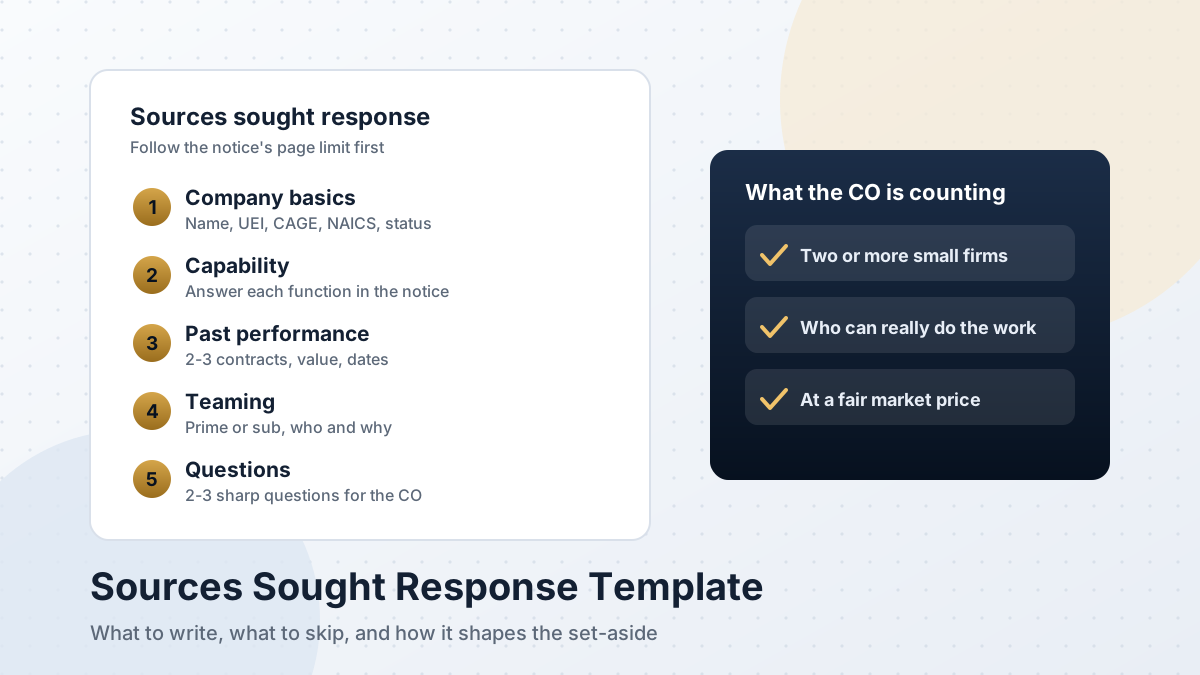
- Five sections cover most notices: company basics, capability, past performance, teaming, and questions for the government.
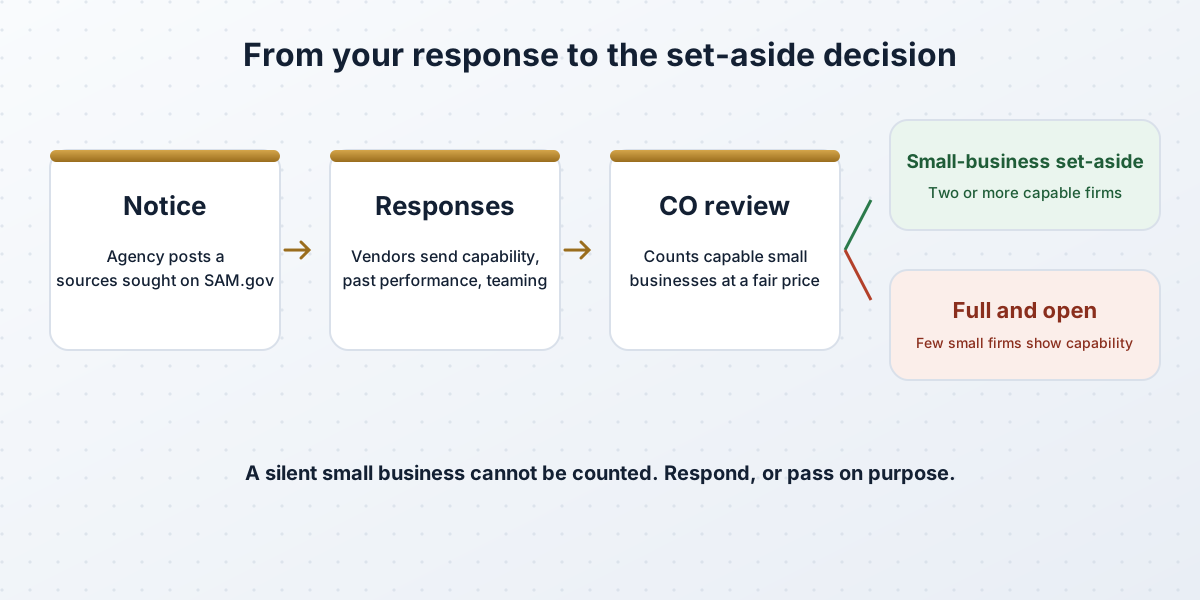
- Your response helps the contracting officer judge whether two or more capable small businesses would compete at a fair price, the test behind a small-business set-aside under FAR 19.502-2.
- For 2027, FAR Part 10 is being rewritten. GSA's version drops the list of required market research techniques, and the formal rules were proposed in June 2026. Sources sought notices are still how many agencies do the work.
Short version: answer exactly what the notice asks, prove you have done similar work, say who you will team with, and send it early. The rest of this post gives you a template to fill in, shows what real notices asked for, and flags what is changing in 2027. If you want a tool for the first draft, our sources sought response builder is free.
What is a sources sought notice, and what does it not do?
It is a public request for information, usually posted on SAM.gov, where a contracting officer asks which vendors could do a future job. Real notices are blunt about it. A 2026 Navy notice said it was not a solicitation for proposals and that no contract would be awarded from it. A 2025 Space Force notice said a solicitation did not presently exist, that no evaluation results would be issued, and that response costs would not be reimbursed.
So a response does not put you in line for a contract. It puts you in front of the buyer early, and it helps the buyer decide how to compete the work. For the full workflow of finding and sorting these notices, read our sources sought response workflow. This post is about the response itself.
What do real sources sought notices ask for?
Do not trust a generic template over the notice in front of you. Two real examples show how much they differ.
| Notice | What it asked for | Limits |
|---|---|---|
| Navy Strategic Systems Programs, N0003026R1030 (posted April 16, 2026) | White paper capability statement; company data (UEI, CAGE, five-year revenue, employees, ownership, clearance); a minimum-qualifications section; each past contract in a set table; teaming letters if you team | 10-page cap, 12-point Times New Roman, 1-inch margins; due April 18, 2026, two days after posting |
| Space Force Enterprise Information Services IV, FA251825R0027 (2025) | Company data; whether you hold an existing vehicle; NAICS fit; proposed team structure; similar projects from the last five years | 10 pages, single-spaced; emails over 5 MB rejected; no extensions |
Three things stand out. Page limits are real, and the second notice warned the government might read only the first ten pages. Windows can be very short, so check SAM.gov often. And past-performance rules are specific: the Navy notice wanted work within five years of posting and set a minimum annual cost for relevant contracts. If your work does not meet a stated threshold, say so and use a teammate.
Should you respond, or skip it?
- Respond when the NAICS code fits, the work overlaps with something you have actually done, and a set-aside you hold could apply.
- Team or watch when the work is bigger than you, or needs a clearance you lack. A teaming partner can fill the gap, but the notice may ask for a letter of intent.
- Skip when the NAICS is wrong, you have no relevant experience and no partner, or you could not start inside the period of performance.
Run the same check you would use on a bid. Our bid/no-bid scorecard takes about five minutes, and Marcus in GovScout Pro gives a GO, TEAM or PASS with the reasons attached.
What sections should a sources sought response include?
Five sections cover most notices. Order them the way the notice orders its questions.
| Section | What to write | Common slip |
|---|---|---|
| 1. Company basics | Legal name, UEI, CAGE, SAM.gov status, size and certifications (SDVOSB, WOSB, 8(a), HUBZone), and the NAICS code you think fits | Leaving off the UEI or CAGE so the officer cannot verify you |
| 2. Capability | Answer each function in the draft work statement, in the same order, in one or two sentences each; say what tools, staff and clearances you already have | Brochure language like "world-class solutions" |
| 3. Past performance | Two or three contracts: customer, contract number, scope, dollar value, dates, your role | No numbers, or work that does not match the scope |
| 4. Teaming | Prime or subcontract; who the partners are and what each does | Naming a partner that has not agreed |
| 5. Questions | Two or three specific questions about the requirement | Asking about price or the incumbent |
What does a fill-in-the-blank response look like?
Subject: [Notice ID] Response from [Company Name]
1. Company
[Legal name], UEI [____], CAGE [____], SAM.gov active through [date]. Status: [small business / SDVOSB / WOSB / 8(a) / HUBZone] under NAICS [____] (size standard [____]).
2. Capability
Requirement: [phrase from the notice]. How we deliver it: [one or two sentences]. Tools, staff, or clearances we hold: [list]. Gaps and how we close them: [partner or hire].
3. Past performance
[Customer], contract [number], [scope in one line], [value], [start to end], our role: [prime / sub].
[Second contract, same format.]
4. Teaming
We plan to [prime / subcontract]. Partners: [name and role], or none at this time.
5. Questions
1) [Question about scope or period of performance]. 2) [Question about where the work is performed].
[Name, title, phone, email]
Keep price out of it. Sources sought notices are about capability, not cost, and a pricing sheet in a response can read as a mistake.
How do responses influence the set-aside decision?
The test behind a small-business set-aside is in FAR 19.502-2. Above the simplified acquisition threshold, a contracting officer must set the work aside for small business when there is a reasonable expectation of offers from at least two responsible small businesses at a fair market price. The Congressional Research Service describes it as the "Rule of Two." Market research is one of the inputs.
That is why a response matters. A capable small business that answers is evidence for the set-aside. A capable one that stays silent cannot be counted. Responses are not a vote, and the officer still decides, but a strong response helps.
Do not read this as a guarantee. A response does not promise a set-aside, a sole-source award or a seat on the contract. It just makes sure the officer knows you exist and can do the work.
What is changing for 2027?
- FAR Part 10 is being rewritten. GSA's overhaul version, issued as a class deviation, stops listing specific market research techniques and leaves methods to agency discretion. Agencies may favor short forms-based requests for information over long ones.
- Formal rules are coming. In June 2026 the FAR Council proposed the first batch of overhauled parts, including Part 10, with comments due in mid-July and a goal of finishing by the end of 2026. Part 19, which holds the Rule of Two, was not in that first batch.
- Thresholds stay put for now. The simplified acquisition threshold is $350,000, per our 2026-2027 thresholds guide.
Practical effect: expect sources sought notices to keep appearing, and expect more variety in their format. The advice to follow each notice exactly gets more important, not less.
How long should a response be, and when is it due?
Follow the notice. The two real examples above set a 10-page cap, and one had a two-day window. If a notice gives no limit, a short response of a few pages plus your capability statement is a safe choice, according to SamSearch's guide. Send it a day early. If the format or deadline is unclear, email the point of contact and keep the reply.
What mistakes sink sources sought responses?
- Marketing copy instead of evidence tied to the work statement.
- Ignoring the page limit, margins, font, or file size.
- No numbers: contracts without customer, value and dates.
- Naming a teaming partner that has not agreed.
- Responding to notices you could never perform, which wastes a day and weakens your next response.
- Missing the deadline by assuming a window is long.
If you are still choosing NAICS codes, my NAICS Code Goldmine: Find Every Set-Aside You Qualify For ($17) on Gumroad walks through it, and our capability statement guide covers the document that goes with your response.
Frequently Asked Questions
Does responding to a sources sought notice obligate the government to award me a contract?
No. Real notices state that they are not solicitations and that no contract will be awarded from them. Your response helps the contracting officer decide how to compete the work. Any award comes later, through a solicitation you would still have to bid on and win.
Can I respond to a sources sought notice with no federal past performance?
Yes, if the work fits your NAICS code and you could start on time. Cite commercial, state or subcontract work that matches the scope, or name a teaming partner. Some notices set minimum experience thresholds, so read them first and be honest about gaps.
Is a sources sought response the same as a capability statement?
No. A capability statement is a general document you reuse. A sources sought response answers one notice, function by function. Many notices ask you to attach a capability statement, but the response itself must address the notice's questions.
How long should a sources sought response be?
As long as the notice allows and no longer. Two real notices capped responses at 10 pages. If there is no limit, keep it short and specific, and attach your capability statement rather than rewriting it.
How do sources sought responses affect small-business set-asides?
Above the simplified acquisition threshold, FAR 19.502-2 requires a set-aside when the officer reasonably expects offers from two or more responsible small businesses at a fair market price. Responses are one piece of the market research behind that judgment.
Does the FAR overhaul change sources sought notices in 2027?
Probably in format, not in existence. GSA's Part 10 rewrite stops listing required market research techniques, and the formal Part 10 rule was proposed in June 2026. Part 19, which holds the Rule of Two, was not in that first batch. Watch each notice and the final rules.
Where do I find sources sought notices?
Search SAM.gov Contract Opportunities and filter by notice type Sources Sought, plus your NAICS code and set-aside. Save the search and turn on notifications. Our federal contracts lookup guide shows the steps.