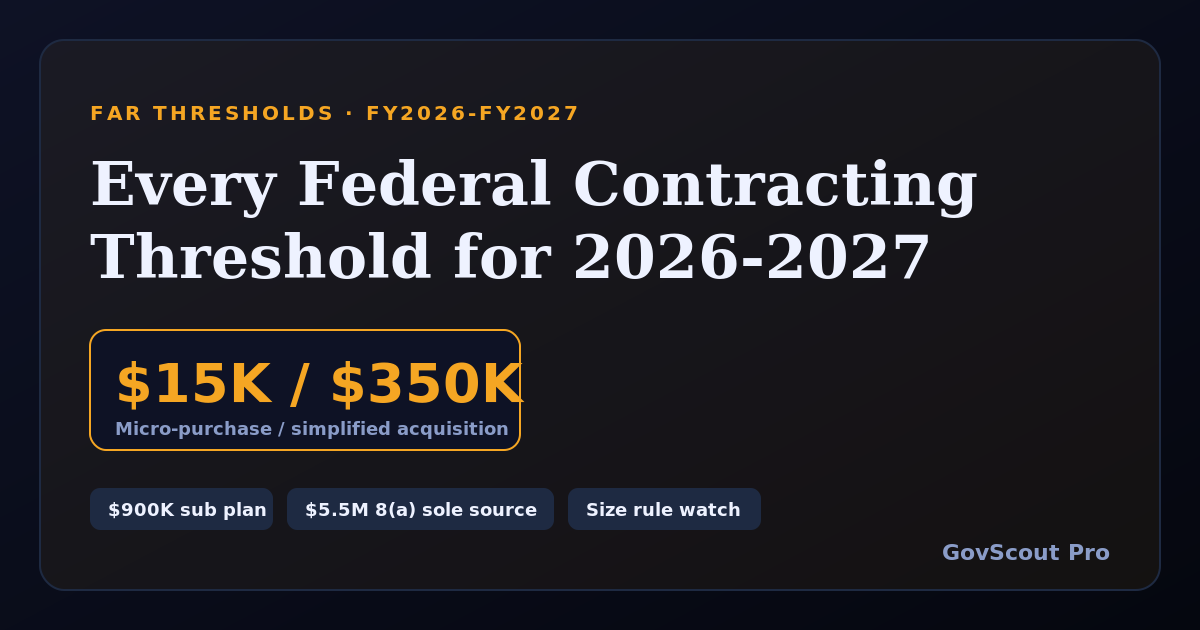
Every dollar threshold in federal contracting decides something: whether the government can buy from you with a card, whether it must set the work aside, whether you need bonds, whether your price gets audited, and whether a sole-source award is even legal. On October 1, 2025 most of those numbers changed. Many government contracting websites still show the old ones.
This is the complete 2026-2027 reference. Every number below is in effect for fiscal year 2026 and, unless Congress or the FAR Council changes it, fiscal year 2027. The next scheduled inflation adjustment is not until October 1, 2030.
Last checked against the official sources: October 13, 2026. These thresholds took effect October 1, 2025. Download the one-page cheat sheet (PDF) and pin it next to your desk.
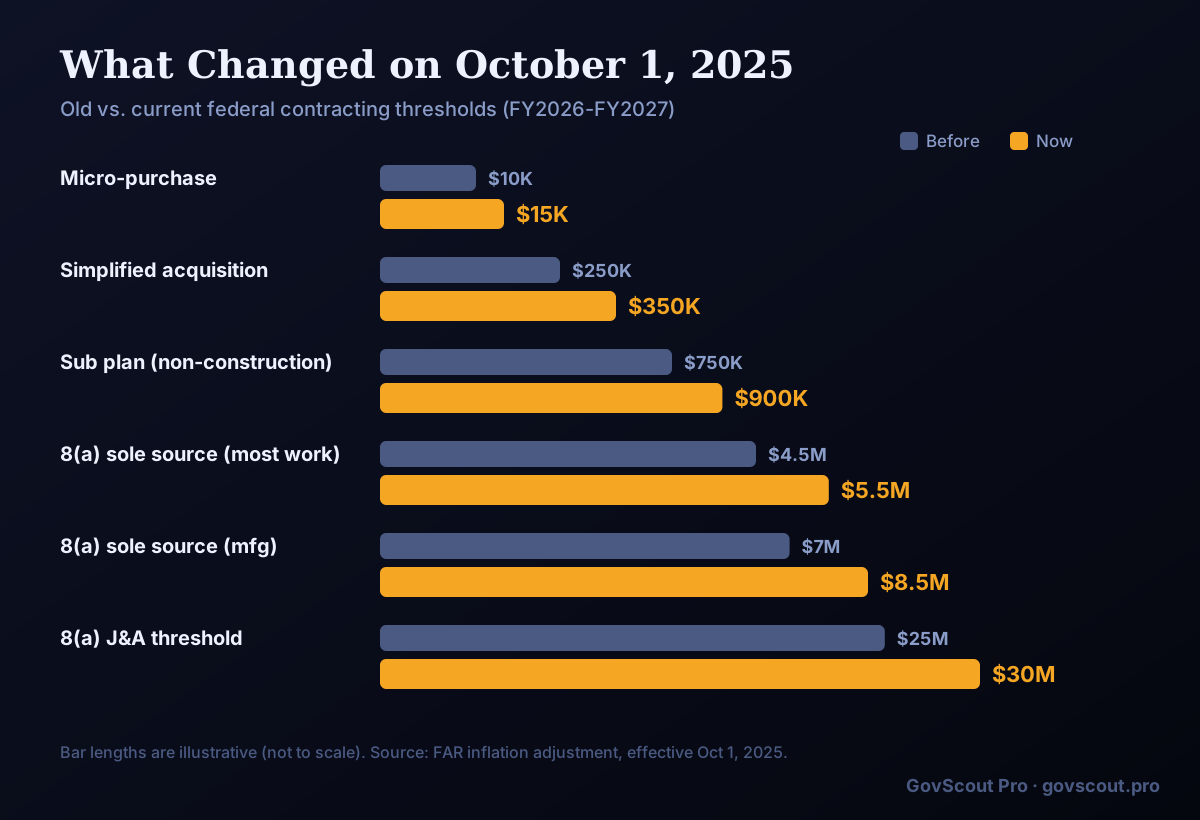
The Complete 2026-2027 Threshold Table
| Threshold | Before Oct 1, 2025 | FY2026-FY2027 | What it triggers |
|---|---|---|---|
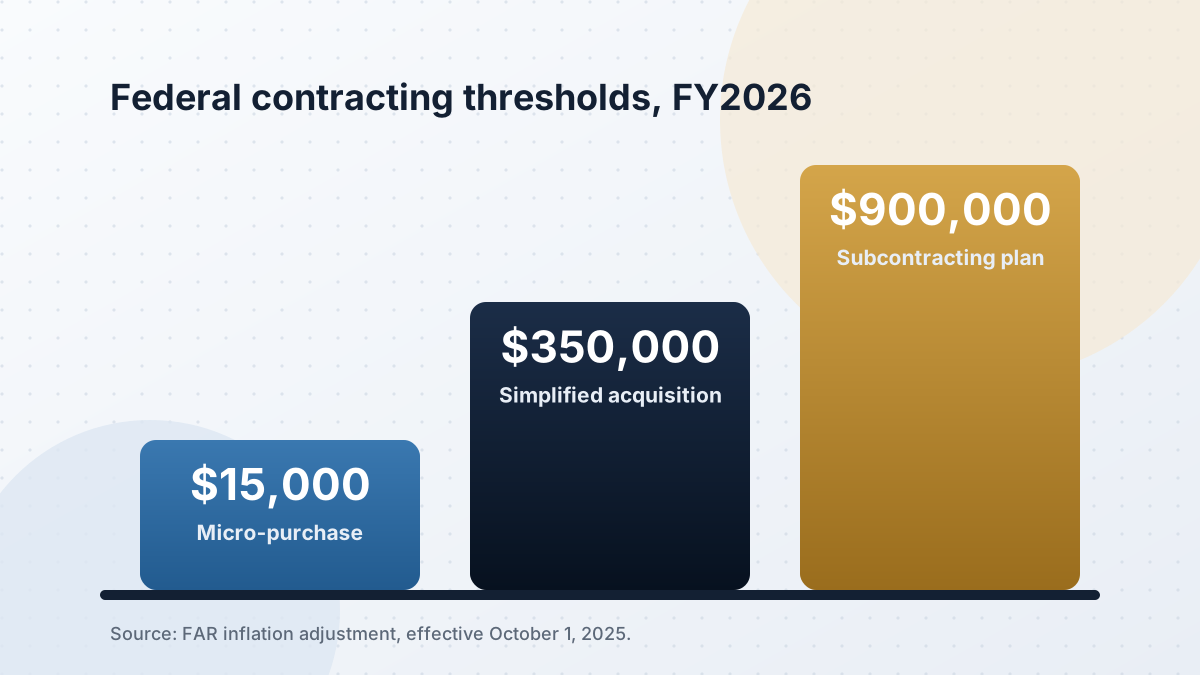
| Micro-purchase threshold (MPT) | $10,000 | $15,000 | Purchases without competition, often by government purchase card |
| MPT, contingency (inside / outside U.S.) | - | $25,000 / $40,000 | Contingency and defense operations |
| Synopsis on SAM.gov | $25,000 | $25,000 (unchanged) | Public notice of proposed contract actions |
| Simplified acquisition threshold (SAT) | $250,000 | $350,000 | Simplified procedures; small business reservation |
| SAT, contingency (inside / outside U.S.) | - | $1 million / $2 million | Contingency operations |
| Simplified procedures for certain commercial products and services (FAR 13.5) | $7.5 million | $9 million | Streamlined commercial buying |
| First-tier subcontract reporting | $30,000 | $40,000 | Prime reports subcontract awards |
| Subcontracting plan (large primes) | $750,000 | $900,000 | Small business subcontracting goals required |
| Subcontracting plan, construction | $1.5 million | $2 million | Same, for construction |
| Certified cost or pricing data (TINA) | $2 million | $2.5 million; $10 million for DoD, NASA and Coast Guard contracts entered after June 30, 2026 | Detailed cost data and defective pricing liability |
| Approval levels for other than full and open competition | - | $900K / $20M / $90M ($150M tier for DoD, NASA, Coast Guard) | Who must approve a sole-source justification |
Sources for every figure are listed at the end of this article. Where a source gave only the new value, the "before" column reflects the prior FAR value.
Small Business Sole-Source Thresholds
Each socioeconomic program lets an agency award without competition up to a limit. Above the limit, the work must be competed within the program. Values include options.
| Program | Manufacturing | All other work |
|---|---|---|
| 8(a) Business Development | $8.5 million | $5.5 million |
| SDVOSB | $8.5 million | $5 million |
| HUBZone | $8.5 million | $5.5 million |
| WOSB / EDWOSB | $8.5 million | $5.5 million |
Firms owned by Alaska Native Corporations and Indian tribes, and NHO-owned firms on DoD contracts, can receive 8(a) sole-source awards above these limits. A written justification is required above $30 million (up from $25 million), or above $100 million at DoD for entity-owned firms. See our full guide to 8(a) sole-source limits for ANC and tribal firms.
Thresholds That Did Not Change
Some numbers are fixed by statute or by trade agreements and were expressly excluded from the 2025 adjustment:
- Davis-Bacon Act: prevailing wages on federal construction contracts over $2,000.
- Service Contract Labor Standards: service contracts over $2,500.
- Miller Act bonds: performance and payment bonds on construction contracts over $150,000. Bond thresholds were excluded from the adjustment.
- Trade agreement thresholds: adjusted separately on their own schedule.
- Synopsis threshold: stays at $25,000.
What the New Numbers Mean for Small Businesses
1. The micro-purchase lane got 50% bigger
At $15,000, a government purchase card holder can buy more from you without a solicitation. Micro-purchases are not posted on SAM.gov, so this money goes to vendors the buyer already knows. If you sell products, training, small repairs, or short services, getting known by the card holders at a nearby base, VA medical center, or federal building is now worth more than it was.
2. More work falls under simplified acquisition
Under the FAR, acquisitions above the micro-purchase threshold and up to the SAT are generally reserved for small businesses when the Rule of Two is met. Raising the SAT to $350,000 pulls more contracts into faster, simpler competitions where small firms do well.
3. Large primes have more room before they owe you a subcontracting plan
A large business only needs a small business subcontracting plan above $900,000 ($2 million in construction). Contracts between the old and new thresholds no longer require one, which slightly reduces formal subcontracting pressure on mid-size awards. Market to primes on larger contracts.
4. Bigger sole-source awards for program participants
An 8(a), HUBZone, or WOSB firm can now be handed up to $5.5 million in non-manufacturing work without competition, and an SDVOSB up to $5 million. Program offices with a tight timeline use this. Pitch requirements that fit under the limit.
5. Defense pricing just got lighter
The FY2026 NDAA raised the certified cost or pricing data threshold to $10 million for DoD, NASA, and Coast Guard contracts entered into after June 30, 2026. A $6 million negotiated DoD contract signed in July 2026 does not require certified cost or pricing data. The same contract signed in June would have. Civilian agencies remain at $2.5 million until the rules are harmonized.
Goals Behind the Numbers
Set-aside decisions are driven by government-wide goals. For FY2026:
| Category | Goal (prime dollars) | FY2025 result |
|---|---|---|
| Small business (all) | 23% | Nearly 28%, about $179 billion |
| Small disadvantaged business (incl. 8(a)) | 5% | 11.6%, $75.3 billion |
| SDVOSB | 5% (raised from 3% by the FY2024 NDAA) | $32.5 billion, 5.01% |
| WOSB | 5% | See SBA scorecard |
| HUBZone | 3% | See SBA scorecard |
The 2026-2027 Calendar: What Could Move Next
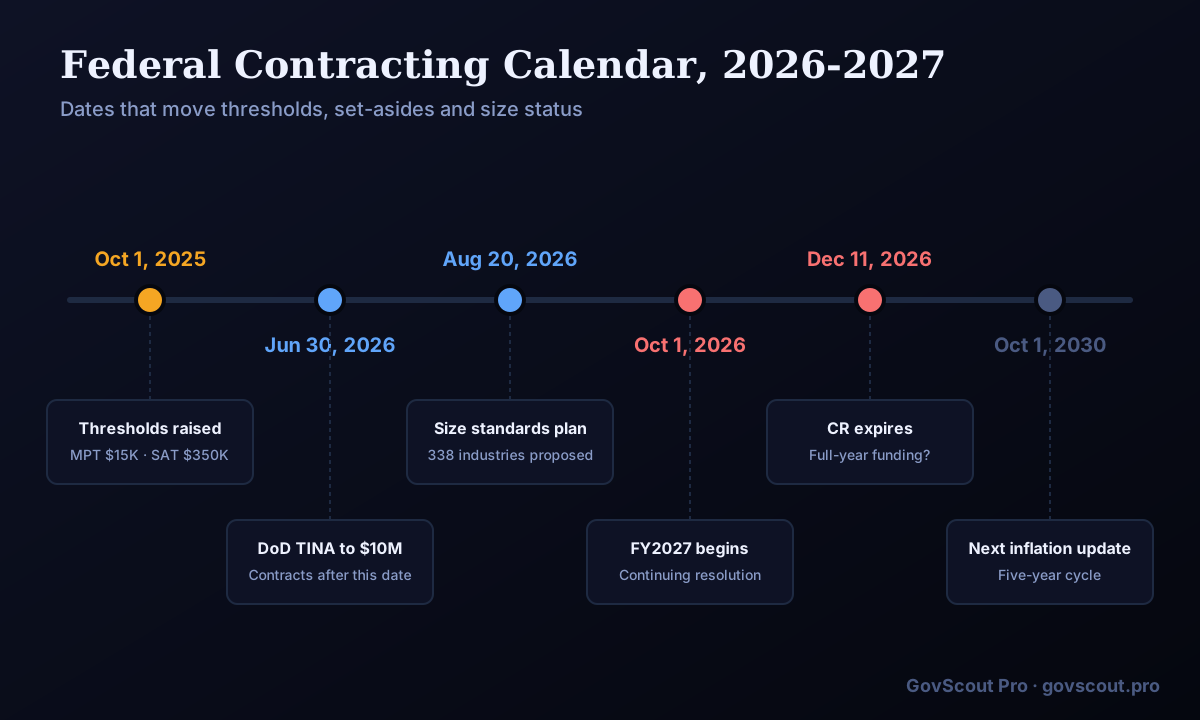
FY2027 started under a continuing resolution
Fiscal year 2027 began October 1, 2026 under a continuing resolution signed September 3, 2026 that runs through December 11, 2026. Under a CR, agencies generally cannot start new programs and often delay new awards. Expect a slow first quarter for new solicitations and a surge once full-year appropriations pass. Use the quiet time for sources-sought responses and relationship building.
The size standards overhaul
On August 20, 2026, SBA proposed replacing nearly 1,000 size standards with 338, shifting most industries to employee-based standards and raising many receipts-based standards sharply. For example, NAICS 541511 (custom programming) would rise from $34 million to $531 million, and NAICS 236220 (commercial building construction) would change from $45 million in receipts to 600 employees. SBA estimates about 114,541 more businesses would become small, including about 37,000 firms that held roughly $71 billion in FY2025 federal contracts. Comments closed September 21, 2026. If a final rule is published in FY2027, your size status, and your competition, could change overnight.
The FAR overhaul
The Revolutionary FAR Overhaul is rewriting the FAR in plain language. The proposed Part 19 keeps the small business Rule of Two (moving it to proposed FAR 19.104-1 and applying it above the micro-purchase threshold), but would not require set-asides for orders under multiple-award contracts. The first proposed rules entered formal rulemaking in June 2026, and more parts, including Part 19, are expected. Thresholds themselves are statutory or set by the inflation adjustment, so the overhaul is unlikely to change the dollar amounts above.
Quick Reference by Situation
| If the contract is... | Expect... |
|---|---|
| $15,000 or less | Micro-purchase. No posting, often a card. Relationships win. |
| $15,001 to $25,000 | Simplified procedures. May not be synopsized on SAM.gov. |
| $25,001 to $350,000 | Posted on SAM.gov, simplified procedures, usually set aside for small business. |
| Over $150,000 in construction | Miller Act performance and payment bonds. |
| Over $350,000 | Standard procedures. Set-aside if the Rule of Two is met. |
| Over $900,000 ($2M construction), large prime | Small business subcontracting plan required. |
| Over $2.5 million, negotiated | Certified cost or pricing data unless an exception applies ($10M for DoD after June 30, 2026). |
How to Use the Thresholds to Pick Your Targets
Thresholds are not just compliance trivia. They tell you where the competition is thin and where the buyer has flexibility. Here is how to turn them into a targeting plan depending on where your business is today.
If you have never won a federal contract
Live below $350,000. That is where the paperwork is lightest, where small business set-asides are the default, and where contracting officers can make awards quickly. Two lanes matter most:
- Micro-purchases up to $15,000. Not posted publicly. You win them by being known: register in SAM.gov, make sure your profile in SBA's Small Business Search is complete, and introduce yourself to the purchasing staff at federal offices within driving distance. A one-page capability statement and a price list are enough to start.
- Simplified acquisitions from $15,000 to $350,000. Most are posted on SAM.gov as combined synopsis/solicitations with short response windows, often 10 to 15 days. Save searches by NAICS and set-aside so you see them on day one, not day nine.
If you have a few wins and want to grow
Aim for the $350,000 to $5.5 million band. This is where set-asides still dominate but the competition is less crowded than the simplified lane, because many tiny firms stay below it and many larger firms do not bother. If you hold a certification, this is also the band where an agency can hand you work directly through a sole-source award. Your job is to find program offices with recurring needs and help them understand that your company fits under the limit.
If you want to subcontract to large primes
Follow the money above $900,000 ($2 million for construction). Large primes on those contracts must have subcontracting plans with small business goals, and they report against them. Search SAM.gov award data for large-business awards in your NAICS codes, then contact the prime's small business liaison officer with a specific offer: which piece of the work you can do, your certification, and your past performance on similar scope.
Five Threshold Mistakes That Cost Small Businesses Money
- Quoting old numbers in proposals and capability statements. A capability statement that says "8(a) sole source up to $4.5 million" tells a contracting officer you are not paying attention. Update every document to the 2026 figures.
- Forgetting that options count. Sole-source limits apply to the total estimated value including options. A $1.2 million base year with four option years is a $6 million requirement, which is above the $5.5 million 8(a) limit for services.
- Pricing a construction job without bonds. A $160,000 repair project crosses the $150,000 Miller Act line. If you did not price performance and payment bonds, the job just got more expensive after award.
- Missing Davis-Bacon or service contract wage requirements. These thresholds are tiny ($2,000 and $2,500), so they apply to almost every construction and service contract. Price from the wage determination attached to the solicitation.
- Assuming you are still small. Size is measured against the NAICS code on each solicitation. If SBA's size standards proposal is finalized, the line moves for nearly every industry. Re-check your size before you certify on each offer.
How Agencies Actually Apply These Numbers
Thresholds set the minimum rules. Agencies layer their own practices on top. A few patterns are worth knowing as you plan for FY2027:
- Purchase card holders usually have single-purchase limits at or below the micro-purchase threshold set by their agency. Some have lower limits. Ask.
- Orders under existing contracts such as GSA Schedules, BPAs, and IDIQs often replace open-market buys. If your competitors are on a vehicle your target agency uses, your open-market chances shrink. That is one reason the proposed FAR Part 19 change on orders under multiple-award contracts matters.
- Year-end spending peaks in July through September, the last quarter of the federal fiscal year. Under a continuing resolution, the first quarter (October through December) is usually slow for new awards.
- Commercial items up to $9 million can use simplified procedures under FAR 13.5. If you sell a commercial product or service, make sure your offer makes the commercial nature obvious.
Frequently Asked Questions
What is the micro-purchase threshold in 2026?
$15,000, effective October 1, 2025. It is $25,000 for contingency operations inside the United States and $40,000 outside.
What is the simplified acquisition threshold in 2026?
$350,000, up from $250,000.
Will the thresholds change again in 2027?
The routine inflation adjustment happens every five years, so the next one is due October 1, 2030. Congress can change specific thresholds sooner through an NDAA, as it did for certified cost or pricing data at DoD in the FY2026 NDAA.
Did the Miller Act bond threshold change?
No. Performance and payment bonds are still required on federal construction contracts over $150,000. Bond thresholds were excluded from the 2025 adjustment.
What is the subcontracting plan threshold in 2026?
$900,000 for most contracts and $2 million for construction, for large business primes.
Related reading: The fastest money in federal contracting, federal construction contracts in 2026-2027, SDVOSB teaming and joint ventures, and the set-aside program comparison.