Most service-disabled veteran-owned small businesses hit the same wall. The set-aside is perfect. The certification is in hand. But the contract is bigger than the company, the past performance is thin, or the bonding is not there. The answer is almost always a partner. The question is which kind of partnership, because the wrong structure can cost you the award, trigger a size protest, or put your VetCert status at risk.
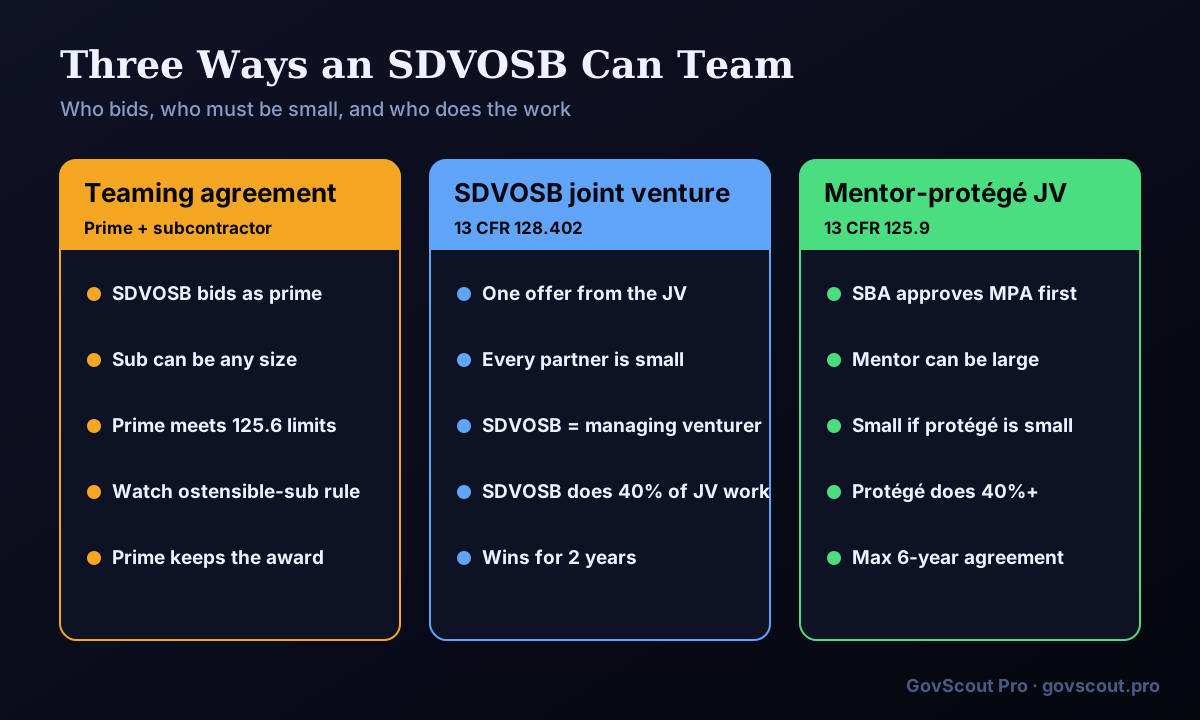
This guide explains the three ways SDVOSBs team in 2026-2027: the teaming agreement (prime and subcontractor), the SDVOSB joint venture, and the mentor-protégé joint venture. It covers the rules that actually decide protests, with citations, plus a checklist you can use before you sign anything.
Why Teaming Matters More in 2026-2027
Three changes make partnering decisions more important now than they were two years ago.
- The SDVOSB goal is 5%. Congress raised the government-wide SDVOSB prime contracting goal from 3% to 5% in the FY2024 NDAA. Agencies awarded $32.5 billion to SDVOSBs in FY2025, just over 5% of eligible dollars. More dollars are being pushed toward SDVOSB set-asides, and larger requirements are being set aside.
- VetCert is mandatory. Since January 1, 2023, SBA's Veteran Small Business Certification program is the only way to be certified as an SDVOSB for set-asides at VA and every other agency. Every SDVOSB partner in a JV must hold its own certification.
- Size standards may jump. SBA's August 20, 2026 proposal would convert most size standards to employee counts and raise many receipts thresholds sharply. If finalized, firms you consider "large" today may become small partners, and your own size runway may change.
Option 1: The Teaming Agreement (Prime and Subcontractor)
FAR Subpart 9.6 recognizes "contractor team arrangements." In practice, most small-business teaming agreements are prime-subcontractor deals: the SDVOSB bids as prime, and the partner agrees to perform part of the work as a subcontractor if the team wins.
When it works
- The SDVOSB can perform the majority of the work and needs a specialist for a slice of it.
- You want to keep your company's name, past performance, and control on the award.
- The partner is large or not similarly situated, and you can stay within the subcontracting limits.
The two rules that sink prime-sub teams
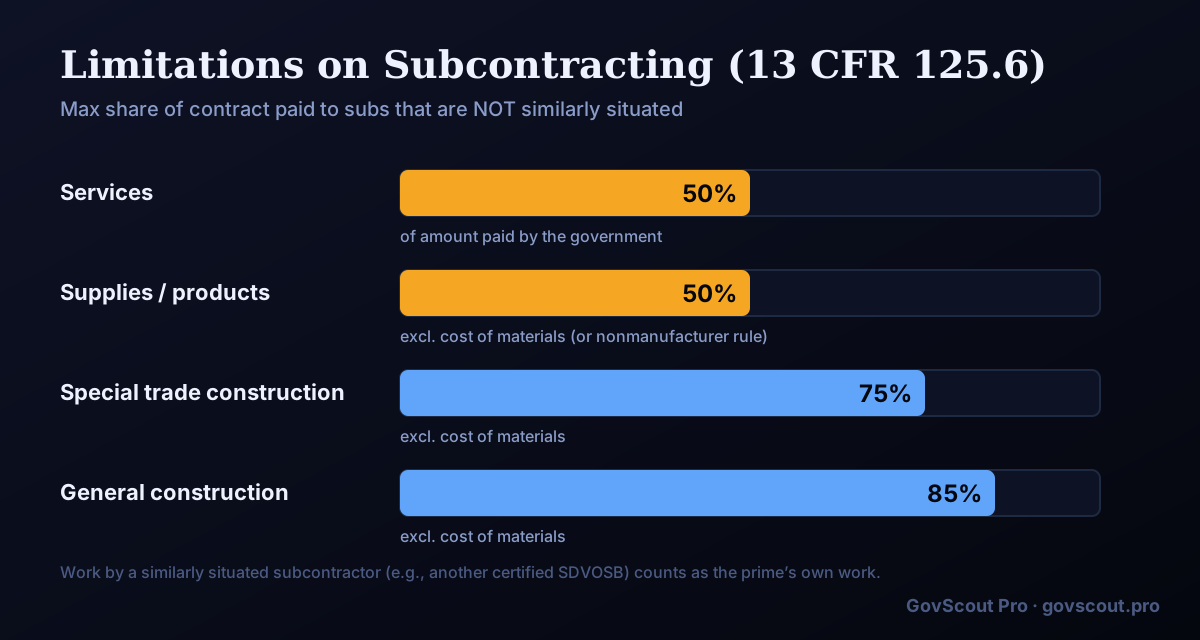
Limitations on subcontracting (13 CFR 125.6). On an SDVOSB set-aside, the prime may not pay firms that are not similarly situated more than:
| Type of contract | Maximum paid to non-similarly-situated subs |
|---|---|
| Services (except construction) | 50% of the amount paid by the government |
| Supplies / products | 50%, excluding cost of materials (or meet the nonmanufacturer rule) |
| General construction | 85%, excluding cost of materials |
| Special trade construction | 75%, excluding cost of materials |
Work done by a similarly situated subcontractor, meaning another VetCert-certified SDVOSB that is small under the contract's NAICS code, counts as if the prime did it. That is a major advantage of teaming SDVOSB-to-SDVOSB.
The ostensible subcontractor rule (13 CFR 121.103(h)). If a subcontractor performs the primary and vital requirements of the contract, or the prime is unusually reliant on it, SBA can treat the two as affiliated joint venturers. If the sub is large, the prime becomes large for that procurement and loses the award. Warning signs reviewers look for:
- The subcontractor wrote most of the proposal or supplied most of the key personnel.
- The subcontractor is the incumbent and the prime has no relevant experience.
- The sub's past performance is the main evidence of capability.
- The prime's role is mostly management with little technical work.
The safest prime-sub team is one where the SDVOSB clearly performs the core work and the sub fills a defined, secondary role.
Option 2: The SDVOSB Joint Venture
When the work is too big or too specialized for a prime-sub team, a joint venture lets two or more firms bid as one offeror. SBA's rule for VOSB and SDVOSB joint ventures is 13 CFR 128.402. The key requirements:
Who can be in the JV
- A VetCert-certified SDVOSB may joint venture with one or more other small businesses, or with its SBA-approved mentor under the mentor-protégé program.
- For an SDVOSB contract, the certified SDVOSB must be the managing venturer.
- An SDVOSB cannot be a partner in more than one JV offering on the same set-aside contract or order.
Size
A JV of a certified SDVOSB and other firms is small if each partner is small under the NAICS size standard for the procurement. This applies to competitive and sole-source awards. A mentor-protégé JV is small if the protégé is small, no matter how big the mentor is.
Control and management
- The managing venturer controls day-to-day management and administration of contract performance.
- The JV agreement must name a Responsible Manager, an employee of the certified SDVOSB. That person cannot be employed by the mentor.
- If the JV is a separate legal entity, such as an LLC, the SDVOSB must own at least 51%.
Work share and profits
- The JV as a whole must meet the limitations on subcontracting.
- The certified SDVOSB partner(s) must perform at least 40% of the work done by the JV, and it must be more than administrative or ministerial work.
- The SDVOSB must receive profits commensurate with the work it performs, or a higher agreed share.
Paperwork SBA requires in the JV agreement
13 CFR 128.402(c) lists required provisions. Among them: a special bank account in the JV's name, records kept at the managing venturer's office, quarterly financial statements within 45 days of each quarter, and a project-end profit and loss statement within 90 days of completion. Missing provisions are a common reason JV offers are found ineligible.
Certification and reporting
- SBA does not certify JVs. Register the JV in SAM.gov, designate it as an SDVOSB joint venture, and identify the certified partner.
- At initial offer, each certified partner certifies its own SDVOSB status and size.
- Before award as apparent successful offeror, the SDVOSB must submit a signed certification to the contracting officer and SBA that the JV agreement complies with the rules.
- Every year, and again at completion, the SDVOSB submits a performance-of-work report to the contracting officer and SBA.
The two-year rule
Under SBA's affiliation rules, a joint venture may be awarded contracts for two years from the date of its first award. After that window, it can keep performing the contracts it already won, including orders under those contracts, but it cannot win new ones. Plan for a new JV entity if the partnership is long term.
Option 3: The Mentor-Protégé Joint Venture
SBA's single mentor-protégé program, at 13 CFR 125.9, is the strongest tool an SDVOSB has for competing on large set-asides. A large business mentor can JV with its SDVOSB protégé, and the JV is still small for set-asides as long as the protégé is small.
| Rule | Requirement |
|---|---|
| Approval | SBA must approve the mentor-protégé agreement before the JV submits an offer. |
| Term | No more than six years total. |
| Protégés per mentor | Generally no more than three at a time. |
| Protégé size | Small for its primary NAICS code, or a secondary code it identifies for development. |
| Affiliation | A protégé is generally not affiliated with its mentor because of assistance received under the approved agreement. |
| Work share | The protégé must perform at least 40% of the JV's work, and more than administrative tasks. |
| Reporting | Annual protégé report to SBA, including JV contracts and mentor subcontracts. |
The catch is that the protégé must really learn and lead. If the mentor runs the contract and the protégé is a name on the door, the JV will fail the work-share and control tests, and the SDVOSB's certification can be questioned.
Which Structure Should You Use?
| Situation | Best fit |
|---|---|
| You can do most of the work and need a specialist for a defined piece | Prime-sub teaming agreement |
| The partner is another certified SDVOSB | Prime-sub with a similarly situated sub, or an SDVOSB-SDVOSB JV |
| The work needs a partner's capacity and both firms are small | SDVOSB joint venture |
| You need a large firm's past performance, bonding, or systems | Mentor-protégé JV (after SBA approves the agreement) |
| The partner would do the "primary and vital" work | Do not structure it as prime-sub. Use a JV or pass. |
What Goes in an SDVOSB Teaming Agreement
A teaming agreement is a contract. Have a government contracts attorney review it. At a minimum, it should cover:
- The specific opportunity by solicitation number or a clear description, so the agreement does not bind you forever.
- Work share by labor category, task, or percentage, written so you can prove compliance with the limitations on subcontracting.
- Exclusivity, if any, and when it ends.
- Proposal responsibilities: who writes what, who pays for what, and deadlines.
- The commitment to subcontract on award, subject to customer approval, and how pricing will be set.
- Termination: what happens if the team loses, the solicitation is canceled, or the government objects to the sub.
- Confidentiality and non-solicitation of employees.
- Compliance flow-downs, including cybersecurity clauses for DoD work and the limitations on subcontracting clause.
Red Flags That Lead to Lost Protests
- The JV agreement is missing provisions required by 13 CFR 128.402(c).
- The Responsible Manager is not an SDVOSB employee, or works for the mentor.
- The SDVOSB's 40% is mostly project management and invoicing.
- The JV keeps bidding after its two-year window closes.
- The SDVOSB partner's VetCert lapsed or is not shown in SAM.gov.
- The prime-sub proposal relies on the large sub's key personnel and past performance for the core work.
What to Watch in 2026-2027
- Size standards final rule. SBA's August 2026 proposal closed for comment September 21, 2026. A final rule would change which partners count as small and may reshape JV eligibility by NAICS code.
- FAR Part 19 rewrite. The Revolutionary FAR Overhaul keeps the small business Rule of Two in proposed FAR 19.104-1, but proposes that it would not apply to orders under multiple-award contracts. That shifts more competition to the order level, where JVs on existing vehicles have an edge.
- SDVOSB sole-source limits. Sole-source SDVOSB awards are allowed up to $5 million, or $8.5 million for manufacturing. A capable SDVOSB-led team can pursue those directly with a program office.
How to Form an SDVOSB Joint Venture, Step by Step
- Confirm both firms' status. The SDVOSB partner's VetCert certification must be active, and every partner must be small under the NAICS code of the target procurement, unless it is an approved mentor in a mentor-protégé JV.
- Pick the opportunity first. JVs are usually formed for a specific pursuit or a short list of related ones. Remember the two-year award window starts with the first award.
- Decide the structure. An unpopulated JV, where each partner performs with its own employees, is the most common for small firms. A separate LLC must be at least 51% owned by the SDVOSB.
- Write the JV agreement with every provision SBA requires: purpose, managing venturer, Responsible Manager, ownership, profit split, special bank account, records, financial statements, and a description of each partner's work.
- Map the work share. Break the scope into tasks and assign them. Check that the SDVOSB performs at least 40% of the JV's work and that the JV meets the limitations on subcontracting.
- Register the JV in SAM.gov. The JV gets its own UEI and CAGE code. Designate it as an SDVOSB joint venture and identify the certified partner.
- Submit the offer as the JV. Each certified partner certifies its own status and size at initial offer.
- Before award, the SDVOSB submits the signed certification to the contracting officer and SBA that the JV agreement complies.
- After award, track performance of work monthly and submit the annual and final performance-of-work reports.
Example: How the Work and Money Flow
Here is a simplified example of an unpopulated SDVOSB-mentor JV on a $10 million services contract. The numbers are illustrative.
| Item | SDVOSB protégé | Large mentor | Outside subs |
|---|---|---|---|
| Share of JV's own work | 45% | 55% | - |
| Labor dollars performed | $3.6 million | $4.4 million | $2.0 million |
| Role | Managing venturer, program manager, core technical work | Specialized technical work, reach-back, systems | Niche tasks |
In this example the JV performs $8 million of the $10 million with its own partners, well inside the 50% services limit, and the SDVOSB performs 45% of the JV's work, above the 40% minimum. The profit split should match each partner's share of the work, or give the SDVOSB more.
Frequently Asked Questions
Can an SDVOSB joint venture with a non-veteran company?
Yes. A certified SDVOSB can JV with another small business, or with its SBA-approved mentor, which may be large. The SDVOSB must be the managing venturer and perform at least 40% of the JV's work.
Does the joint venture need its own VetCert certification?
No. SBA does not certify VOSB or SDVOSB joint ventures. Each certified partner must be certified, and the JV is designated as an SDVOSB joint venture in SAM.gov with the certified partner identified.
How long can an SDVOSB joint venture win contracts?
Two years from the date of its first award. After that it can keep performing existing contracts and their orders, but it cannot receive new awards.
What is a similarly situated entity?
A subcontractor that holds the same certification as the prime (for an SDVOSB set-aside, another certified SDVOSB) and is small under the NAICS code the prime assigns to the subcontract. Work it performs counts toward the prime's limitations on subcontracting.
Is a teaming agreement the same as a joint venture?
No. In a typical teaming agreement the SDVOSB is the prime offeror and the partner is a subcontractor. In a joint venture the firms submit one offer together as a single entity, under SBA's joint venture rules.
Related reading: Teaming agreement basics, the SDVOSB contracts guide, the VA Rule of Two, and 2026-2027 federal contracting thresholds.