SDVOSB Set-Aside Contracts in 2026-2027: How Service-Disabled Veterans Find and Win Them
SDVOSB set-aside contracts are federal contracts reserved for small businesses owned and controlled by service-disabled veterans. In fiscal 2025 the government sent $32.5 billion of prime contract dollars to SDVOSBs, 5.01% of eligible spending, just over the 5% goal. This guide covers who qualifies, where the money actually goes, and how to get your share in 2026 and 2027.
I'm a service-disabled veteran and I run GovScout Pro, so this is the guide I wish someone had handed me: the rules in plain English, the real numbers, and the moves that matter.
- Free training: SBA funded a $3.75 million Veteran Federal Procurement Entrepreneurship Training Program. It offers no-cost, in-person training and mentorship to certified veteran-owned and service-disabled veteran-owned firms and transitioning service members, about 250 businesses a year in five cohorts. The first-year award is $750,000 and the program began September 1, 2026.
- Goal check: The Congressional Research Service updated its SDVOSB primer on September 8, 2026. It confirms agencies beat the 5% goal in FY2023, FY2024, and FY2025, and that the subcontract share still falls short.
- Certification speed: SBA announced on November 11, 2025 that it had cleared its VetCert backlog, from more than 2,700 pending applications to zero, with an average processing time of 12 days. That was a year ago, so check the current wait before you plan around it.
- Pending bills: According to CRS, H.R. 6648 would raise the SDVOSB sole-source limit, and H.R. 865 and S. 2510 would require agency training to increase SDVOSB awards. We have not seen any of them enacted.
What numbers matter for SDVOSB set-asides in 2026-2027?
| What | Number | Source |
|---|---|---|
| Government-wide SDVOSB goal | 5% of prime and subcontract dollars (raised from 3% by the FY2024 NDAA) | CRS |
| FY2025 SDVOSB prime dollars | $32.5 billion, 5.01% (third straight year over 5%) | SBA FY2025 scorecard |
| FY2025 SDVOSB subcontract share | 2.42% | SBA FY2025 scorecard |
| VA spending with SDVOSBs, FY2025 | $10.1 billion, 21.6% of VA prime dollars | CRS |
| SDVOSB sole-source limit | $5 million ($8.5 million manufacturing), since October 1, 2025 | FAR inflation rule |
| VetCert processing time | 12-day average after SBA cleared a backlog of more than 2,700 applications (November 11, 2025) | SBA, via ExecutiveGov |
| VetCert certification term | 3 years | 13 CFR 128.306 |
Who qualifies as an SDVOSB?
You qualify if your business is small under the size standard for the NAICS code you're bidding, and one or more service-disabled veterans own at least 51% and control day-to-day operations and long-term decisions. "Control" is where firms get tripped up: if a non-veteran partner can veto decisions or runs the money, expect trouble in a protest.
Since January 2023 the SBA, not the VA, certifies veteran firms through VetCert. Self-certification for government-wide set-asides ended January 1, 2024, and since August 2024 only certified firms count toward agency goals. Translation: if you're not certified, contracting officers have little reason to pick you for an SDVOSB set-aside.
Three details people miss, per CRS: VA, not SBA, decides whether an individual counts as a service-disabled veteran, so your disability rating has to be on file before SBA can certify the firm. A surviving spouse of a deceased service-disabled veteran owner can qualify (13 CFR 128.202(i)). And you recertify every three years.
Where does SDVOSB money actually go?
Defense and the VA together account for about 70% of SDVOSB dollars. We pulled FY2025 contract data from USAspending.gov to see which agencies spend the most with SDVOSB-flagged companies.
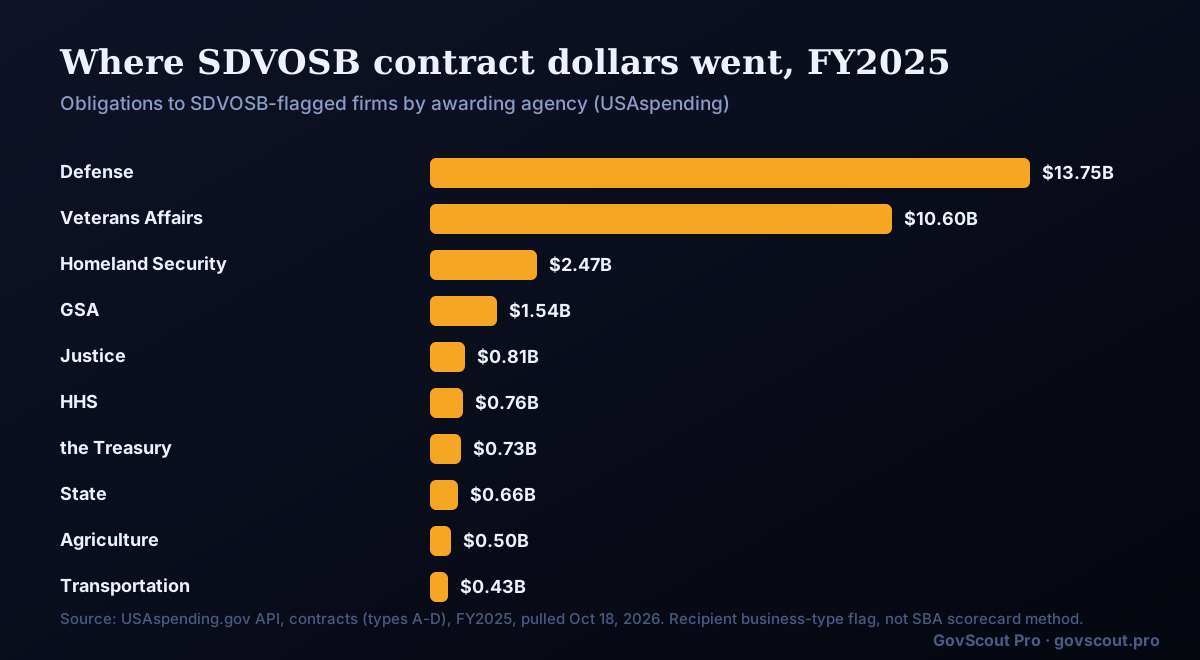
| Agency | FY2025 to SDVOSB-flagged firms | Share of agency contract dollars | Change from FY2024 |
|---|---|---|---|
| Department of Defense | $13.75B | 2.8% | +2.3% |
| Department of Veterans Affairs | $10.60B | 13.5% | -3.4% |
| Department of Homeland Security | $2.47B | 8.7% | +14.2% |
| General Services Administration | $1.54B | 6.4% | +13.2% |
| Department of Justice | $0.81B | 9.5% | -3.6% |
| Department of Health and Human Services | $0.76B | 3.6% | -26.5% |
| Department of the Treasury | $0.73B | 8.6% | -2.1% |
| Department of State | $0.66B | 6.7% | -11.4% |
| Department of Agriculture | $0.50B | 5.3% | -16.0% |
| Department of Transportation | $0.43B | 4.7% | +4.5% |
| National Aeronautics and Space Administration | $0.43B | 2.7% | -2.3% |
| Department of Commerce | $0.32B | 7.6% | -22.2% |
How to read this: These are net obligations in FY2025 to firms that marked themselves SDVOSB in their registration, for all contract types. That's broader than SBA's scorecard, which counts only certified firms and only "eligible" dollars, so our total ($34.4 billion) runs a bit higher than SBA's $32.5 billion. The shares use each agency's total contract obligations as the base, so the VA shows 13.5% here versus 21.6% in SBA's math. Use this table for direction (who buys the most), not for official goal numbers.
What jumps out: Homeland Security (+14%) and GSA (+13%) grew their SDVOSB spending in FY2025, while HHS, Interior, Commerce, and Social Security cut back by 22% to 37%.
What do SDVOSBs get paid to do?
| NAICS | Industry | FY2025 to SDVOSB-flagged firms |
|---|---|---|
| 541519 | Other Computer Related Services | $6.57B |
| 236220 | Commercial and Institutional Building Construction | $3.91B |
| 541330 | Engineering Services | $2.99B |
| 541512 | Computer Systems Design Services | $2.69B |
| 541611 | Administrative Management and General Management Consulting Services | $1.35B |
| 488190 | Other Support Activities for Air Transportation | $1.03B |
| 541511 | Custom Computer Programming Services | $0.95B |
| 561210 | Facilities Support Services | $0.90B |
| 541715 | Research and Development in the Physical, Engineering, and Life Sciences (except Nanotechnology and Biotechnology) | $0.70B |
| 561599 | All Other Travel Arrangement and Reservation Services | $0.69B |
IT services, building construction, and engineering lead. If your NAICS codes are on this list, the competition is real but so is the money. If they're not, look for the agencies that buy your work and check their SDVOSB track record before you invest in them.
What is the VA rule most SDVOSBs never use?
The VA works under its own law. 38 U.S.C. 8127 says the VA must set a contract aside for SDVOSBs (or VOSBs) when it expects at least two of them to bid at a fair and reasonable price. In Kingdomware Technologies v. United States (2016), the Supreme Court ruled unanimously that this "Rule of Two" applies even to Federal Supply Schedule orders and even after the VA has met its goals.
The VA also has a pecking order. Per CRS, it looks first to SDVOSBs, then to veteran-owned small businesses (VOSBs), then to 8(a) or HUBZone firms, and only then to other small businesses. In FY2025 the VA sent $10.3 billion (22.1%) to VOSBs overall, including $10.1 billion (21.6%) to SDVOSBs. It can sole-source to a VOSB only when it has found no responsible SDVOSB, which is why answering sources sought notices matters.
- Get certified in SBA VetCert first. No VetCert, no VA set-aside award.
- Call the contracting office at your nearest VA Medical Center. Each one buys on its own. A 20-minute intro call beats chasing national contracts you have no history with.
- Answer every VA sources sought notice in your NAICS codes. The VA uses those answers to prove two SDVOSBs exist. Your response is literally what triggers the set-aside.
See the VA contracts guide for where each kind of work is bought.
How do you find SDVOSB set-aside contracts on SAM.gov?
- On SAM.gov, search Contract Opportunities and filter Set Aside to "Service-Disabled Veteran-Owned Small Business (SDVOSB) Set-Aside" and "SDVOSB Sole Source."
- Add your 3 to 5 strongest NAICS codes. Not 15.
- Include Sources Sought and Presolicitation notices, not just Solicitations. That's where you get in early.
- Save the search and turn on email notifications.
- Check agency procurement forecasts once a month for what's coming next year.
What tips and tricks actually move the needle?
- Ask for a sole-source award. Contracting officers can award SDVOSB sole-source contracts up to $5 million ($8.5 million manufacturing) when only one capable SDVOSB is expected to bid. Most veterans never ask. Bring a capability statement that shows you're the one.
- Become the prime's favorite sub. Large primes have SDVOSB subcontracting goals and missed them as a group in FY2025 (2.42% against a 5% goal). Primes with plans over $900,000 need you.
- Team before you're ready to prime. An SDVOSB joint venture or mentor-protégé arrangement can combine your certification with a partner's past performance. Our SDVOSB teaming and JV guide covers the rules.
- Follow the growth, not just the size. DHS and GSA grew their SDVOSB spending in FY2025. Growing buyers are easier to break into than shrinking ones.
- Keep your SAM.gov registration and VetCert current. An expired registration on the day of award means no award. Set a calendar reminder 60 days before each renewal.
- Watch the size standard proposal. SBA proposed a big size standard overhaul in August 2026 (comments now close November 20, 2026). If it goes final, some firms that are "too big" today could become small again, which means more SDVOSB competition in 2027.
- Take the free training. SBA's new Veteran Federal Procurement Entrepreneurship Training Program covers finding opportunities, capability statements, proposals, and pricing, with mentorship, at no cost to certified veteran-owned and SDVOSB firms. Start at sba.gov/veterans; no application deadline was published in the coverage we reviewed.
- Do not borrow 8(a) numbers. The SDVOSB sole-source limit is $5 million, while the 8(a) limit is $5.5 million for the same non-manufacturing work. Quote the right one in your capability pitch.
- Watch where 8(a) work is going. One reading of SBA's FY2025 scorecard has 8(a) dollars falling about $1.5 billion, the largest drop in more than a decade, while SDVOSB dollars held above goal. If you also hold an 8(a) certification, or team with an 8(a) firm, read our 8(a) sole-source limits guide to see how the program is changing.
Which SDVOSB bids should you skip?
Don't chase every listing. Pass when the incumbent has a clear advantage, the deadline is too tight to write a compliant response, or you'd have to subcontract most of the work to a non-SDVOSB. Remember the limitations on subcontracting: on services, you can't pay more than 50% of what the government pays you to subcontractors who aren't similarly situated. Run every notice through the bid/no-bid checklist first.
Frequently Asked Questions
What is an SDVOSB set-aside contract?
A federal contract that only small businesses owned and controlled by service-disabled veterans can bid on. Agencies use set-asides to reach the government-wide goal of 5% of contract dollars going to SDVOSBs.
Do I need VetCert to win SDVOSB contracts?
Yes. SBA's Veteran Small Business Certification (VetCert) has been required for government-wide SDVOSB set-asides since January 1, 2024, and for VA set-asides since the program moved to SBA in 2023.
How much did SDVOSBs win in 2025?
$32.5 billion in prime contracts in fiscal 2025, or 5.01% of eligible federal contract dollars, according to SBA's FY2025 scorecard.
What is the SDVOSB sole-source limit in 2026?
$5 million, or $8.5 million for manufacturing, since the FAR inflation adjustment took effect October 1, 2025.
Which agency spends the most with SDVOSBs?
The Department of Defense spends the most in total dollars, about $13.75 billion with SDVOSB-flagged firms in FY2025. The VA spends the highest share of its budget with them.
How long does VetCert take?
SBA said on November 11, 2025 that it had cleared its backlog of more than 2,700 applications and that average processing time was 12 days. Wait times can change, so check SBA's certification site for current guidance before you promise a bid date.
Can I get an SDVOSB sole-source award without VetCert?
Generally no. Since January 1, 2024, FAR 19.1406(b) allows a sole-source award only to a firm designated as an SBA-certified SDVOSB in SAM.gov, with a narrow exception for firms that applied for certification by December 31, 2023.
Is there free training for SDVOSBs?
Yes. SBA funded a $3.75 million Veteran Federal Procurement Entrepreneurship Training Program that began September 1, 2026. It offers no-cost, in-person training and mentorship to certified veteran-owned and SDVOSB firms and to transitioning service members.
Official Sources Reviewed
- SBA FY2025 small business procurement scorecard release (June 25, 2026)
- CRS IF13309, SDVOSB Contracting Program (September 2026)
- CRS IN12313, SDVOSB goal increase and certification
- Kingdomware Technologies v. United States (2016)
- SBA VetCert one-year anniversary release
- 2025 FAR threshold increases, including SDVOSB sole-source limits
- SBA proposed size standards rule (August 20, 2026)
- FAR 19.1406, SDVOSB sole source (reviewed October 29, 2026)
- CRS IF13123, acquisition thresholds effective October 1, 2025 (reviewed October 29, 2026)
- SBA VetCert backlog cleared, November 2025 (reviewed October 29, 2026)
- SBA Veteran Federal Procurement Entrepreneurship Training Program (reviewed October 29, 2026)
- Fed Contract Pros, reading of the FY25 scorecard (reviewed October 29, 2026)
- USAspending.gov award search (FY2025 data pulled October 18, 2026)
Find SDVOSB Set-Asides Worth Chasing
GovScout Pro searches SAM.gov for SDVOSB set-asides in your NAICS codes and has Marcus score each one GO, TEAM, or PASS against your business profile.
Start with Marcus