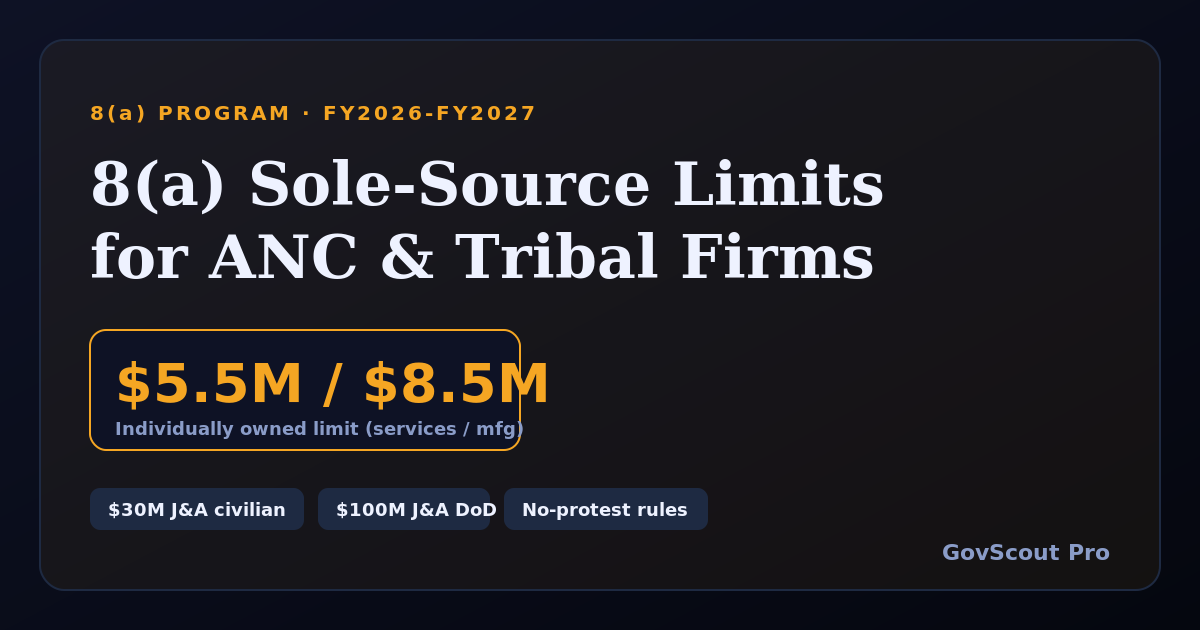
If you searched for the 8(a) sole-source limit for an ANC firm, you probably found three different numbers on three different websites. Some still say $4.5 million. Some say there is no limit at all. A few mix up the justification threshold with the award ceiling. All of them miss what changed in 2025 and 2026.
This guide puts the rules in one place: what an 8(a) sole-source award is, the current dollar limits for individually owned and entity-owned firms, when a written justification is required, why competitors usually cannot protest these awards, and what the 2025-2026 shakeup means for anyone planning 8(a) work in fiscal years 2026 and 2027.
What an 8(a) Sole-Source Award Actually Is
The SBA 8(a) Business Development Program lets agencies award contracts to program participants through SBA, with or without competition. A sole-source 8(a) award is a contract the agency gives directly to one named 8(a) firm. Nobody else bids. There is no public solicitation race and no evaluation against other offerors.
The process runs through SBA, not around it:
- The agency identifies a requirement and decides it is suitable for the 8(a) program, often after market research or after an 8(a) firm markets its capabilities directly to the program office.
- The agency sends an offering letter to SBA describing the requirement, the NAICS code, the estimated value, and, for a sole-source offer, the firm it wants to use.
- SBA accepts the requirement into the 8(a) program and confirms the nominated firm is eligible and small under the assigned NAICS code.
- The agency negotiates directly with the firm and awards the contract.
That last step is why the program is so valuable. A firm that does the relationship work can turn months of proposal effort into a negotiation. It is also why the program draws so much scrutiny.
The Two Rulebooks: Individually Owned vs. Entity-Owned Firms
Most confusion comes from mixing two different sets of rules. The dollar limits depend on who owns the 8(a) firm.
Individually owned 8(a) firms
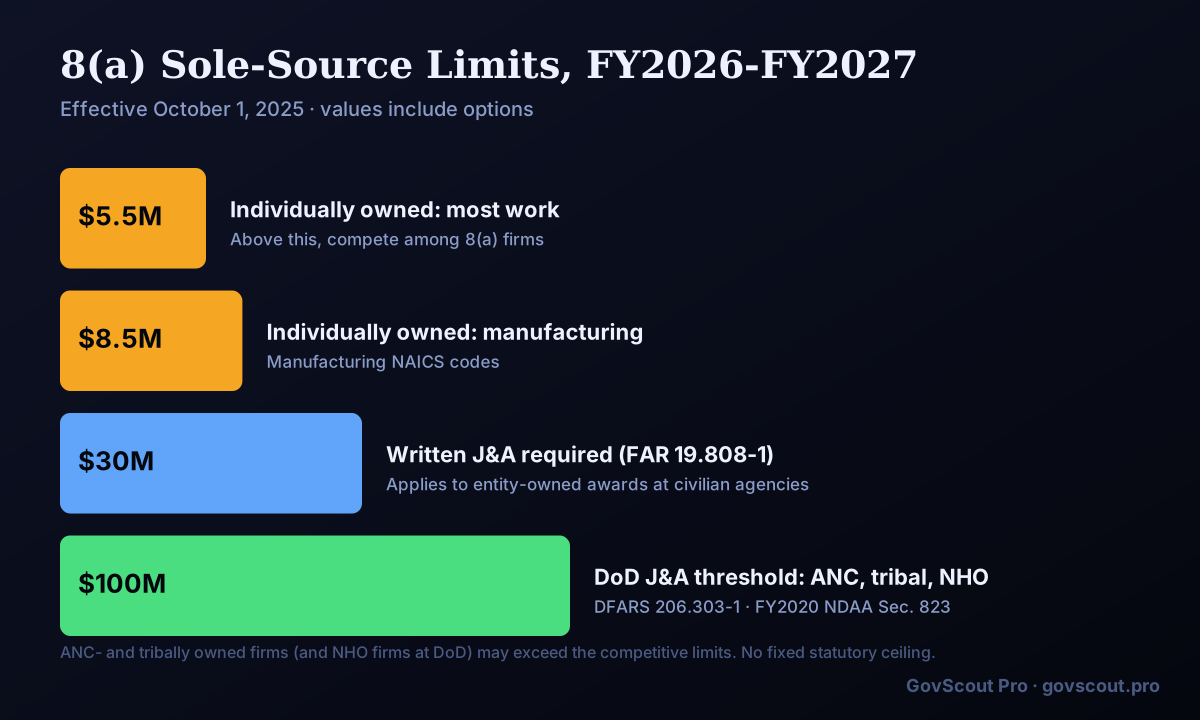
A firm owned and controlled by socially and economically disadvantaged individuals can receive a sole-source award only when the total contract value, including options, is at or below the competitive threshold. Above that, the requirement must be competed among 8(a) firms.
The FAR Council's inflation adjustment effective October 1, 2025 raised those thresholds:
| Type of work | Before Oct 1, 2025 | Current (FY2026-FY2027) |
|---|---|---|
| Manufacturing NAICS codes | $7 million | $8.5 million |
| All other NAICS codes (services, construction, etc.) | $4.5 million | $5.5 million |
If you see $4.5 million or $7 million in an article dated 2026, it is out of date. Those numbers were correct from 2020 until September 30, 2025.
Entity-owned firms: ANCs, tribes, and NHOs
Firms owned by Alaska Native Corporations and Indian tribes are treated differently under the Small Business Act and SBA's regulations at 13 CFR Part 124. They can receive sole-source 8(a) awards above the competitive thresholds. Firms owned by Native Hawaiian Organizations get the same authority for Department of Defense contracts.
That is the source of the "no limit" claim. It is true that no statute sets a hard dollar cap on these awards. It is not true that anything goes. Two controls apply:
- Written justification and approval (J&A). Under FAR 19.808-1, SBA may not accept a sole-source 8(a) contract above $30 million unless the contracting agency has completed a justification under FAR 6.303. That figure rose from $25 million with the October 2025 inflation adjustment.
- DoD's higher threshold. Section 823 of the FY2020 National Defense Authorization Act raised DoD's J&A threshold for sole-source 8(a) awards to firms owned by tribes, ANCs, and NHOs to $100 million, implemented through DFARS 206.303-1.
So "how high can an ANC sole-source award go?" has a practical answer: as high as the agency can justify, with paperwork kicking in at $30 million at civilian agencies and $100 million at DoD.
The sister-company follow-on rule
Entity-owned firms face one restriction individually owned firms do not. Under FAR 19.808-1(f), an 8(a) firm owned by an ANC, tribe, NHO, or Community Development Corporation may not receive a sole-source 8(a) follow-on contract if the predecessor 8(a) contract was performed by another firm owned by the same entity. The rule exists to stop parent corporations from passing the same contract between sister subsidiaries indefinitely.
When a Justification Is Required
A justification is a written document explaining why the agency is awarding without competition. For large 8(a) sole-source awards it typically covers:
- Confirmation that the firm is a current 8(a) participant and eligible under the assigned NAICS code.
- Why the sole-source approach is in the government's interest.
- Market research and the price reasonableness basis.
- Approval at the level required for the dollar value.
The approval levels for other-than-full-and-open competition were also adjusted in October 2025: $900,000, $20 million, and $90 million tiers, with a $150 million tier for DoD, NASA, and the Coast Guard. The bigger the award, the more senior the official who must sign.
Can a Competitor Protest an 8(a) Sole-Source Award?
This is the "8(a) sole source no protest" question, and the answer is mostly no.
SBA's regulation at 13 CFR 124.517 sets the rules:
- Eligibility cannot be protested by another firm, in a sole-source or competitive 8(a) procurement. Someone with information about a firm's eligibility can send it to SBA, but that is a report, not a protest.
- Size cannot be protested for a sole-source 8(a) award. Size protests are allowed only in competitive 8(a) procurements, against the apparent successful offeror.
- The NAICS code assigned to a sole-source 8(a) requirement cannot be challenged by competitors. Only SBA's Associate Administrator for Business Development can appeal it.
The Government Accountability Office will generally not review an agency's decision to place work in the 8(a) program unless there is a showing of possible bad faith or a violation of regulation. For a competitor, that is a narrow door.
What this means in practice: if you are not in the program, you cannot win an 8(a) sole-source award, and you usually cannot stop one. Your options are to team with an 8(a) firm, compete when the work comes out of the program, or position for a different set-aside.
Limitations on Subcontracting Still Apply
An 8(a) firm cannot win a sole-source contract and hand the work to a large company. The limitations on subcontracting at 13 CFR 125.6 apply:
- Services: the 8(a) firm may not pay more than 50% of the amount paid by the government to firms that are not similarly situated.
- Supplies: 50% of the amount paid, excluding the cost of materials, unless the firm qualifies under the nonmanufacturer rule.
- General construction: 85%. Special trade construction: 75%. Cost of materials is excluded.
Whether firms actually perform the work is one of the main things the 2026 reviews are looking at, so documentation matters more now than it did two years ago.
What Changed in 2025 and 2026
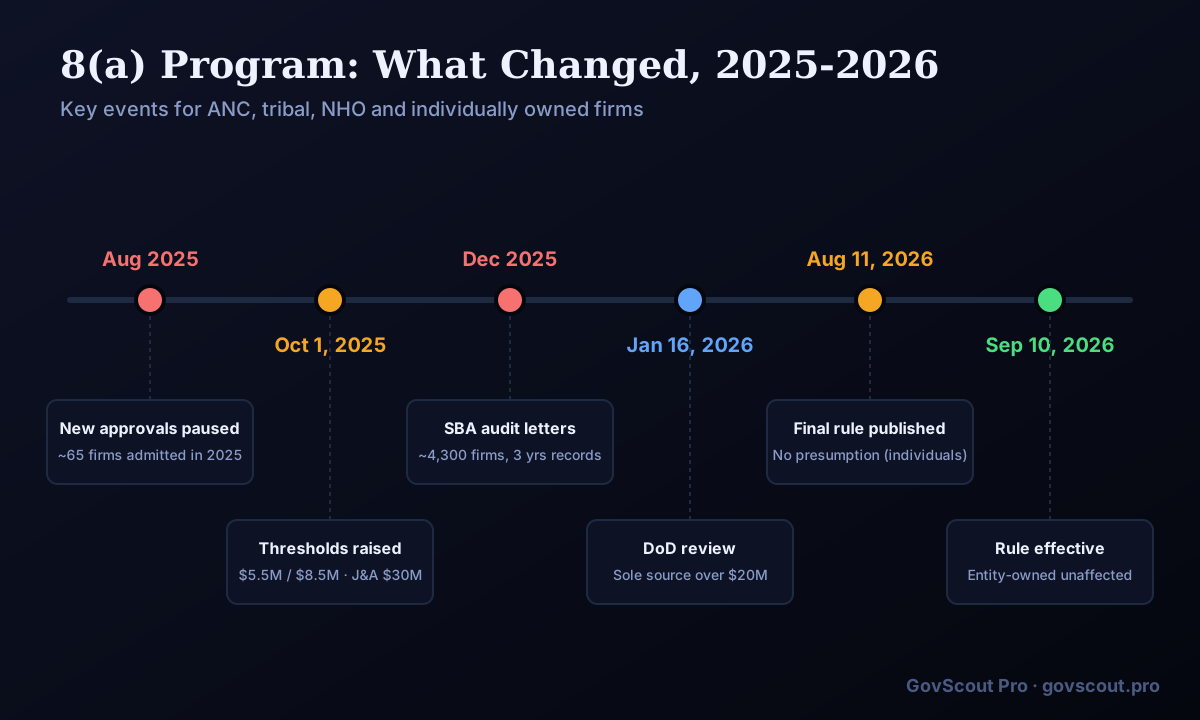
The 8(a) program went through more change in the last 18 months than in the previous decade. Here is the sequence that matters for planning.
| Date | What happened | Why it matters |
|---|---|---|
| Aug 2025 | SBA stopped approving new 8(a) applications while the social-disadvantage rule was in dispute. | Only about 65 firms were admitted in 2025, versus more than 2,100 the year before. |
| Oct 1, 2025 | FAR inflation adjustment: competitive thresholds to $5.5M / $8.5M; J&A threshold to $30M. | Bigger sole-source awards are possible for individually owned firms. |
| Dec 2025 | SBA sent compliance letters to roughly 4,300 participants requiring three years of financial records by January 5, 2026. | Firms that could not comply were suspended; roughly 1,000 lost active status. |
| Jan 16, 2026 | The Secretary of Defense announced a line-by-line review of 8(a) sole-source contracts above $20 million. | In practice, only entity-owned firms receive sole-source awards that large, so the review centers on ANC, tribal, and NHO work. |
| Feb 2026 | Senate Committee on Indian Affairs hearing on 8(a) contracting. | Senators from Alaska and Hawaii publicly defended the entity-owned authorities. No law has changed them. |
| Aug 11, 2026 | SBA published its final rule removing the presumption of social disadvantage for individually owned firms (effective Sept 10, 2026). | Individual applicants now prove disadvantage with evidence. Entity-owned firms are not affected by this rule. |
| Aug 20, 2026 | SBA proposed a sweeping overhaul of size standards across 338 industry groups. | If finalized, many 8(a) subsidiaries stay small far longer, and about 37,000 experienced firms would newly qualify as small competitors. |
The Pentagon review: what it does and does not do
The January 2026 DoD review is a review, not a ban. It asks whether large sole-source 8(a) contracts support military readiness and whether the 8(a) firm is doing the work itself. It did not change the statute or the $100 million J&A threshold. Expect more questions, more documentation, and slower decisions on large entity-owned sole-source actions through FY2027, especially at DoD.
The new social-disadvantage test
For individually owned applicants, the final rule effective September 10, 2026 replaces the old group presumption with an evidence test. An applicant must show discrimination or bias, based on race, ethnicity, sex, or disability, and that it caused material harm. It applies to new and pending applications, not to firms already in the program. Entity-owned firms are outside this rule entirely.
How the Proposed FAR Overhaul Could Change 8(a) Sole Source
The Revolutionary FAR Overhaul (RFO) is rewriting the FAR. The proposed Part 19 text, issued as a model deviation in September 2025 and adopted early by GSA, includes two 8(a) changes worth watching:
- Competitive 8(a) orders first. Proposed FAR 19.108-7 would require contracting officers, for acquisitions below the competitive threshold, to first try a competitive 8(a) order using SBA-approved government-wide contracts that permit it, before awarding sole source.
- Easier release from the program. Proposed 19.108-11 would automatically release a requirement from the 8(a) program if the follow-on will be set aside for HUBZone, SDVOSB, or WOSB firms. Today that release needs SBA approval.
Formal rulemaking for Part 19 had not been published as of mid-2026. Treat these as likely direction, not current law, and check your agency's deviation status before relying on them.
A Practical Playbook for FY2026-FY2027
If you are an 8(a) firm, or you want to work with one, these are the moves that hold up under the new scrutiny.
If you are an 8(a) participant
- Keep three years of financial records ready, including payroll, bank statements, and subcontract agreements. That is exactly what SBA asked for in December 2025.
- Track your performance-of-work percentage monthly, not at contract end. Limitations on subcontracting are the first thing reviewers check.
- Price the requirement before you pitch it. Know which side of $5.5 million, $8.5 million, $30 million, and $100 million it falls on, because each line changes the paperwork the agency has to do.
- Market to program offices with a clear capability fit, then help the contracting officer by being ready for SBA's eligibility check under the right NAICS code.
- Watch the size standards rule. If it is finalized, your growth runway may change in your primary NAICS code.
If you are not in the program
- Do not waste time protesting sole-source 8(a) awards. The rules are stacked against it.
- Team as a subcontractor with an 8(a) firm that needs capacity, while staying inside the subcontracting limits.
- Watch for work leaving the program. Under the proposed release rule, some follow-ons may move to SDVOSB, HUBZone, or WOSB set-asides.
- Consider whether you qualify under the new evidence-based standard if you are individually owned. SBA has resumed approving entity-owned applications and said it would resume individual applications under the final rule, so check current processing status before you apply.
How to Bring a Sole-Source Requirement to a Program Office
8(a) sole-source awards rarely come from SAM.gov. They come from conversations. The firms that win them do the program office's homework for it.
- Find the need. Look for recurring work, expiring contracts, and new program funding in your NAICS codes. SAM.gov contract award data and agency forecasts show what is ending and when.
- Meet the program office and the small business specialist. The program office owns the requirement; the agency's Office of Small and Disadvantaged Business Utilization (OSDBU) helps place work in the 8(a) program.
- Show fit, not just status. A capability briefing with directly relevant past performance, key personnel, and a clear understanding of the mission does more than "we are 8(a)."
- Size the requirement honestly. Know the realistic total value including options and which threshold it falls under. If it is above the competitive limit and you are individually owned, the agency will have to compete it.
- Make SBA's job easy. Keep your 8(a) annual review current, your SAM.gov record accurate, and your size status clean in the assigned NAICS code so SBA can accept the offering quickly.
- Prepare to perform. Plan staffing that meets the limitations on subcontracting from day one. In 2026, reviewers are checking.
Three Scenarios
Scenario 1: $4 million IT services, individually owned firm
Below the $5.5 million limit. The agency can offer it to SBA as a sole-source 8(a) requirement naming your firm. Under the proposed FAR overhaul, the contracting officer might first be required to try a competitive 8(a) order on an available government-wide vehicle, so be ready for that path too.
Scenario 2: $12 million facilities support, individually owned firm
Above the $5.5 million limit. The agency must compete it among 8(a) firms. Your best move is to compete, or to team with an entity-owned 8(a) firm as a subcontractor.
Scenario 3: $45 million logistics support at DoD, ANC-owned firm
An ANC-owned firm can receive a sole-source award above the competitive limits. At DoD, a justification is required only above $100 million for ANC, tribal, and NHO firms, so no J&A is required at this value. At a civilian agency, the $30 million line would require a justification. In 2026, expect the action to face extra scrutiny under the Pentagon review of sole-source 8(a) contracts over $20 million.
Frequently Asked Questions
What is the 8(a) sole-source limit in 2026?
$5.5 million for most NAICS codes and $8.5 million for manufacturing, including options, for individually owned 8(a) firms. These took effect October 1, 2025.
What is the 8(a) sole-source limit for ANC firms?
There is no fixed statutory dollar ceiling for ANC- and tribally owned 8(a) firms. Civilian agencies need a written justification above $30 million. DoD needs one above $100 million for firms owned by ANCs, tribes, and NHOs.
How do ANC 8(a) sole-source contracts work?
The agency offers the requirement to SBA and names the ANC-owned firm. SBA accepts it into the 8(a) program and confirms eligibility and size. The agency then negotiates directly with the firm. Above $30 million at civilian agencies, or $100 million at DoD, the agency must also complete a justification and approval.
Can you protest an 8(a) sole-source award?
Generally no. Under 13 CFR 124.517, competitors cannot challenge an 8(a) firm's eligibility in any 8(a) procurement, and cannot challenge its size on a sole-source award. GAO reviews 8(a) placement decisions only for possible bad faith or a violation of regulation.
Do NHO-owned firms get the same authority as ANCs?
For DoD contracts, yes: NHO-owned firms can receive sole-source awards above the competitive thresholds. At civilian agencies, NHO firms follow the standard competitive thresholds.
Related reading: How to use 8(a) sole-source authority, the 8(a) certification guide, every federal contracting threshold for 2026-2027, and how set-aside programs compare.