Federal construction is one of the best markets a small contractor can enter. Projects are steady, payment is backed by the U.S. Treasury, and a large share of the work is set aside for small businesses. It is also one of the easiest markets to lose money in, because federal construction runs on its own rules: bonds, prevailing wages, certified payroll, subcontracting limits, and size standards that may change in 2027.
This guide is for small construction firms, general and specialty trades alike, that want to win federal projects in fiscal years 2026 and 2027. It covers where the projects come from, the dollar triggers on every federal job, how to qualify, and the changes coming over the next 12 months.
Where Federal Construction Projects Come From
Most federal construction dollars flow through a handful of buyers. Learn their processes and you learn the market.
| Buyer | Typical work | Where to look |
|---|---|---|
| U.S. Army Corps of Engineers (USACE) | Military construction, civil works, dams, levees, environmental remediation | District websites, SAM.gov, industry days |
| NAVFAC (Naval Facilities Engineering Systems Command) | Navy and Marine Corps facilities, waterfront, base maintenance | SAM.gov, regional small business offices |
| Air Force civil engineering (AFCEC and base contracting) | Base facilities, runways, repairs | SAM.gov, base contracting squadrons |
| Department of Veterans Affairs | Medical center renovation, minor construction, non-recurring maintenance | SAM.gov; VA's Veterans First program favors SDVOSBs |
| GSA Public Buildings Service | Federal buildings, courthouses, land ports of entry | SAM.gov, GSA regional offices |
| Interior, Agriculture, State, Homeland Security | Park and forest facilities, roads, embassy and border work | SAM.gov |
Search SAM.gov the way construction buyers code it
- NAICS codes: 236220 (commercial and institutional building), 237310 (highway, street, and bridge), 237990 (other heavy and civil engineering), and the 238 specialty trades (electrical, plumbing and HVAC, roofing, concrete, and so on).
- Product Service Codes: PSCs beginning with Y cover construction of structures and facilities. PSCs beginning with Z cover maintenance, repair, and alteration. Many small-business projects are Z-coded repair and alteration jobs.
- Notice types: include Sources Sought and Presolicitation notices, not just Solicitations. Construction buyers often post a presolicitation notice with the magnitude range months in advance.
- Set-aside filters: total small business, 8(a), HUBZone, SDVOSB, and WOSB.
The Rules That Decide Whether You Make Money
Davis-Bacon prevailing wages (over $2,000)
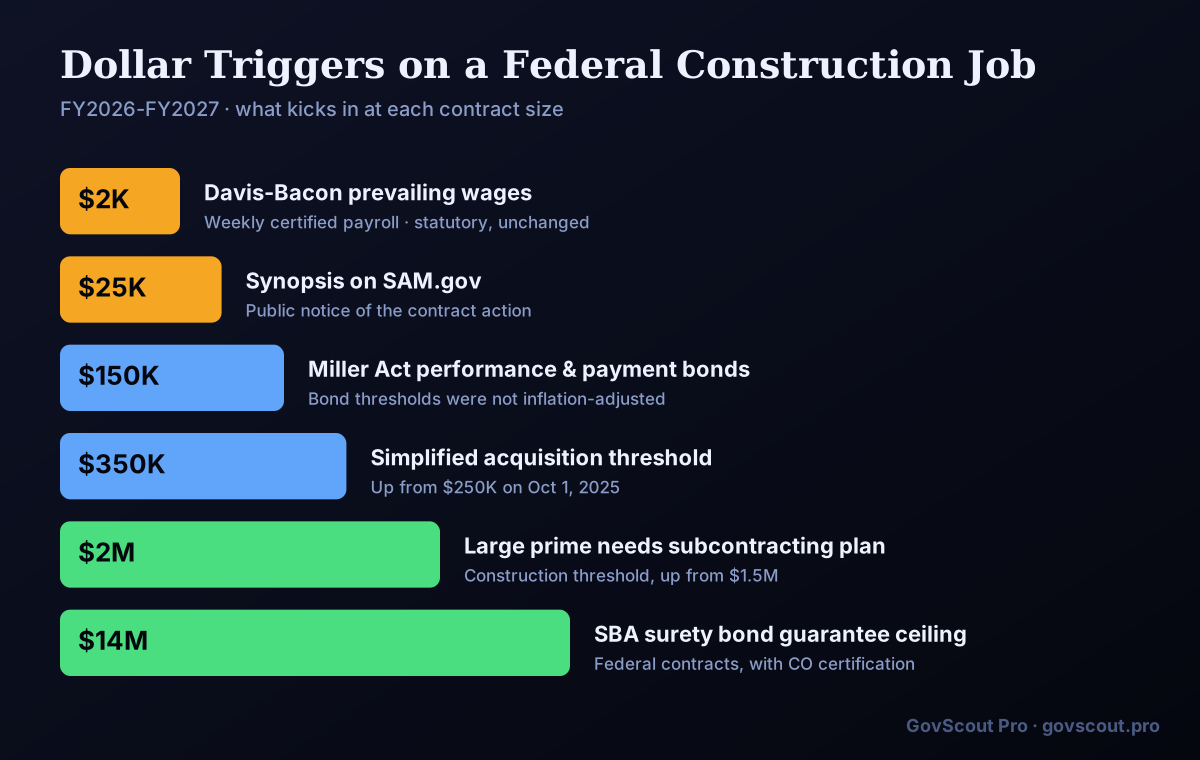
Every federal construction contract over $2,000 requires you and your subcontractors to pay at least the locally prevailing wages and fringe benefits in the wage determination attached to the contract. You must submit certified payroll weekly. The $2,000 threshold is statutory and was not changed by the 2025 inflation adjustment.
Cost trap: Bid with the wage determination in the solicitation, by classification, and include fringe benefits. Underpricing labor is the most common reason small firms lose money on their first federal job.
Miller Act bonds (over $150,000)
Under the Miller Act, the prime contractor on a federal construction contract over $150,000 must furnish a performance bond and a payment bond, usually each for 100% of the contract price. Bond thresholds were excluded from the October 2025 inflation adjustment, so $150,000 still applies in 2026-2027. Smaller contracts may require alternative payment protections under FAR 28.102-1.
Many solicitations also require a bid guarantee, typically 20% of the bid price, up to $3 million. Missing or defective bid bonds make a bid nonresponsive.
Limitations on subcontracting
On a small business set-aside, the prime must keep enough of the work in-house. Under 13 CFR 125.6:
| Contract type | Max paid to non-similarly-situated subs | Excludes |
|---|---|---|
| General construction | 85% of the amount paid | Cost of materials |
| Special trade construction | 75% of the amount paid | Cost of materials |
Subcontractors that hold the same small business status as you, called similarly situated entities, count as your own work. A HUBZone general contractor that uses HUBZone subs, or an SDVOSB that uses SDVOSB subs, has much more flexibility.
Subcontracting plans (large primes over $2 million)
Large business primes on construction contracts over $2 million (up from $1.5 million) must have small business subcontracting plans. That is your opening as a specialty trade sub: primes need to meet those goals. Get on their bidder lists before the prime contract is awarded.
Bonding: The Real Barrier, and How to Get Past It
For most small contractors, bonding capacity, not skill, is what limits project size. Sureties look at your working capital, net worth, credit, backlog, and track record.
Use the SBA Surety Bond Guarantee program
SBA guarantees bonds issued by participating sureties, which makes them more willing to bond small and growing contractors.
| Feature | Limit |
|---|---|
| Non-federal contracts | Up to $9 million |
| Federal contracts | Up to $14 million, if a federal contracting officer certifies the guarantee is necessary |
| Guarantee rate | 90% for contracts of $100,000 or less, or for socially and economically disadvantaged, HUBZone, veteran-owned, and service-disabled veteran-owned businesses; 80% otherwise |
Build capacity step by step
- Start with Z-coded repair and alteration jobs under $150,000, where Miller Act bonds are not required.
- Keep CPA-reviewed financial statements. Sureties want them, and they speed up bond decisions.
- Build a relationship with a surety bond producer who works federal construction.
- Grow bond size gradually with clean completions. Each successful project raises your single-job and aggregate limits.
- Consider an SBA mentor-protégé joint venture with a larger contractor for projects beyond your bonding.
Size Standards: The Big Change Coming in 2027
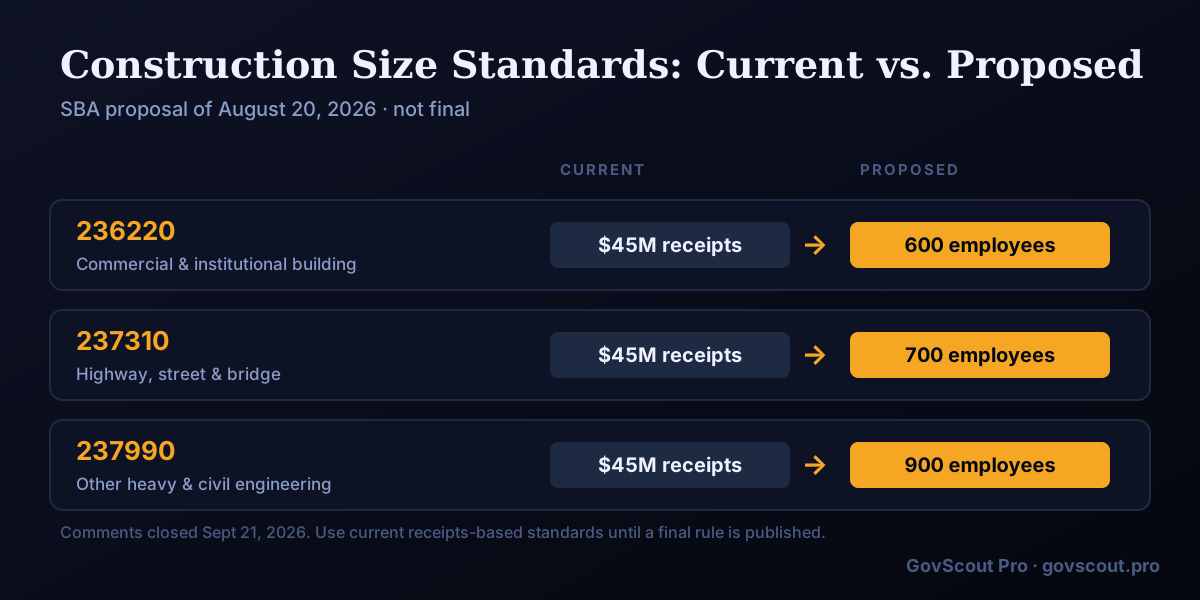
Today, most construction size standards are based on average annual receipts. On August 20, 2026, SBA proposed converting the entire construction sector to employee-based standards as part of a sweeping overhaul.
| NAICS | Industry | Current standard | Proposed (Aug 2026) |
|---|---|---|---|
| 236220 | Commercial and institutional building | $45 million receipts | 600 employees |
| 237310 | Highway, street, and bridge | $45 million receipts | 700 employees |
| 237990 | Other heavy and civil engineering | $45 million receipts | 900 employees |
What it would mean if finalized:
- No revenue cap. A general contractor with high revenue but a lean workforce, which is common in construction because so much work is subcontracted, could stay small far longer.
- More competition on set-asides. SBA estimates about 114,541 additional businesses would become small across all industries, including about 37,000 firms holding roughly $71 billion in FY2025 federal contracts. Some of those are experienced construction firms.
- Headcount planning matters. Self-performing contractors with large crews could find the employee count tighter than the receipts test.
Comments closed September 21, 2026. Until a final rule is published, use the current receipts-based standards in SBA's table of size standards.
Certifications That Win Federal Construction Work
- SDVOSB: VA sets aside most of its construction work for SDVOSBs and VOSBs under the Veterans First program. Certification through SBA's VetCert is required. The government-wide SDVOSB goal is now 5%.
- HUBZone: Popular with USACE and other construction buyers. HUBZone firms also get a 10% price evaluation preference against large businesses in full and open competition.
- 8(a): Sole-source construction awards up to $5.5 million for individually owned firms, plus competitive 8(a) projects.
- WOSB / EDWOSB: Eligible in certain construction NAICS codes. Check the current eligible-industries list.
2026-2027 Market Outlook
- A slow start to FY2027. The fiscal year began under a continuing resolution through December 11, 2026. New construction starts are often delayed until full-year appropriations pass. Use the first quarter to respond to sources-sought notices and attend industry days.
- Higher simplified thresholds. The simplified acquisition threshold is now $350,000, which pulls more small repair and alteration jobs into faster competitions.
- FAR overhaul. The Revolutionary FAR Overhaul is rewriting the FAR, including construction and small business parts. Proposed Part 19 keeps the small business Rule of Two. Watch for final rules during 2026-2027.
- Size standards. A final rule would reset who is small in every construction NAICS code.
A 90-Day Plan to Win Your First Federal Construction Contract
- Days 1-15: Register in SAM.gov with accurate NAICS codes, get your UEI, and confirm your size status. Apply for any certification you qualify for (VetCert, HUBZone, 8(a), WOSB).
- Days 1-30: Meet a surety bond producer. Get prequalified and learn your single-job and aggregate limits.
- Days 15-45: Build a one-page construction capability statement: trades, bonding capacity, safety record (EMR), licenses, and three best projects with photos.
- Days 15-60: Save SAM.gov searches by NAICS, PSC Y and Z, and set-aside. Register with USACE district and NAVFAC small business offices near you.
- Days 30-90: Bid two or three small repair and alteration jobs under $350,000. Price labor from the wage determination. Win, perform cleanly, and use it as past performance.
How to Price a Federal Construction Bid Without Losing Money
Federal construction pricing has a few line items commercial estimators often miss. Build them into your estimate template so they are never forgotten.
| Cost item | What to include |
|---|---|
| Labor | Wage rate plus fringe from the Davis-Bacon wage determination for each classification, not your normal rates. Apply it to subcontractor labor too. |
| Bonds | Bid, performance, and payment bond premiums. Ask your surety producer for your rate before you bid. |
| Payroll administration | Time to prepare weekly certified payrolls and collect them from every subcontractor. |
| Site and security requirements | Base access, badging, escort time, background checks, and restricted work hours on military installations. |
| Submittals and quality control | Many federal projects require a dedicated quality control manager, submittal registers, and specific testing. |
| Safety program | Federal safety requirements such as the USACE safety manual (EM 385-1-1) on Corps projects, with a written safety plan and site safety staff. |
| Cash flow | Monthly progress payments, possible retainage, and the time it takes to get paid. Price your financing cost. |
Read the whole solicitation, not just the drawings
Federal construction solicitations often run hundreds of pages. Special contract requirements, liquidated damages, phasing, and working hours sit in Sections C, H, and the specifications. Liquidated damages for late completion can wipe out the profit on a small job. Read them before you price, and ask questions during the question period if anything is unclear.
Five Reasons Small Contractors Lose Money on Their First Federal Job
- Pricing labor at commercial rates instead of the wage determination.
- Underestimating submittals and QC. Federal projects require more paperwork before and during work than most private jobs.
- Ignoring base access delays. Gate processing, escorts, and restricted hours slow crews down.
- Subcontracting too much. On a set-aside, paying non-similarly-situated subs more than the limit is a compliance problem, not just a margin problem.
- Running out of cash. Bonds, payroll, and materials go out before the first progress payment comes in. Line up working capital first.
Breaking In as a Subcontractor First
Many successful federal general contractors started as specialty subs on federal projects. It is a good way to learn the system with less risk.
- Find the primes. Search SAM.gov contract award data for construction awards in your region, then look at who keeps winning.
- Use their subcontracting plans. Large primes on construction contracts over $2 million must have small business subcontracting goals. Your certification helps them hit those goals.
- Get on bidder lists early. Primes build their sub teams before the prime bid is due. Contact them when a presolicitation notice appears, not after award.
- Learn certified payroll on someone else's project. By the time you prime your first job, the paperwork will not be new.
Frequently Asked Questions
How do I find federal construction projects?
Search SAM.gov Contract Opportunities using construction NAICS codes (236220, 237310, 237990, and 238 specialty trades), PSC codes beginning with Y and Z, and your set-aside type. Include Sources Sought and Presolicitation notices, and register with USACE and NAVFAC small business offices.
What bonds are required on federal construction contracts?
Miller Act performance and payment bonds are required on contracts over $150,000. Many solicitations also require a bid guarantee, typically 20% of the bid price, up to $3 million.
What is the Davis-Bacon threshold?
Federal construction contracts over $2,000 require prevailing wages and fringe benefits under the Davis-Bacon Act, with weekly certified payroll.
How much can a small construction prime subcontract on a set-aside?
No more than 85% of the amount paid to non-similarly-situated subcontractors for general construction, or 75% for special trade construction, excluding the cost of materials.
What is the size standard for NAICS 236220?
Currently $45 million in average annual receipts. SBA's August 2026 proposal would change it to 600 employees, but that is not final.
Related reading: the construction contracts guide, 2026-2027 federal contracting thresholds, SDVOSB teaming and joint ventures, and the HUBZone program guide.