Historically Underutilized Business Zone · Updated October 29, 2026
HUBZone Contracts: 10% Price Edge In Full & Open Competitions
HUBZone certification gives your business a 10% price evaluation preference against large businesses in full-and-open federal competitions, plus set-aside and sole-source access. This guide was rechecked against SBA, FAR and CFR sources on October 29, 2026, and GovScout Pro finds HUBZone opportunities in your NAICS codes every day.
252 new governor-designated covered areas. On October 22, 2026, SBA approved 18 governor petitions (SBA release 26-111). Thirty states now take part, and Indiana, Nevada and Hawaii are newly added. If your town was not on the map last year, check it again.
The map is not static. Qualified census tracts and non-metro counties update on a five-year cycle (next: July 2028), but redesignated, disaster and governor-designated areas change in between and some carry expiration dates.
Sole-source limits: $5.5 million ($8.5 million manufacturing) for awards made since October 1, 2025.
Rules unchanged: 35% residency, a principal office in a HUBZone, and recertification every three years.
The Map
Six Ways an Address Becomes a HUBZone
Your address qualifies through one of these area types on the SBA map. The type matters because some expire.
01
Qualified census tracts
Tracts designated by HUD for poverty and low household income. Five-year cycle, next update July 2028.
02
Qualified non-metropolitan counties
Non-metro counties that meet at least one socioeconomic test. Same five-year cycle.
03
Indian lands
Qualified land within Indian reservations or Indian Country.
04
Redesignated areas
Tracts or counties that lost qualification but stay qualified for three years after redesignation. They expire on a date shown on the map.
05
Qualified disaster areas
Areas covered by a presidentially declared major disaster or catastrophic incident. These can start and expire during the year.
06
Governor-designated covered areas
Rural areas a governor requests and SBA approves, generally outside urbanized areas with limited population and higher unemployment. Newest batch: 252 areas on October 22, 2026.
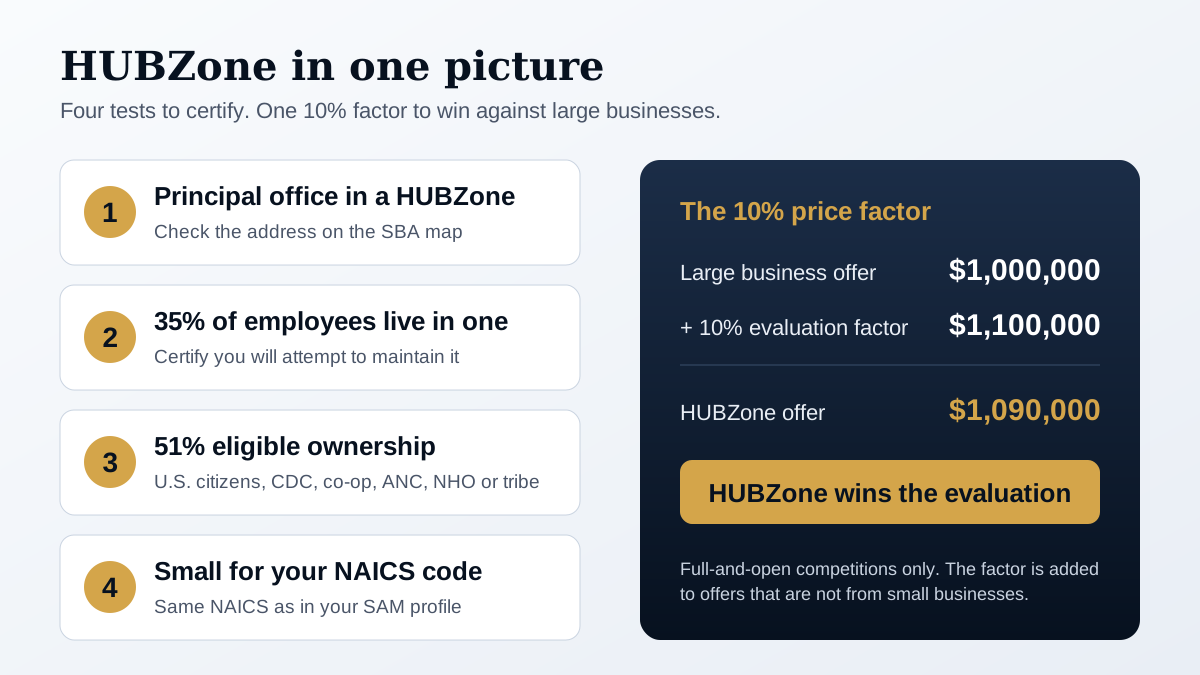
Four tests to certify, one 10% factor to win against large businesses.
What Is HUBZone?
Location-Based Contracting Advantage
The SBA's HUBZone (Historically Underutilized Business Zone) program steers federal contracting to small businesses in economically distressed communities. The government's goal is to award at least 3% of federal contract dollars to HUBZone-certified firms each year. If your principal office is in a qualified area and 35% of your employees live in one, you get these advantages:
10%
Price Preference
In full-and-open competitions, the contracting officer adds 10% to offers that are not from small businesses. A HUBZone firm can price above a large business and still win the evaluation. It does not help you against another small business.
Set-Asides
Exclusive Contracts
Agencies set aside contracts exclusively for HUBZone firms when two or more can compete at a fair market price. Sole-source awards are allowed up to $5.5 million ($8.5 million for manufacturing).
Eligibility
The 4 Requirements for HUBZone
You must meet all four to certify. After that you recertify every three years, and SBA can examine you without notice, so keep your records clean.
📍
LOCATION
Principal Office in HUBZone
Your principal office must be in a HUBZone. Shared offices and personal residences are excluded from the long-term-investment rule, and a purchase or 10-year-plus lease in a HUBZone can keep the office counted for up to 10 years (13 CFR 126.200).
👥
EMPLOYEES
35% Employee Residency
At least 35% of your employees must be HUBZone residents to certify, rounded to the nearest whole number. You then certify that you will attempt to maintain it. Up to four legacy employees can keep counting after they move.
🏛️
OWNERSHIP
51% U.S. Citizen Ownership
At least 51% must be owned and controlled by U.S. citizens, or by a Community Development Corporation, small agricultural cooperative, Alaska Native corporation, Native Hawaiian organization or Indian tribe.
📏
SIZE
Small Business Status
You, with your affiliates, must be small under the size standard for a NAICS code in your SAM profile. For a HUBZone contract you must be small under that contract's NAICS code.
How GovScout Pro Helps
Find HUBZone Contracts Daily
Both HUBZone set-asides and price-preference opportunities on SAM.gov — filtered by your NAICS codes and delivered before deadlines hit.
🎯
SET-ASIDES
HUBZone Set-Aside Filter
GovScout Pro scans SAM.gov for contracts set aside specifically for HUBZone firms in your NAICS codes. Get the list every morning.
💰
PRICE PREF
Full-and-Open Opportunities
Your 10% price preference applies to many full-and-open competitions too. GovScout Pro flags these so you can calculate whether your pricing wins with the preference applied.
🧠
AI
Marcus Hale Contract AI
Paste a solicitation link and ask Marcus to summarize requirements, identify incumbent contractors, or flag past performance needs — in plain English.
📬
ALERTS
Email + Telegram Daily Alerts
Opportunities land in your inbox or Telegram each morning. No SAM.gov login needed. Deadlines included. Reply to engage GovScout Pro's AI directly.
Field Notes
Five Things to Do Before You Bid
Print the map result. Save the SBA map result for your office and each counted employee, with the date. Areas that expire show an expiration date.
Count residents before you hire. One hire changes the percentage. With 10 employees you need 4 residents (35% rounds to 3.5, then 4).
Price the preference honestly. It only beats large businesses. If a small business is in the running, the 10% does not save you.
Look at set-asides first. A HUBZone set-aside limits the field to firms like yours, and that usually beats a full-and-open bid.
Team up if you are thin. HUBZone status is a selling point to larger primes who need small-business credit. See the prime contractor teaming guide.
Related Guides
Keep the HUBZone Path Practical
Use these guides to connect HUBZone status to real buyer lanes and faster decisions.
Use the SBA HUBZone Map at maps.certify.sba.gov/hubzone/map. Type the address, confirm the match, and read the status. Areas that are about to expire show an expiration date, so screenshot or print the result. Check your principal office and every employee address you plan to count.
Qualified census tracts and qualified non-metropolitan counties follow a five-year cycle, with the next update in July 2028. Redesignated areas, qualified disaster areas and governor-designated areas can start or expire at other times, so recheck the map before you certify, before you recertify and before you bid.
They are rural areas that a state governor petitions SBA to cover. On October 22, 2026, SBA approved 18 petitions that created 252 governor-designated covered areas. Thirty states now take part, and Indiana, Nevada and Hawaii are new to the list. Check the SBA map for your exact address because the designation is area by area.
At least 35% of your employees must be HUBZone residents when you apply. Under 13 CFR 126.200 you certify that you will attempt to maintain that level at each recertification, each offer and during performance. A firm performing a HUBZone contract that slips below 35% can still recertify if at least 20% of its employees live in a HUBZone and it documents real efforts to get back to 35%.
Sometimes. A legacy employee is someone who lived in a HUBZone for 180 days after your certification (or anniversary) and has been continuously employed. They can keep counting after they move. You can have up to four, and you still need at least one other HUBZone resident on payroll. Check 13 CFR 126.200 for the exclusions before you rely on this.
In a full-and-open competition, the contracting officer adds a 10% factor to offers that are not from small businesses. A HUBZone small business can then win while pricing above a large-business competitor. Example: a large business offers $1,000,000, which evaluates as $1,100,000, so a HUBZone offer of $1,090,000 wins. See FAR 19.1307 for the exceptions.
No. It applies only to full-and-open acquisitions where price is a factor. It does not apply to acquisitions where price is not a selection factor, such as architect-engineer work, to multiple award schedule contracts where all fair and reasonable offers are accepted, or to the reserved portion of a multiple-award solicitation. It also is not added against otherwise successful offers from small businesses.
For awards made since October 1, 2025, the HUBZone sole-source limit is $5.5 million, or $8.5 million for manufacturing. The contracting officer must still have a reasonable expectation that the price is fair and that the work cannot be set aside for two or more HUBZone firms, so sole source is the exception, not the default.
Apply through MySBA Certifications at certifications.sba.gov. Certification does not expire as long as you keep qualifying, but you must recertify every three years and tell SBA about any merger or acquisition. SBA can also conduct unannounced program examinations. SBA does not guarantee a decision date, so check your MySBA account for status.
Yes. HUBZone can stack with SDVOSB, WOSB and 8(a), which opens more set-aside lanes and makes you a stronger teaming partner. Each program has its own rules and its own limits, so read the certification page for each one.
Your HUBZone Advantage Needs the Right Opportunities
A 10% price preference is useless if you don't know which contracts to bid. GovScout Pro delivers daily HUBZone set-aside alerts for your NAICS codes so you can put that advantage to work.