Many small businesses treat Sources Sought notices like background noise. They wait for the full solicitation, assume the notice is just an agency formality, and only start reading seriously when the final package appears on SAM.gov. That is usually too late to learn the buyer, understand the likely contract shape, or decide whether the work belongs in your lane.
The better move is not to romanticize Sources Sought notices or pretend they guarantee an inside track. It is to use them as what the federal acquisition system says they are: part of market research and public notice. If you read them well, they help you see the buyer's early questions, the likely scope, the set-aside signal, and whether your company should respond, team, watch, or pass.
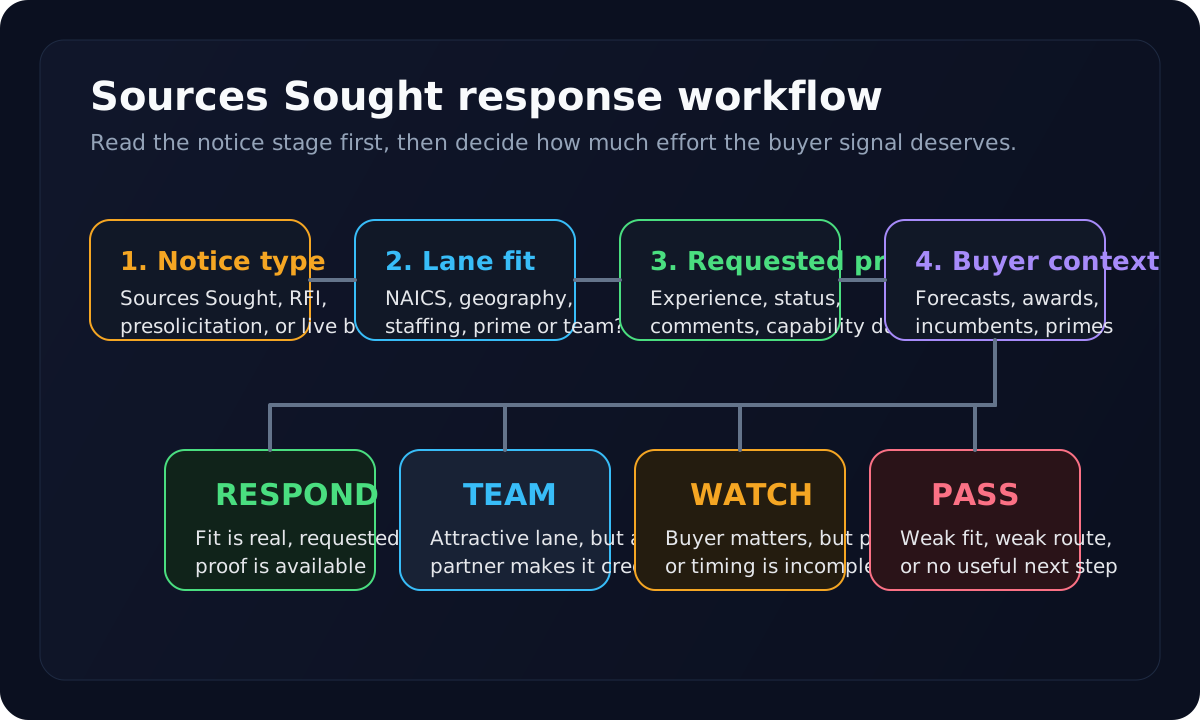
Start with the rule: this is market research, not a shortcut promise
FAR Part 10 says agencies conduct market research to determine what products, services, and sources are available and what acquisition approach makes sense. FAR Subpart 5.2 adds the public-notice layer: the governmentwide point of entry exists to improve small-business access to acquisition information and enhance competition. Together, those two sources explain why Sources Sought notices matter without turning them into mythology.
A Sources Sought notice usually tells you that the agency is still trying to understand the market. It may be checking whether qualified small businesses exist, whether a set-aside is realistic, whether commercial practices can meet the need, or whether the statement of work is pointed in the right direction. That does not mean the agency is promising a future award to anyone who replies. It means the buyer is still learning.
That distinction matters because bad advice usually swings to one extreme or the other. One camp says these notices do not matter. The other says the future winner is already decided here. Both frames are sloppy. The practical truth is narrower: a response can help a small business become visible earlier, but only when the work fits and the response actually answers the buyer's questions.
Identify the notice type before you spend any time
SAM.gov help documentation separates different contract-opportunity notice types, and that alone cleans up a lot of confusion. A Sources Sought notice is not the same thing as a solicitation. A request for information, presolicitation notice, special notice, or combined synopsis-solicitation each signals a different stage and a different expected response.
If you misread the notice type, you waste time doing the wrong work. Small businesses often download an early-market notice and treat it like an RFP. They start looking for a pricing template, evaluation factors, or a final statement of work that does not exist yet. The better question is simpler: what exactly is the agency asking from industry at this stage?
Usually the response instructions tell you the useful boundary. The notice may ask for a capabilities statement, a narrative on relevant experience, NAICS and socioeconomic status, comments on performance requirements, or confirmation that your firm can perform under a certain contract structure. Those instructions are the job. If the notice does not ask for a full proposal, do not send one.
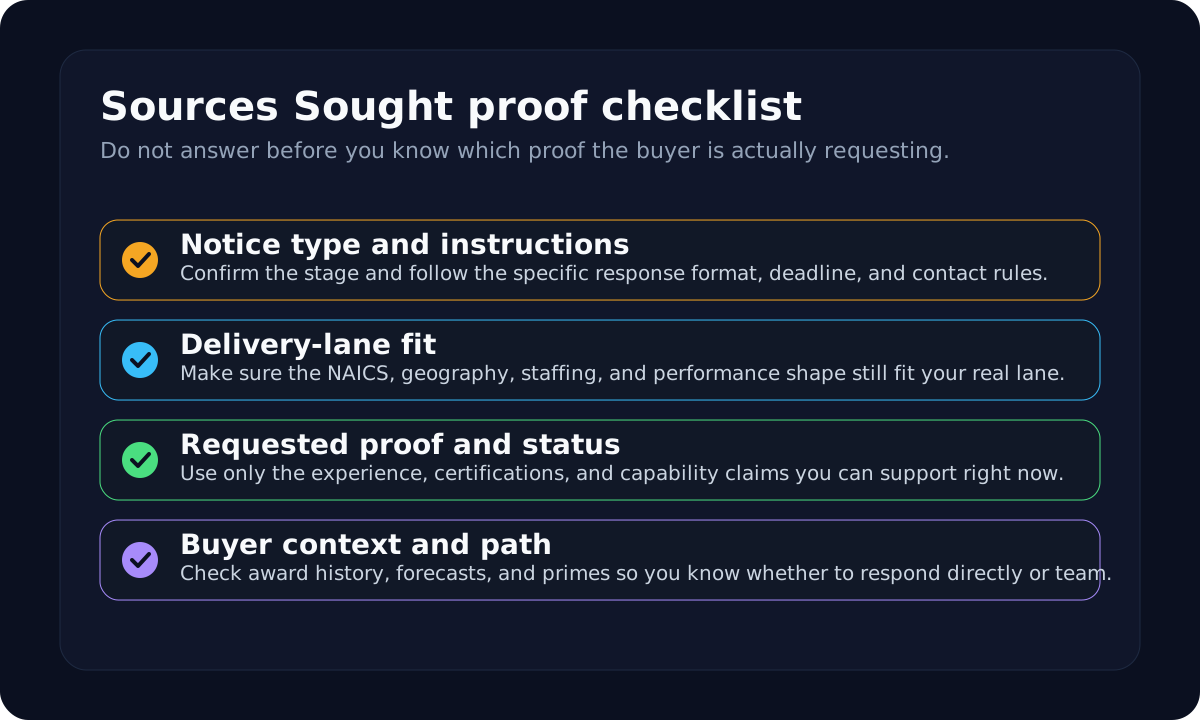
Match the notice to your lane before you answer anything
The right first screen is the same one used in a disciplined search workflow: does this notice actually belong in your lane? That means your current scope, your NAICS identity, your geography, your staffing reality, and your pursuit posture all have to make sense together.
A Sources Sought notice can look attractive because it is early. Early does not equal good. If the work would require capabilities you do not have, facilities you do not operate, clearances you cannot support, or a delivery footprint you cannot cover, the better call may be to watch or team rather than force a prime response.
This is also where the official small-business and certification surfaces matter. SBA's getting-started guidance and Small Business Search environment are relevant because they affect how agencies and primes discover firms. If the notice is checking for qualified small-business sources and your profile language, NAICS alignment, or certification posture is weak, the response alone will not fix the deeper issue. The notice may reveal the gap, but your business profile still has to support the story.
That makes Sources Sought useful for more than one immediate response. Sometimes the most valuable output is not the reply itself. It is the realization that your profile, teaming plan, or proof package needs work before you chase the full competition.
Answer the buyer's actual questions, not the speech you wanted to give
The strongest Sources Sought responses are disciplined. They do not try to sound grand. They show that the business read the request, understood the work, and can provide the specific information being requested. If the notice asks whether your company can perform as a prime under a given NAICS, answer that. If it asks for examples of similar work, provide scoped examples. If it asks for comments on the draft requirements, comment on the requirements.
Useful response elements commonly include:
- Business identity. Your legal name, SAM registration alignment, NAICS, and socioeconomic status if the notice requests them.
- Relevant proof. Brief examples of similar work, commercial or government, at the right scope and complexity.
- Performance posture. Whether you are responding as a likely prime, team member, or firm with partial capability.
- Requirement feedback. Specific comments on the draft scope, period of performance, labor, mobilization, or deliverability where the notice invites that feedback.
- Operational realism. Honest statements about what you can do now versus what would require a partner.
The goal is not to impress the contracting office with volume. The goal is to make it easier for the agency to classify you correctly. Agencies are trying to determine whether capable sources exist and how the requirement may need to be structured. A concise, relevant, evidence-based response helps them more than a generic marketing deck.
That is also why small businesses should be careful about invented certainty. Do not imply you are ready for prime performance if you only have part of the capability. Do not describe a certification you have not secured. Do not turn a capability statement into a claim sheet. Early-stage credibility is usually won by being clear, not by sounding bigger than you are.
Check the buyer history before you decide how much effort to invest
Official opportunity systems are only one part of the decision. USAspending describes itself as the official source for federal spending data, and that makes it the fastest place to sanity-check what the buyer has historically done. If a notice looks promising, ask whether the agency has actually bought work like this, at what size, and from what kind of firms.
Award history helps answer questions the notice alone cannot answer:
- Is this buyer regularly purchasing this scope or is the requirement unusual?
- Are small businesses already winning this lane, or are large integrators dominating it?
- Is the contract size consistent with your current operating capacity?
- Does the work often lead to subcontracting routes that are more realistic than a direct prime pursuit?
If the response is still likely worth doing, keep going. If the award history says the agency buys the work almost exclusively through large prime vehicles, the smarter path may be to answer the notice lightly, then shift some effort toward finding the incumbent or adjacent primes. SBA's subcontracting guidance and SUBNet both matter here because they give small businesses a governed route into subcontracting opportunities rather than waiting passively for a perfect prime bid.
The same logic applies to forecasts. GSA's Forecast of Contracting Opportunities tool exists to help small businesses prepare early, sometimes months before a solicitation appears on SAM.gov. If a Sources Sought notice lines up with a forecasted opportunity and buyer history, you are no longer looking at one isolated notice. You are seeing a repeatable lane.
Decide whether this is a respond, team, watch, or pass situation
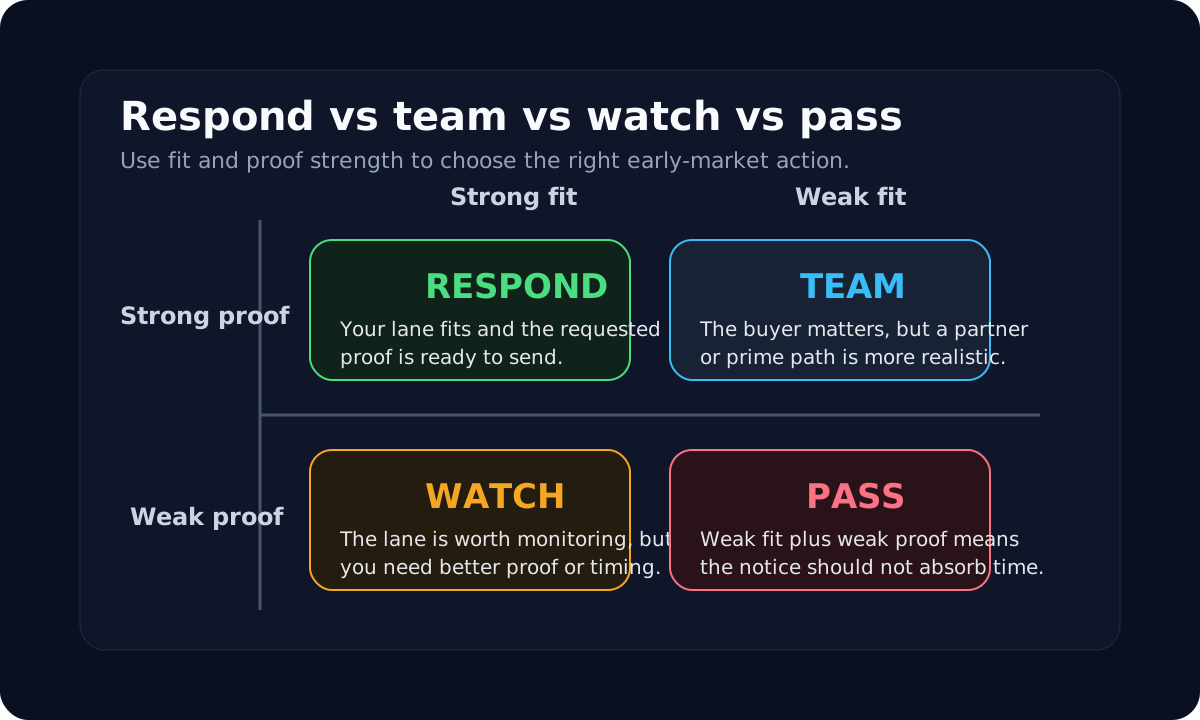
A Sources Sought notice should end in a decision, not in an archive folder. The four most useful outcomes are:
- Respond. The notice fits your lane, the requested proof is available, and a response helps position you for the likely follow-on work.
- Team. The notice is attractive, but a partner or prime relationship would make the pursuit more credible than a solo prime reply.
- Watch. The buyer or requirement matters, but your proof, timing, or profile is not strong enough yet. Keep monitoring the notice thread, forecasts, and related awards.
- Pass. The work does not fit your real lane, delivery constraints, or pursuit posture well enough to justify more effort.
That structure protects small businesses from two recurring mistakes: responding to every early notice because it feels proactive, and ignoring every early notice because it does not look like immediate revenue. Both waste time. The first creates noise. The second removes the chance to learn the buyer early.
What this looks like in the real world
Take a small IT and operations-support firm that serves utilities and public-sector infrastructure. A Sources Sought notice appears for monitoring support, data integration, and field-service coordination at a regional federal facility. The weak move is to fire off a generic capability statement because the words look familiar.
The disciplined move is different:
- Confirm that the notice is actually a Sources Sought or RFI and not a live solicitation.
- Check whether the requested NAICS, geography, and performance profile fit your current lane.
- Identify what proof the buyer is asking for: staffing, experience, transition capability, past projects, or teaming posture.
- Look at award history to see whether this work usually lands with regional specialists, large integrators, or incumbent facility operators.
- Decide whether your best path is a direct response, a team response, or a watchlist move while you strengthen proof.
That process is not glamorous, but it is how a company stops guessing. It also turns Sources Sought into something more useful than motivational lore. The notice becomes one evidence point inside a broader pursuit decision.
How Marcus should be used here
Marcus should not replace the official notice or invent a response strategy without facts. He should be used after you gather the notice text, your company proof, and the buyer context. The useful prompts are operational:
- "Turn this Sources Sought notice into a response checklist with the exact proof the agency is asking for."
- "Compare this notice against our current staffing, past performance, and geography, then tell me whether the honest move is respond, team, watch, or pass."
- "Draft a concise response outline that mirrors the notice instructions without overstating our readiness."
- "Use this notice, the buyer's award history, and our lane to suggest whether we should approach a prime instead of forcing a direct prime reply."
If you are not ready for Marcus, use the free Sources Sought Response Builder to organize the response and the Bid / No-Bid Scorecard to pressure-test whether the notice should lead to real pursuit work. That sequence is much stronger than answering from adrenaline.
What to monitor after the response
After publication, this page should be judged by measured search and product behavior, not by vibes. The refresh improves claim safety, source depth, internal linking, and conversion paths; Google recrawl, page-level ranking movement, and article-to-tool conversion impact still have to be measured after release.
Once the release path and evidence bundle are available, the right things to monitor are:
- Impressions and clicks for Sources Sought, pre-solicitation, and market-research query variants.
- Internal-link support from Federal Contract Opportunity Search, Become a Federal Prime Contractor, and the Federal Contracting for Small Businesses guide.
- Article-to-tool clicks into the Sources Sought Response Builder and SAM.gov Search Plan Builder.
- Whether the page stays indexed and claim-safe after release and recrawl.
That measurement discipline matters because this page is part of the broader pursuit-decision cluster. Its job is to help a reader move from early notice confusion into a concrete response, teaming, watch, or pass decision.
Bottom line
Sources Sought notices are useful because they expose buyer thinking early, not because they guarantee a contract. A small business that reads the notice type correctly, checks lane fit, answers the agency's real questions, verifies buyer history, and makes a disciplined respond/team/watch/pass decision will usually get more value from market-research notices than a company waiting for the final solicitation every time.
If you want one next step, do not start by writing a speech. Start by tightening one lane, one proof package, and one response checklist. Then use Sources Sought notices to learn where your effort belongs before the full competition arrives.