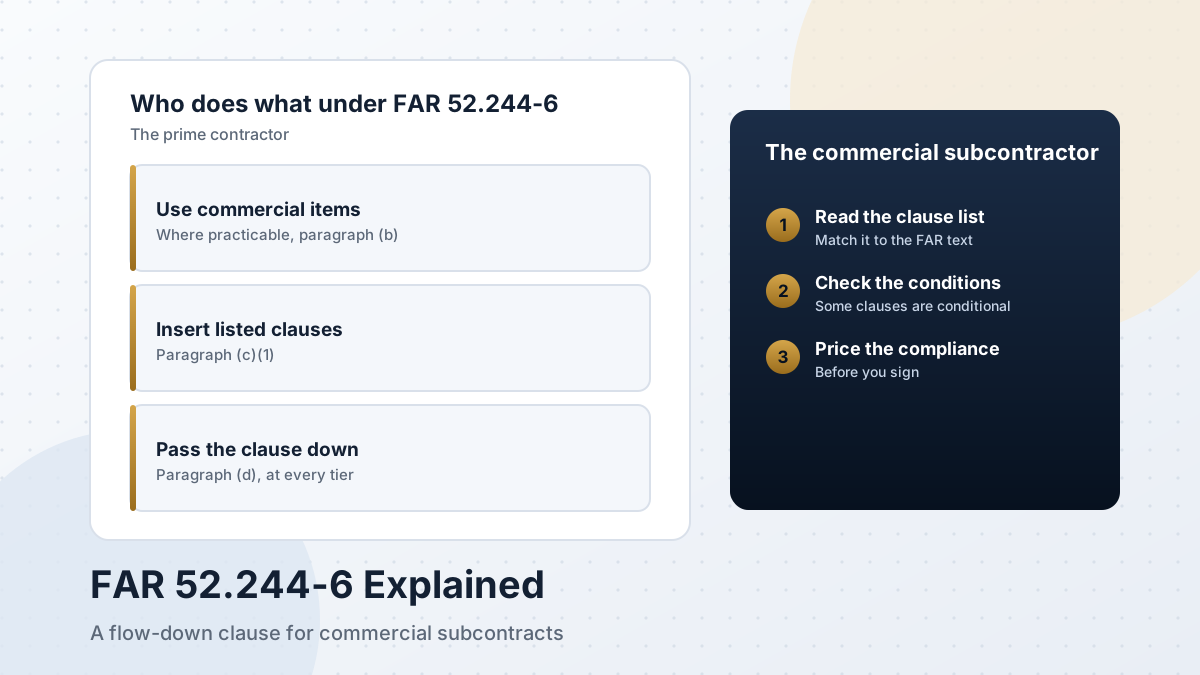
- FAR 52.244-6, Subcontracts for Commercial Products and Commercial Services, is a flow-down clause. It lists the clauses a prime must put into subcontracts for commercial products or services.
- FAR 44.403 prescribes it for solicitations and contracts that are not themselves for commercial products or services, so it shows up when a non-commercial prime buys commercial items from you.
- Paragraph (c)(1) is the list. Many entries are conditional, such as a dollar threshold or a rule inside the clause itself, so a long list in your subcontract does not mean every clause applies.
- Paragraph (c)(2) lets the prime add a small number of other clauses it needs to meet its own contract. Ask which ones.
- It is not the same as FAR 52.244-2 (consent to subcontract) or 52.244-5 (competition in subcontracting).
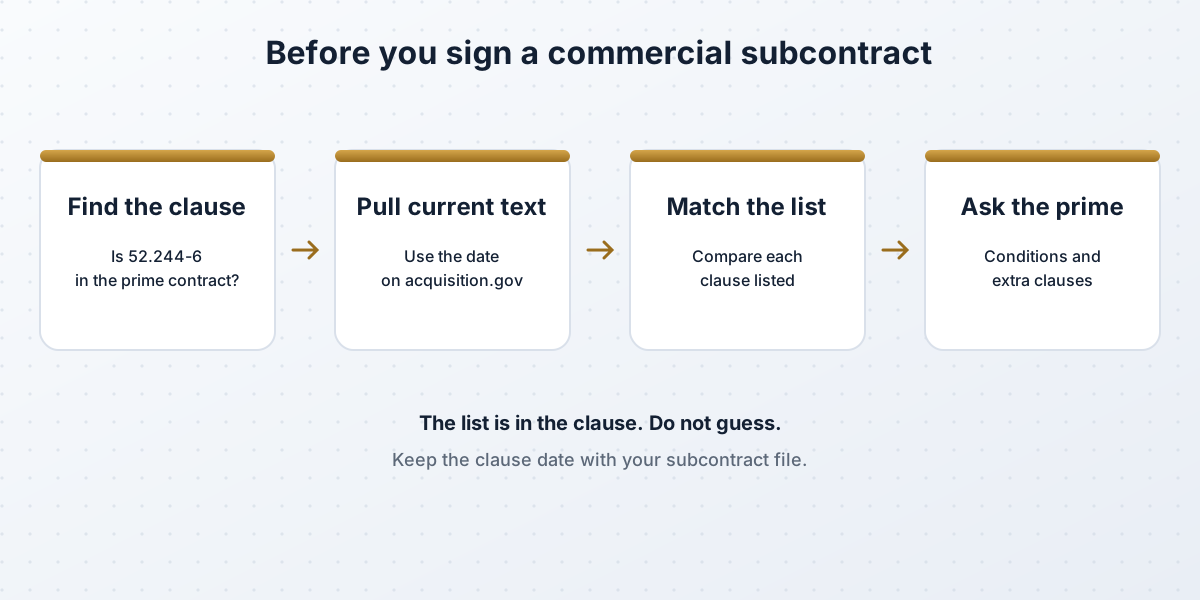
- Tip: save the clause date with your subcontract. The current text is dated October 2025, and the list changes as the FAR changes.
Short answer: FAR 52.244-6 is a checklist the prime has to pass down. It tells the prime which government clauses must appear in subcontracts for commercial products or services, and it tells the prime to put the clause itself into those subcontracts. If your prime sent you one, you are on the receiving end of that list.
What is FAR 52.244-6?
The clause is titled "Subcontracts for Commercial Products and Commercial Services." FAR 44.403 says the contracting officer puts it into solicitations and contracts for acquisitions that are not for commercial products or services. In other words, it mostly lives in prime contracts for non-commercial work where the prime buys commercial items or services from subcontractors. The current version is dated October 2025. Pull the text on acquisition.gov and use that, not a summary, for anything you sign.
If you are new to working under a prime, start with our subcontracting tips and teaming agreement basics, then come back to the clause.
What does each paragraph do?
| Paragraph | What it does |
|---|---|
| (a) Definitions | Commercial product, commercial service and commercially available off-the-shelf item take their FAR 2.101 meanings. A subcontract also covers transfers between divisions, subsidiaries or affiliates of the contractor or a subcontractor. |
| (b) Use commercial items | The contractor uses commercial products, commercial services or nondevelopmental items as components of what it supplies, to the maximum extent practicable, and requires subcontractors at all tiers to do the same. |
| (c)(1) The list | Clauses the contractor must insert in subcontracts for commercial products or services, many with conditions. |
| (c)(2) Extras | The contractor may add a minimal number of other clauses it needs to meet its own contract obligations, but is not required to. |
| (d) Pass it down | The contractor includes the terms of 52.244-6, including paragraph (d), in subcontracts awarded under the contract. |
Notice what is not in there. The clause does not create a subcontractor representation form, and it does not say the government holds the prime liable in any particular way. Those are things people assume. If your prime asks you to sign a certification, it comes from another clause or from the prime's own paper, so ask which one.
Which clauses does the prime have to flow down?
Paragraph (c)(1) lists about two dozen entries, and the list moves as the FAR changes. Here is a sample so you can see the pattern. Always check the live clause for the full set.
| Clause | Subject | Condition in the clause |
|---|---|---|
| 52.203-13 | Contractor Code of Business Ethics and Conduct | Subcontract above the FAR 3.1004(a) threshold at award with a performance period over 120 days |
| 52.204-21 | Basic Safeguarding of Covered Contractor Information Systems | Not for commercially available off-the-shelf items; only if 52.204-21(c) requires the flow-down |
| 52.204-23 | Kaspersky Lab covered entities prohibition | None stated |
| 52.204-25 | Certain telecommunications and video surveillance equipment prohibition | None stated |
| 52.219-8 | Utilization of Small Business Concerns | Applies if the subcontract offers further subcontracting opportunities, and non-small businesses above the FAR 19.702(a) threshold pass it on |
| 52.222-26 | Equal Opportunity | None stated |
| 52.222-50 | Combating Trafficking in Persons | None stated |
| 52.232-40 | Accelerated payments to small business subcontractors | Only if 52.232-40(c) requires the flow-down |
Where do people get this wrong?
- They assume every clause applies at every dollar value. Some do, some have a threshold, and some depend on a rule inside the clause itself.
- They confuse similar clause numbers. 52.204-23 is about Kaspersky Lab covered entities, not semiconductors. 52.222-50 is about trafficking in persons.
- They mix up the neighbors. FAR 52.244-2 is the "Subcontracts" clause about getting the contracting officer's consent in certain cases. FAR 52.244-5 is "Competition in Subcontracting." Neither is 52.244-6.
What should a subcontractor check before signing?
- Is the clause really in the prime contract? Ask the prime for the solicitation or contract number and read it.
- Does your subcontract list match the clause? Check each clause against the live text and its conditions. A prime that pastes the full list into every subcontract may be passing down duties that do not apply to you.
- Are there extras? Paragraph (c)(2) allows a minimal number of additional clauses. Anything extra becomes your obligation once you sign, so ask for the list.
- What does compliance cost you? Reporting, training and safeguarding duties take time. Price them into your quote. Our SDVOSB teaming guide covers who carries which risk.
- Are your registrations current? Keep your SAM.gov registration active so the prime can pay and report you.
What should a prime do?
Keep it plain. Insert paragraph (d) so the duty keeps flowing to lower tiers, use the live clause list for each subcontract, and write down the clause date you used. If a clause is conditional, note why it does or does not apply. When a contracting officer or auditor asks, the file should answer for you. For finding small and veteran-owned subs to team with, browse our federal contract guides by category, and use the NAICS Code Goldmine ($17) to match codes.
What changed for 2027?
- The clause is dated October 2025. That is the version current as of this writing, and the list has been updated over the years, so always check the date.
- The FAR overhaul is moving. Agencies apply it through class deviations, so cite the version your solicitation uses.
- New prohibitions keep landing in the list. Recent entries cover items like drone and covered-application restrictions, which is a good reason to avoid old templates.
Frequently Asked Questions
What is FAR 52.244-6?
It is the clause titled Subcontracts for Commercial Products and Commercial Services. It lists the clauses a prime contractor must insert in subcontracts for commercial products or services and tells the prime to include the clause itself in those subcontracts.
When does FAR 52.244-6 appear in a contract?
FAR 44.403 prescribes it for solicitations and contracts for acquisitions that are not for commercial products or services. Check your solicitation to see whether it is cited.
Does every listed clause apply to every subcontract?
No. Many entries in paragraph (c)(1) carry a condition, such as a dollar threshold or a rule inside the clause itself, so check each one against the live text.
Can the prime add other clauses?
Paragraph (c)(2) lets the contractor add a minimal number of additional clauses it needs to meet its own contract obligations, but it is not required to.
Is FAR 52.244-6 the same as 52.244-2 or 52.244-5?
No. 52.244-2 is the Subcontracts clause about consent to subcontract, and 52.244-5 is Competition in Subcontracting.
Where can I read the current clause?
On Acquisition.gov or Cornell Law School LII. Use the current dated text each time you issue or review a subcontract.