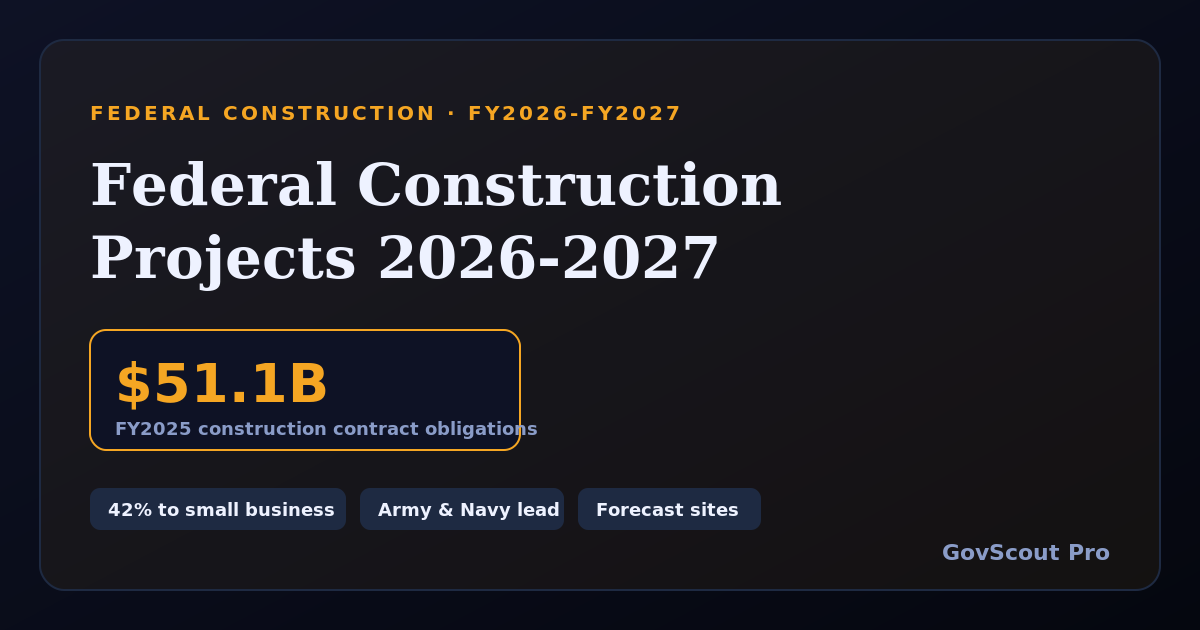
Here's the short version. In fiscal 2025 the federal government obligated about $51.1 billion on contracts under construction NAICS codes, and about $21.6 billion of that (42%) went to small businesses. The Army and Navy alone bought more than half of it. For 2026 and 2027, the money to watch is military construction, barracks, shipyards, and the Army Corps of Engineers.
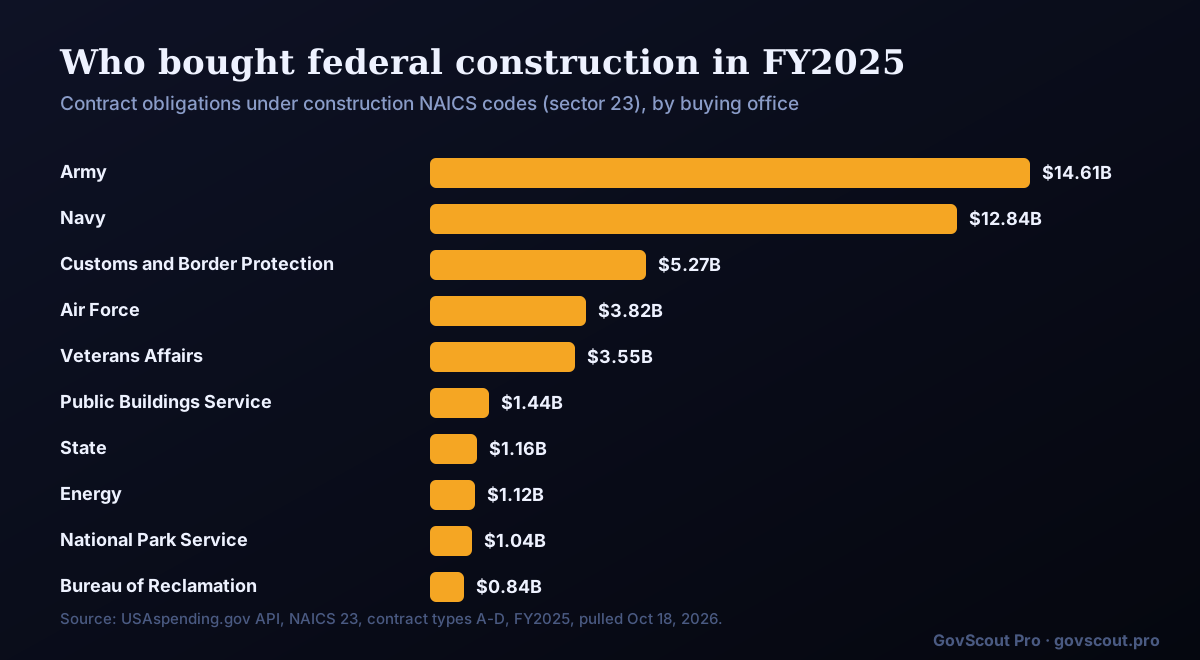
Who Bought Federal Construction in FY2025
We pulled FY2025 contract data from USAspending.gov for every contract under a construction NAICS code (sector 23).
| Department | FY2025 construction obligations |
|---|---|
| Department of Defense | $31.45B |
| Department of Homeland Security | $6.17B |
| Department of Veterans Affairs | $3.55B |
| Department of the Interior | $2.29B |
| General Services Administration | $1.47B |
| Department of Transportation | $1.33B |
| Department of State | $1.20B |
| Department of Energy | $1.12B |
The Army number is mostly the U.S. Army Corps of Engineers, which builds for the Army, the Air Force in many places, and civil works like locks, dams, and levees. If you only learn one buyer, learn your local Corps district.
The Budget Behind 2026-2027 Projects
| Program | Amount | Status |
|---|---|---|
| Military construction (MILCON), FY2026 | $19.7 billion enacted (plus $1.9 billion family housing) | Enacted November 2025 |
| Army Corps of Engineers civil works, FY2026 | $10.4 billion enacted, about 20% above FY2025; $3.2 billion in the construction account | Enacted January 2026 |
| VA major construction, FY2026 | $1.39 billion enacted, plus a planned $900 million from VA's transformational fund | Enacted |
| MILCON request, FY2027 | $26.8 billion requested, with $21.5 billion aimed at barracks | Not enacted; government on a continuing resolution through December 11, 2026 |
The continuing resolution matters for 2027 planning. It generally blocks new defense construction starts until Congress passes full-year bills, so many FY2027 projects will slide later into the year. Projects already funded in FY2026 keep moving.
Big Programs to Watch
- Navy shipyards (SIOP). GAO says the Shipyard Infrastructure Optimization Program will cost more than $200 billion and could run 50 years. The giant dry dock work goes to large primes, but the program also produces smaller jobs like an $8.6 million dry dock concrete repair at Portsmouth in 2025. Small firms win the repair work and the subcontracts.
- Barracks. The FY2027 request puts about $21.5 billion toward barracks across the services. Renovation work is a natural fit for small general contractors and trades.
- Corps of Engineers districts. Each district posts its own forecast. New England's 2026-2027 list alone runs about 30 projects from $100,000 to $750 million, with 11 marked for small business set-asides.
- Border infrastructure. Customs and Border Protection was the third-largest construction buyer in FY2025 at $5.3 billion.
Where Agencies Post Projects Before the RFP
| Buyer | Where to look |
|---|---|
| Many civilian agencies | GSA Acquisition Gateway forecast tool |
| Army Corps of Engineers | Each district's small business page (start at the USACE small business page) |
| Navy (NAVFAC) | NAVFAC long-range and MILCON forecasts |
| Air Force | Department of the Air Force forecast search |
| Veterans Affairs | VA Forecast of Contracting Opportunities, linked from VA Construction and Facilities Management |
| Homeland Security (incl. CBP) | DHS Acquisition Planning Forecast System |
| GSA Public Buildings Service | SAM.gov (PBS doesn't keep a separate construction forecast) |
The Rules Small Contractors Need to Know
- Size standard: $45 million in average annual receipts for general building and heavy civil, $19 million for most specialty trades. SBA has proposed switching construction to employee counts (for example, 600 employees for commercial building). Comments close November 20, 2026, and nothing changes until a final rule.
- Limitations on subcontracting: on a small business set-aside you can't pay more than 85% of the contract (75% for special trades) to subcontractors who aren't similarly situated, not counting materials.
- Bonds: Miller Act performance and payment bonds are required over $150,000.
- Wages: Davis-Bacon prevailing wages apply over $2,000.
- Bonding help: SBA's surety bond guarantee covers contracts up to $9 million, or $14 million on federal jobs when the contracting officer certifies it's needed.
Our federal construction rules guide covers each of these in depth.
Tips for Getting Your First Federal Construction Job
- Start at the small end. Jobs under $350,000 use simplified procedures and fewer bidders. They build the past performance the big jobs ask for.
- Pick one district or base and learn it cold. Go to the industry days. Meet the small business specialist. Read every forecast they post.
- Price Davis-Bacon wages from the wage determination in the solicitation, not from your normal commercial rates. Getting this wrong eats your whole margin.
- Line up bonding before you need it. A surety wants financials and a track record. Talk to one six months before you bid big.
- Sub to a prime on a MACC. Multiple-award construction contracts hand out task orders all year. Primes on them need reliable small subs.
- Read the specs, then the drawings, then the specs again. Most federal construction disputes start with something in Division 01 nobody read.
Frequently Asked Questions
How much does the federal government spend on construction?
About $51.1 billion in contract obligations under construction NAICS codes in fiscal 2025, based on USAspending.gov data.
How much federal construction goes to small businesses?
About $21.6 billion, or 42%, of FY2025 construction contract obligations went to small businesses.
Where can I find upcoming federal construction projects?
Check agency forecasts first: the GSA Acquisition Gateway forecast tool, your local Army Corps of Engineers district, NAVFAC, the Air Force forecast site, the VA forecast, and the DHS planning system. Then watch SAM.gov for the actual notices.
Which agency spends the most on construction?
The Army, mostly through the Army Corps of Engineers, with about $14.6 billion in FY2025, followed by the Navy at about $12.8 billion.