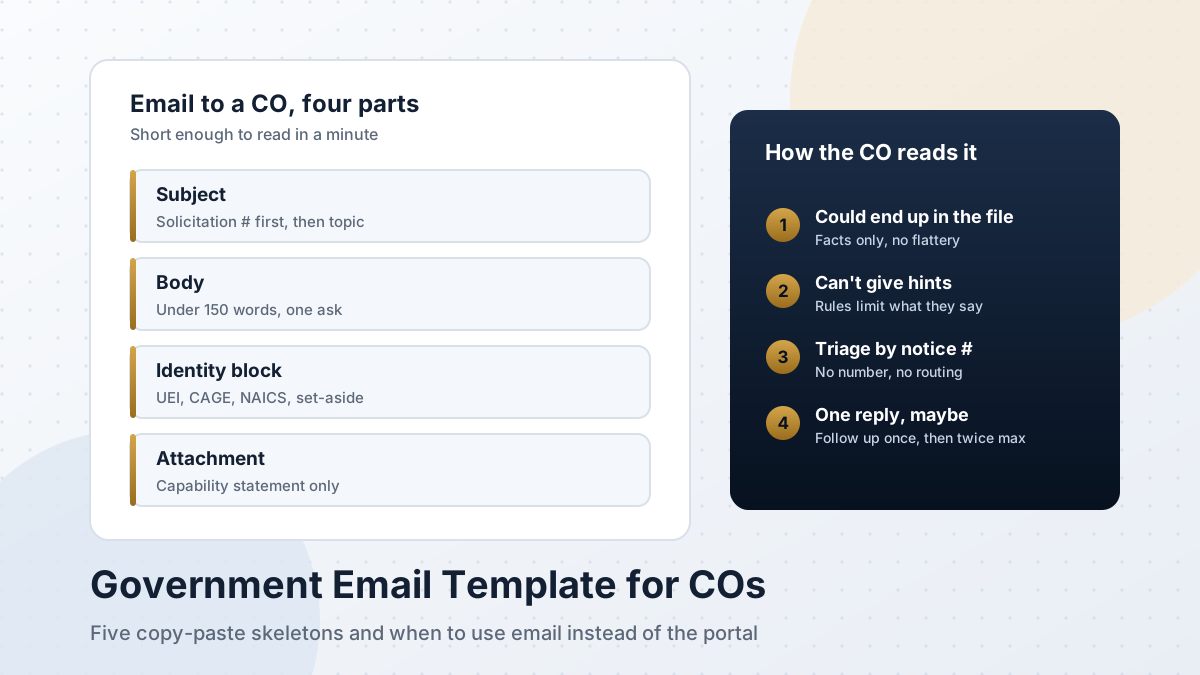
- Every email to a contracting officer needs a subject line with the solicitation number and a signature block with UEI, CAGE code, NAICS and set-aside status.
- Ask exactly one thing per email. Multiple asks get deferred, and deferred emails get deleted.
- Assume every email can enter the procurement record and be reviewed in a protest. State facts and skip flattery or speculation.
- Follow up once after seven business days on the same thread, and stop after two follow-ups.
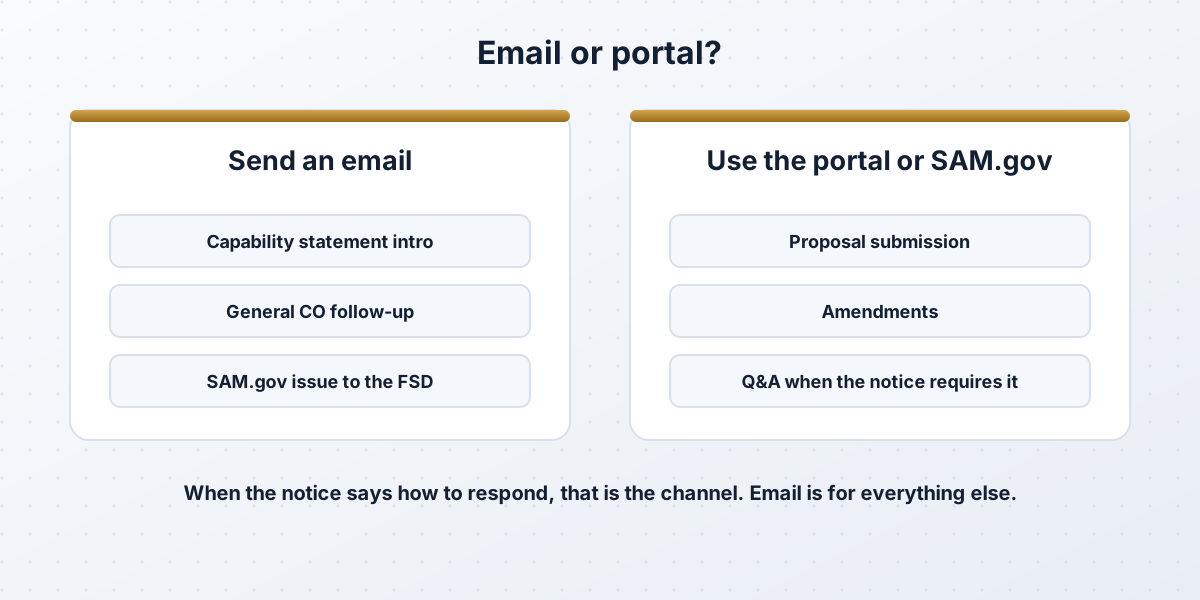
- Use the portal for formal actions like proposals and portal-required Q&A. Use email for outreach and informal clarification.
- Tip: save your four-line identity block as a text snippet in your email app, so it goes on every message without retyping, and keep a one-line log of every send so you never follow up twice by accident.
A government email template exists because federal correspondence follows rules a normal sales email ignores. This guide covers five situations in the order most small businesses hit them, with a skeleton you can paste for each, a note on why every line is there, and a plain answer on when email is the wrong tool.
What makes a government email different from a regular business email?
Everything you write can end up in the contract file, and the contracting officer (CO) is constrained in how they can talk to you. That changes how you write.
The record rule: assume it ends up in a file
Emails to a CO can become part of the procurement record and may be reviewed in a protest. Write as if a lawyer will read it later: state facts, skip flattery, and never speculate about competitors or pricing.
Why COs cannot chat casually with vendors
FAR 1.602 defines a contracting officer's authority and responsibilities, and FAR 15.201 says exchanges with industry have to stay consistent with procurement integrity rules. It also says that once a solicitation is out, the CO is the main point of contact, and that specifics shared with one potential offeror have to be made available to the rest. That is why a CO will not drop informal hints mid-solicitation. Match their formality. For more fill-in-the-blank skeletons, see our free templates.
What must every email to a contracting officer include?
Contracting officers read fast and delete faster. Every email you send needs the same core elements so they can identify you, place you and act on your ask in under a minute.
Subject line format that gets opened
Lead with the solicitation number if one exists, then the topic, for example "Solicitation W912XX-27-R-0001 – Question re: Past Performance Requirement." (That number is a made-up example of the format.) For cold outreach, use "[Company] – SDVOSB, NAICS 541611 – Capability Overview." A CO should never have to open an email to figure out what it is about.
The identity block: UEI, CAGE, NAICS, certifications
Put a four-line block at the bottom of every email: UEI, CAGE code, primary NAICS and set-aside status, for example "SDVOSB, verified in VetCert." This is how a CO confirms you are registered and eligible without leaving their inbox. If you are unsure which NAICS codes fit your firm, the NAICS code lookup narrows it down before you hit send, and the NAICS Code Goldmine ($17) lists the codes that pay.
One email, one ask
Ask exactly one thing: a question, a meeting or a review of your capability statement. Multiple asks get deferred, and deferred gets deleted. If you are working from a draft solicitation and unsure whether it is worth your week, run it through the bid/no-bid scorecard first, so your single ask is a sharp one.
How do you email a contracting officer for the first time?
Use this when a sources sought notice or draft solicitation names a CO and you fit the work. Check the notice first: if it says to respond through SAM.gov or to a specific mailbox, do that. An email to the CO does not replace the response the notice asks for.
Why each line exists
The subject line leads with the solicitation number because contracting officers triage hundreds of messages and file by notice. Stating certification, UEI and CAGE code up front lets the CO verify you in SAM.gov without a follow-up exchange. Naming the NAICS code shows you read the notice and understand how the agency buys this work.
Keep the body under 150 words and attach nothing but the capability statement. If you are unsure whether your email reached a live mailbox, check the contact details on the notice itself. Once you have sent outreach on a notice, log it against the opportunity. Our outreach email builder does the same job for primes, and the sources sought guide shows how those early notices work.
What should a capability statement email actually say?
A capability statement email has one job: make it easy for the CO to decide whether to open the attachment. Keep the body under 120 words, name the NAICS code and set-aside you fit, and cite one or two past performance items that match the agency's mission. The ask is a specific next step, not "let's connect." If your statement is not tight yet, start with our capability statement section guide.
What to cut (and why it hurts you)
Cut company history, mission statements and lists of every service you have ever offered. COs triage dozens of vendor emails a week, and a long body signals you do not understand their time. Cut "checking in" language too. If you are pitching into a market like cloud contracts, tie the ask to a real requirement area. A generic blast to every CO you can find gets ignored, and repeated identical sends can get your domain flagged. Send one tailored email per agency contact.
How do you submit a question during a solicitation Q&A period by email?
Only submit a question if the solicitation says email is accepted. Many agencies require questions through the procurement portal, and an emailed question sent to the wrong channel gets ignored. Check the Q&A deadline in the solicitation and send at least two business days before it.
One question per email. No pricing, no strategy, no "if we assumed a fixed-price structure, would..." framing. Ask what the requirement means, not how you would bid it. If you are new to a code like HVAC, the HVAC contracts guide shows what typical solicitations ask.
Why your question becomes public
The contracting officer posts answers to all vendors, stripped of the asker's identity. Everything you write may be read by competitors, so never reveal your pricing approach, teaming plans or past performance concerns in a question.
How do you follow up with a contracting officer who has not responded?
A missing reply often means the CO is busy, not ignoring you. Many questions get answered through public Q&A posts or amendments rather than individual replies, because agencies share answers with all interested vendors. Wait before chasing.
Reply on the original thread so the history stays attached. No new subject line, no cc'ing supervisors.
When to stop following up
Two follow-ups is the ceiling. After that, move on and watch SAM.gov for the next opportunity.
How do you report a SAM.gov registration problem by email?
SAM.gov support runs through the Federal Service Desk (FSD), and most first replies ask for details you could have included up front. Put them in the first email and you skip a round trip.
Details that speed up resolution
Attach screenshots showing the error message, the page URL and the timestamp in the corner. Reference any FSD ticket number from prior contact. State whether you are mid-renewal, expired or blocked from submitting an offer, because urgency affects routing. One issue per email; a second problem gets its own message.
When should you use email versus SAM.gov or the procurement portal?
Use the portal for anything formal: proposals, amendments and Q&A submissions when the solicitation requires them. Email is for relationship-building and informal clarification, like asking whether a sources sought notice fits your NAICS code.
| Situation | Use |
|---|---|
| Proposal submission | Portal, always |
| Solicitation amendments | Portal or SAM.gov |
| Q&A (when the notice requires the portal) | Portal |
| Capability statement intro | |
| CO follow-up on a general question | |
| SAM.gov registration issue | Email the FSD, or use the SAM.gov help desk |
Emailing a capability statement only works if the statement itself holds up. Our capability statement guide covers what it should contain, so your email has something credible to attach.
What email mistakes hurt your credibility with agencies?
- ['No solicitation number. COs manage dozens of active solicitations. Put the number in your subject line and first sentence, or your email gets filed under "can\'t route."', 'Attachment with no body text. Some agencies filter unsolicited attachments, and no CO wants a mystery file. Write two sentences in the email itself, then attach.', 'Asking the CO to bend the rules. Requests like "can you share the winning price?" or "can you extend the deadline just for me?" mark you as someone who does not understand FAR-based procurement. Ask through the official Q&A process instead.', 'Sloppy signature. A missing CAGE code or UEI forces the CO to look you up. Include business name, UEI, CAGE, certification (for example SDVOSB), phone and email.', 'Mass-blasting capability statements. COs recognize copy-paste blasts. Reference the specific agency mission or solicitation, or skip the send.']
What changed for 2027?
The templates do not change, but the ground under them moved in 2026. Three things are worth knowing before you hit send.
- ['Your SAM.gov record has to match your signature. SAM.gov modernized its representations and certifications on March 24, 2026, and FPDS and eSRS were folded into SAM.gov. If a CO checks your UEI and CAGE, the name, NAICS codes and business types in the record should agree with what you wrote.', 'The FAR rewrite is touching Part 15. On September 18, 2026 the FAR Council issued a second round of overhaul proposed rules that includes Part 15 (FAR Case 2026-003), with comments due October 19. As proposed, the early-exchanges-with-industry language moves out of 15.201 into the acquisition planning rules in Part 7, and "discussions" becomes "negotiations." These were proposals when we checked, and acquisition.gov still showed 15.201 in effect, so the habits in this guide still apply. Recheck once the rules are final.', 'Check your certification dates. If your set-aside status in the signature block is SDVOSB, make sure your SBA VetCert approval is current before you cite it. A lapsed status in a signature is worse than none.']
Frequently Asked Questions
Can I send the same capability statement email to multiple contracting officers at once?
No. Mass-blasting the same message gets recognized and ignored, and repeated identical sends can get your domain flagged as spam. Tailor each email to one contact, referencing that agency's mission or a specific solicitation, and keep the body under 120 words. One tailored email per agency contact beats a generic blast to every CO you can find.
What do I do if a contracting officer tells me to stop contacting them?
Stop immediately and confirm in writing that you will. A CO's communication is constrained by procurement rules, so pushing further damages your standing and can mark you in the contract file. Log the interaction, then watch SAM.gov for future notices and route any genuine solicitation questions through the official Q&A process instead of direct email.
Should I CC my teammates or prime contractor partner on emails to a CO?
Avoid it. Everything you send can become part of the procurement record and may be reviewed in a protest, so keep correspondence tight and controlled. If a partner's details are relevant, summarize them in your identity block or body text. CCing supervisors or extra parties on follow-ups signals pressure and tends to slow the response you want.
How long should I wait before assuming a solicitation question will not get answered?
Wait at least seven business days, then send one follow-up on the same thread, replying to your original email. Many questions get answered publicly through Q&A posts or amendments rather than individual replies. Two follow-ups is the ceiling. After that, stop chasing and monitor SAM.gov for the next opportunity.
Do I need a government email address to do business with federal agencies?
No. You use your normal business email for outreach, capability statements and follow-ups, provided every message carries your UEI, CAGE code, NAICS and set-aside status. Formal actions like proposals and portal-required Q&A submissions happen through the procurement system, not email. SAM.gov support runs through the Federal Service Desk using your existing contact email.
Does emailing the contracting officer count as responding to a sources sought notice?
No. A sources sought or RFI response has to go the way the notice says, usually through SAM.gov or to a named mailbox by the deadline. An email to the CO is a courtesy on top of that, not a substitute. If you only email and skip the required response, the agency may never count you in its market research.
Can I email a contracting officer after a solicitation is released?
Only for what the notice allows. Once a solicitation is out, the CO is the main point of contact, but questions usually have to follow the Q&A process and deadline in the solicitation, and the answers go to everyone. Keep relationship-building emails for the time before a solicitation or after award.