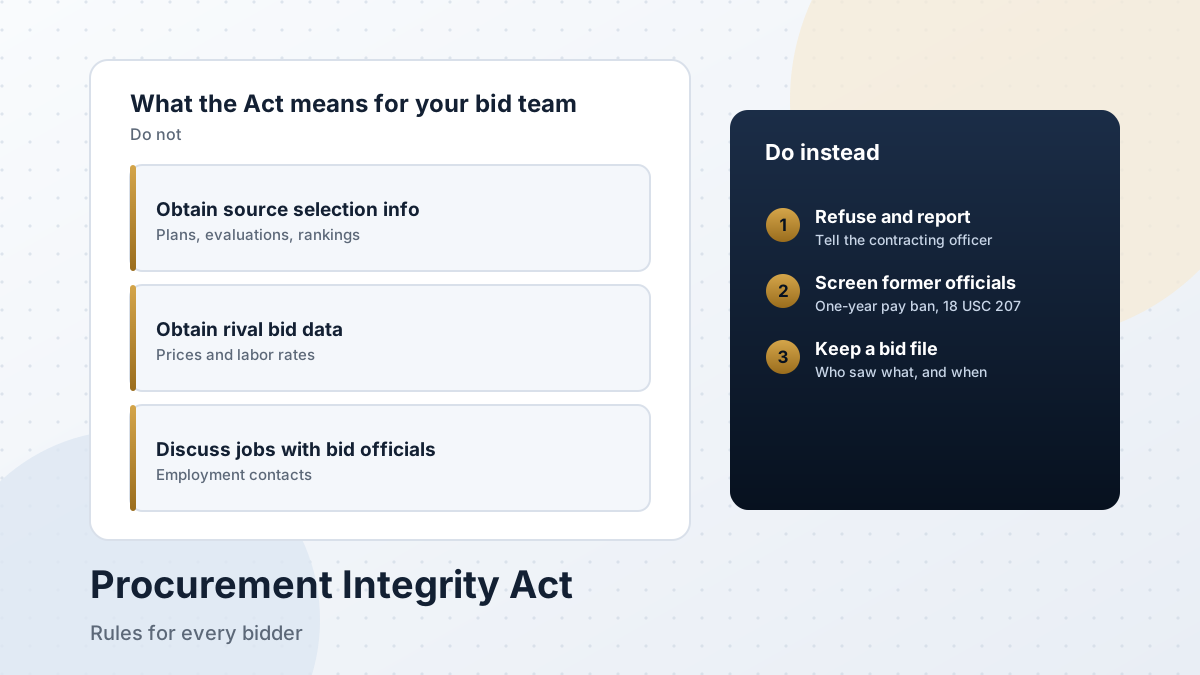
- The Procurement Integrity Act is 41 U.S.C. chapter 21 (sections 2101 to 2107). FAR 3.104 puts it into the regulations. There is no size exemption.
- Nobody may knowingly obtain contractor bid or proposal information or source selection information before award. That includes you, and it includes a subcontractor or consultant on your team.
- The only post-employment rule inside the Act is a one-year compensation ban for certain officials on contracts above $10 million. The lifetime and two-year bars people quote come from a different law, 18 U.S.C. 207.
- Penalties are real: up to 5 years in prison for the criminal offense, civil penalties per violation, cancelled awards, rescinded contracts and debarment.
- Organizational conflicts of interest are a separate topic under FAR subpart 9.5, not part of the Act.
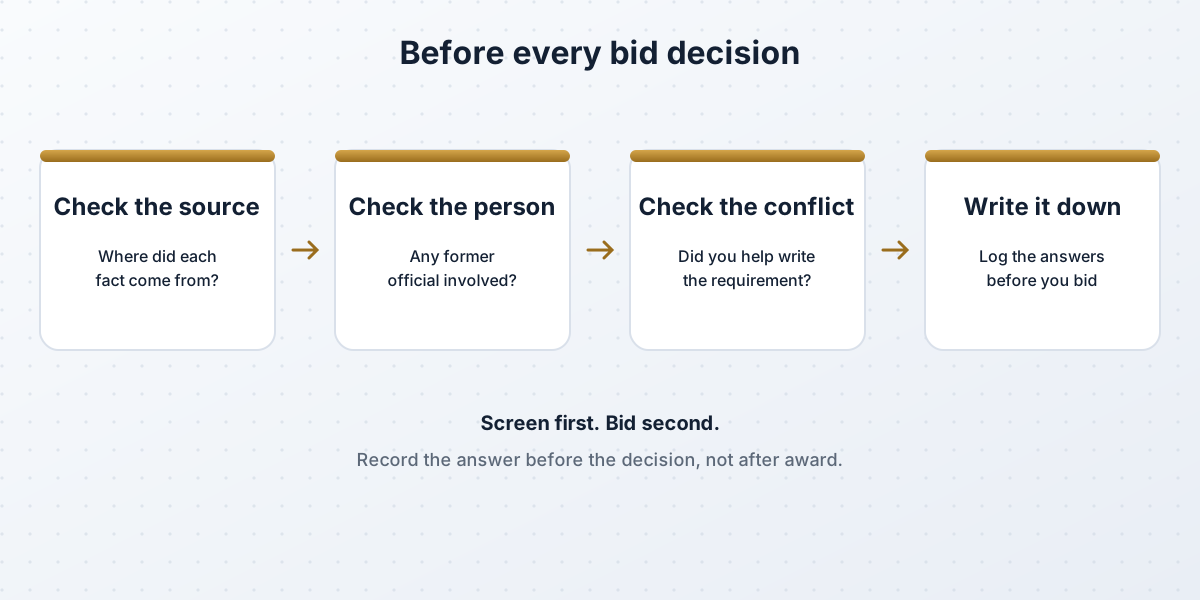
- Tip: run a four-question screen (source, person, conflict, record) before every bid or no-bid decision and keep the answers in the bid file.
Short answer: the Procurement Integrity Act (PIA) says you cannot knowingly obtain a competitor's proposal data or the government's source selection information before award, it limits what officials can do about jobs while a bid is live, and it puts a one-year compensation ban on certain former officials. Break it and you can lose the award, the contract or your ability to bid. You do not need a lawyer to follow the basics, but you do need a habit.
What is the Procurement Integrity Act and who does it cover?
The Act is codified at 41 U.S.C. 2101 to 2107 and implemented in FAR 3.104. Its core prohibitions apply to "a person," not just to large primes. A one-person SDVOSB is covered the same way a major contractor is. Nothing in the statute sets a company size or dollar threshold for the basic ban on obtaining protected information.
Two definitions matter. Contractor bid or proposal information means things like cost or pricing data, indirect costs and direct labor rates, and information a company properly marked as proprietary, if it has not been made public. Source selection information means things prepared for the agency to evaluate bids, such as bid prices before opening, proposed prices, source selection plans, technical evaluation plans, evaluations, competitive range determinations and rankings, again if not public.
One nuance people miss: the statute defines a "Federal agency procurement" as a competitive acquisition that ends in a contract using appropriated funds. Do not read that as a loophole. Treat any live procurement as covered and you will never be wrong.
What does the Act prohibit?
Disclosing information (section 2102(a))
Current and former officials, and people who advise the government on a procurement, may not knowingly disclose bid or proposal information or source selection information before award. This one is aimed at the government side, but it matters to you because you are the other half of the transaction.
Obtaining information (section 2102(b))
This is the one that catches bidders. Nobody may knowingly obtain contractor bid or proposal information or source selection information before award of the contract it relates to. The word "knowingly" matters, but you cannot rely on it if you ask for the material or keep reading after you realize what it is. If someone offers you a rival's pricing or the evaluation plan, say no, and do not forward it around the office.
Employment contacts (section 2103)
An agency official who is personally and substantially involved in a procurement above the simplified acquisition threshold must report in writing if they contact, or are contacted by, an offeror about a job. They must then either reject the idea or step away from the procurement. The offeror is on the hook too: a bidder that keeps having job talks with an official, knowing the official has not followed these steps, can face the Act's penalties.
For you, that means one rule. If an official working on your bid raises a job, do not run with it. Do not recruit people off your own evaluation panel.
One-year compensation ban (section 2104)
A former official may not accept compensation from a contractor as an employee, officer, director or consultant for one year after certain roles or decisions. The roles are: procuring contracting officer, source selection authority, member of the source selection evaluation board or chief of a financial or technical evaluation team on a contract above $10 million awarded to that contractor; program manager, deputy program manager or administrative contracting officer on a contract above $10 million; or personally deciding to award, set rates for, pay or settle a claim worth more than $10 million with that contractor.
There is an exception for a division or affiliate that does not produce the same or similar products or services as the part of the company responsible for the contract. And the Act requires an advice process so a former official can ask the agency ethics official whether the ban applies. FAR 3.104-6 provides it.
How does FAR 3.104 put it into practice?
FAR 3.104 mirrors the statute and adds the process. Three pieces are worth knowing:
- Reports of possible violations. Under FAR 3.104-7 the contracting officer decides whether a reported violation affects the award and sends it up to the head of the contracting activity, who can investigate, refer it for criminal review, disqualify an offeror, cancel the procurement or direct other action.
- Clauses. FAR 3.104-9 says to insert 52.203-8 (Cancellation, Rescission, and Recovery of Funds for Illegal or Improper Activity) and 52.203-10 (Price or Fee Adjustment for Illegal or Improper Activity) in solicitations and contracts above the simplified acquisition threshold, other than those for commercial products or services.
- Related laws. FAR 3.104-2 reminds officials that bribes and gratuities, job-seeking conflicts and post-employment restrictions sit in other statutes and rules.
A correction while we are here: gratuities (FAR 52.203-3) are a separate topic from the Act, and 52.203-18 is a representation about internal confidentiality agreements, not about telecommunications equipment. Do not call either a "PIA clause."
What are the penalties for violating the Procurement Integrity Act?
| Track | What the statute says |
|---|---|
| Criminal (2105(a)) | Violating section 2102 to exchange the information for anything of value, or to obtain or give a competitive advantage in a contract award, carries a fine under title 18, up to 5 years in prison, or both. |
| Civil (2105(b)) | The Attorney General can sue. Up to $50,000 per violation for an individual and $500,000 per violation for an organization, plus twice the compensation received or offered. These figures are adjusted for inflation. The Justice Department's July 2025 table lists $131,308 and $1,313,069; check 28 CFR 85.5 for the current numbers. |
| Administrative (2105(c)) | The agency can cancel the procurement before award, rescind a contract, start suspension or debarment, or take personnel action against its own employee. If a contract is rescinded the government can recover the amount spent under it. |
The Act also says that conduct constituting an offense under sections 2102 to 2104 affects present responsibility in a suspension or debarment proceeding. For a small firm, the practical risk is not a courtroom. It is losing the award and being shut out of bidding.
What about former government employees on your team?
Two different laws get mixed together here, and that is where most online guides go wrong.
- The Procurement Integrity Act sets the one-year compensation ban described above. It limits who can take a paycheck from the contractor.
- 18 U.S.C. 207 limits what former employees may do on your behalf. There is a permanent bar on representing someone to the government on a specific matter they personally and substantially worked on, and a two-year bar for matters that were under their official responsibility in their last year. Senior employees also face a one-year bar on contacting their former agency. These rules are about communications and appearances meant to influence the government, so a former employee generally is not barred from helping behind the scenes, though your counsel should check the specifics.
Where do organizational conflicts of interest fit?
They do not fit in the Act at all. Organizational conflicts of interest are handled under FAR subpart 9.5, which groups them into unequal access to information, biased ground rules and impaired objectivity. If you helped write the requirement you are bidding on, or saw another company's proprietary data on earlier work, raise it with the contracting officer early. Do not bury it.
This matters for small teams because a micro-firm often wears many hats: consultant on one contract, bidder on the next. Keep a list of every active federal job and what you had access to.
What is a practical compliance checklist for a small bid team?
| When | What to do | Why |
|---|---|---|
| Before bidding | Brief everyone who touches a bid, including subs and consultants, on what you cannot obtain or ask for. | Section 2102(b) applies to a person, not only to employees. |
| Before bidding | Screen new hires and consultants who left government in the last year. | Section 2104 and 18 U.S.C. 207 both come into play. |
| During the bid | Keep one access log: who saw which solicitation documents and when. | If anything is questioned, the log answers for you. |
| During the bid | If anyone offers inside information or a job conversation, decline and tell the contracting officer. | The contracting officer must assess any possible violation under FAR 3.104-7. |
| Before submitting | Mark proprietary data carefully and tie markings to protected categories. | Marking is how proposal information stays protected. |
| After award | Re-screen hires and keep training and screening records with the contract file. | Rescission can reach an awarded contract. |
Our go/no-go decision guide pairs well with this. Add the four-question screen as a gate. If the answer to any question is "I am not sure," treat that as a pass until you know.
How does this fit your bid decision?
Run the screen before every bid or no-bid call. Ask: where did each fact in my capture file come from? Is a former official involved? Did I help shape the requirement? Is it all written down? Keeping a clean file also helps in sources sought conversations and in teaming agreements, where partners may bring information you should not have. A sources sought response is market research, not a bid, but the ban on knowingly obtaining protected information applies to anyone, so build the habit early. If you also want a clean first impression, tighten your capability statement and use the NAICS Code Goldmine ($17) to line up the codes you will bid on.
GovScout Pro reads public SAM.gov notices, which keeps your starting information on the right side of the line. When you are ready to pick targets, browse our federal contract guides by category.
What changed for 2027?
- The Act itself is unchanged. The statute text on sections 2101 to 2105 is the version in force; check the Cornell LII and govinfo pages for updates.
- The FAR overhaul touches Part 3. On June 23, 2026 the FAR Council issued proposed rule FAR Case 2026-007 (Parts 3 and 49). Law firm summaries say it keeps the procurement integrity requirements and proposes a new FAR 3.104-4(d) process: if a contracting officer thinks a marking on proposal or source selection information is improper, the offeror gets written notice and up to 60 days to justify it before the agency ignores the marking. It also proposes to state the preponderance-of-the-evidence standard for rescission. It was a proposal when this was written, so check whether it has been finalized.
- Use current clause dates. Cite the FAR version your solicitation uses; agencies apply the overhaul through class deviations.
Frequently Asked Questions
Does the Procurement Integrity Act apply to small businesses?
Yes. The core prohibition applies to "a person," with no size threshold. A one-person firm is covered the same way a large prime is, including its subcontractors and consultants.
What counts as source selection information?
Information prepared for the agency to evaluate bids or proposals that has not been made public. Examples in the statute include bid prices before opening, proposed prices, source selection plans, technical evaluation plans, evaluations, competitive range determinations and rankings of bids or competitors.
Can I talk to the contracting officer while my bid is pending?
Yes, through the channels the solicitation allows. The Act's employment rules are about job talks: an official who is personally and substantially involved in a procurement above the simplified acquisition threshold must report an employment contact in writing and either reject it or step away. Do not start job conversations with anyone working on your bid.
How long does the post-employment restriction last?
Under the Act itself, one year, and only for the specific roles and decisions tied to contracts above $10 million. Separate rules in 18 U.S.C. 207 add permanent, two-year and one-year limits on what former employees may do on a contractor's behalf. They are different laws with different triggers.
What are the penalties for violating the Act?
Criminal: a fine and up to 5 years in prison for exchanging protected information for value or to gain competitive advantage. Civil: up to $50,000 per violation for an individual and $500,000 for an organization before inflation adjustment, plus twice the compensation. Administrative: cancellation, rescission, suspension or debarment.
Do I have to certify Procurement Integrity Act compliance in my proposal?
Not as a standalone FAR certification today. FAR 3.104-9 calls for clauses 52.203-8 and 52.203-10 in covered solicitations and contracts above the simplified acquisition threshold that are not for commercial products or services. Read your solicitation, because agencies can add their own requirements.