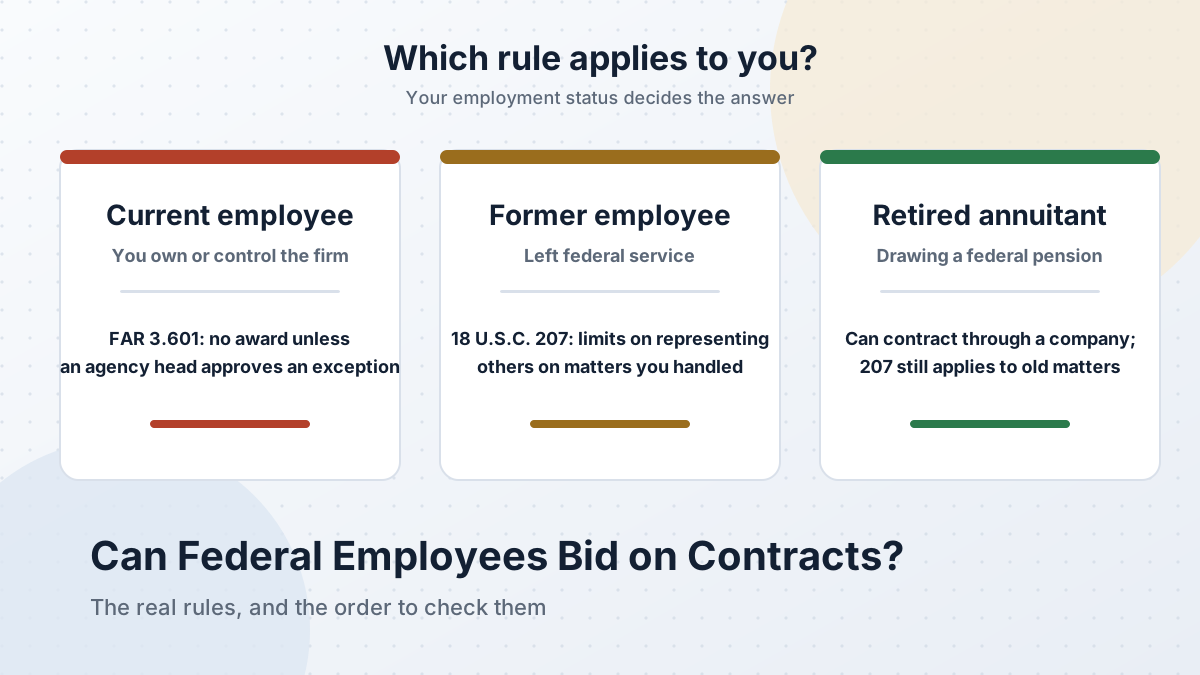
- FAR 3.601 says a contracting officer shall not knowingly award a contract to a government employee, or to a business substantially owned or controlled by one. An exception needs an agency head (or a designee no lower than the head of the contracting activity) to find a "most compelling reason" under FAR 3.602.
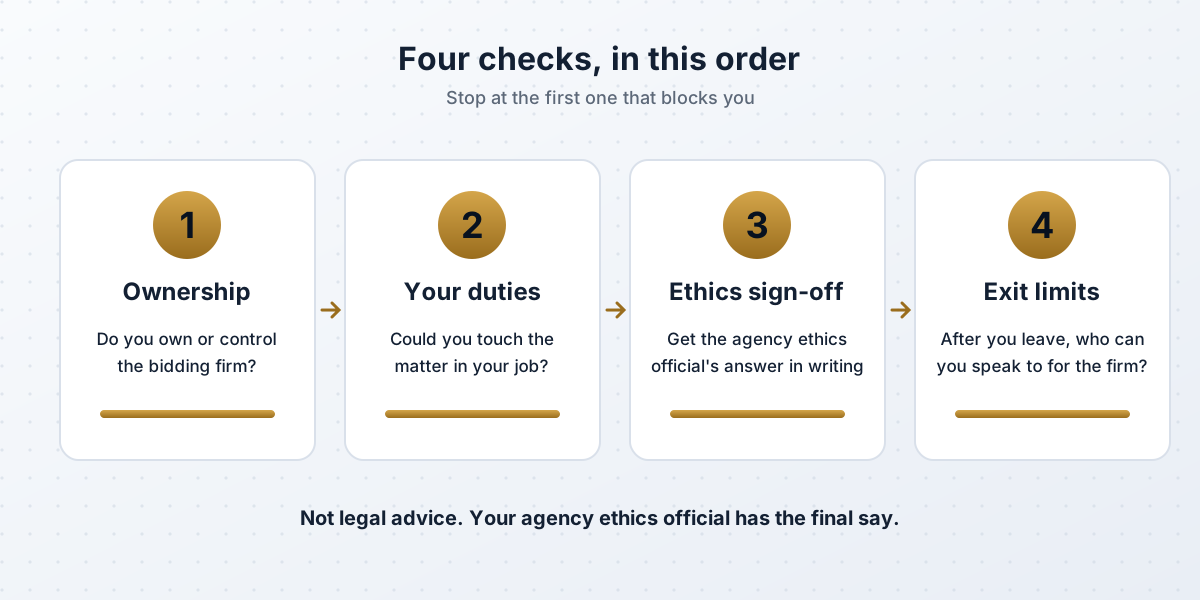
- Owning a business is not banned on its face. The trouble is what you touch: 18 U.S.C. 208 bars you from taking part in official matters that affect your firm, and 18 U.S.C. 203 and 205 limit representing an LLC or corporation to the government.
- Check your agency's outside-activity rules first. Some agencies require prior approval for outside business, so get your ethics official's answer in writing before you register anything.
- After you leave, 18 U.S.C. 207 limits who you can speak to on behalf of others: a lifetime bar on matters you handled personally and substantially, and two years on matters under your official responsibility in your last year.
- Retired annuitants face dual-compensation rules only when reemployed in a federal civilian position, and 207 still applies to your old matters.
Short version: yes and no. Federal employees are not forbidden from owning companies, but a rule written for exactly this situation blocks awards to them. Your answer depends on whether you are still employed, whether you own or control the firm, and what you did in your federal job. Read this as a map of the rules, not a ruling on your case. Your agency ethics official gives the answer that counts.
What does FAR 3.601 say about contracts with government employees?
It is the rule most guides skip. FAR Subpart 3.6 covers contracts with government employees and with businesses they own or control. The policy in FAR 3.601 says a contracting officer shall not knowingly award a contract to a government employee, and the same ban reaches a business or organization substantially owned or controlled by government employees. The aim is to avoid conflicts between your personal interests and your official duties, and the appearance of favoritism.
Three details matter:
- It is not limited to your own agency. The text bars awards to employees, not to employees of the buying agency. Do not assume a different agency is a safe harbor.
- There is an exception, but it is narrow. Under FAR 3.602, the agency head or a designee no lower than the head of the contracting activity can allow an award only if there is a "most compelling reason," such as when the government's needs cannot reasonably be met any other way.
- Special government employees are treated differently. Experts, advisors, consultants and committee members are generally not covered, unless the contract comes directly from that role, they can influence the award through it, or another conflict exists.
FAR 3.603 adds that a contracting officer who knows or suspects a bidder is barred needs the 3.602 authorization before awarding. For firms owned or controlled by employees, the contracting officer must also follow FAR Subpart 9.5 on organizational conflicts of interest.
Can a current federal employee own a contracting business?
Ownership alone is not a crime, but it puts you inside several rules at once. The Office of Government Ethics (OGE) guidance on business ownership lays out the pieces.
| Rule | What it limits | What it means for you |
|---|---|---|
| 18 U.S.C. 208 | Taking part in official matters that directly and predictably affect your firm's finances | Stay out of any decision that touches your company. A spouse's or minor child's business is analyzed as if you owned it. |
| 5 C.F.R. 2635.502 | Impartiality when you have a "covered relationship" | Owning a business creates one. If a reasonable person would question your impartiality, get authorization before you participate. |
| 18 U.S.C. 205 and 203 | Representing a third party to the government, and being paid for it while employed | Representing your own sole proprietorship is not treated as representing a third party. Representing an LLC, corporation or partnership is. |
| 5 C.F.R. 2635.803 | Prior approval of outside activities | Follow your agency's approval process. Some agencies also restrict certain business holdings. |
| FAR 3.601 | Awards to employee-owned or controlled firms | The bid can be blocked at the contracting officer, whatever your ethics paperwork says. |
So the practical answer for a current employee who owns and controls the bidding firm is: do not expect an award. Your ethics approval does not override FAR 3.601, and FAR 3.601 does not erase your duty to stay out of your own firm's matters.
What if my spouse owns the business?
FAR 3.601 speaks of businesses owned or controlled by government employees, so a firm you neither own nor control is not caught by that text. But 18 U.S.C. 208 analyzes a spouse's business as if it were yours. That means you must stay out of any official matter that affects it, and you cannot pass along procurement information. Ask your ethics official before the first bid, not after.
What post-employment limits apply after I leave federal service?
Leaving does not erase everything. 18 U.S.C. 207 limits what you can do for others after you go. The agency ethics guides from the Interior Department and the Bureau of Reclamation summarize them.
| Limit | Who it covers | What it bars |
|---|---|---|
| 207(a)(1), lifetime | Anyone who participated personally and substantially in a particular matter involving specific parties, such as a contract | Appearing or communicating on behalf of another to a federal agency or court about that matter, permanently |
| 207(a)(2), two years | Matters involving specific parties that were under your official responsibility in your last year of service | The same appearances and communications, for two years after you leave |
| 207(c), one year | Former "senior" employees | Communicating with or appearing before your former agency with intent to influence, for one year |
| 207(d), two years | Former "very senior" employees | Communications and appearances with intent to influence covered officials, for two years |
The key word is representing. These limits focus on appearing or communicating on behalf of someone else. They do not list a general ban on helping behind the scenes. That is why many former employees can run a contracting company, as long as someone else is the face to the government on matters they handled. Confirm that line with an ethics counselor, because some matters carry narrower rules, such as trade and treaty negotiations.
The Procurement Integrity Act (41 U.S.C. 2104; FAR 3.104-3(d)) adds restrictions for certain employees who worked on procurements valued over $10 million, so check it if you handled a big one.
Can retired federal employees bid on contracts?
Generally yes, through a company, subject to the same 207 limits above. A common worry is the pension. The dual-compensation rules apply to annuitants reemployed in federal civilian positions: Commerce's summary says CSRS pay is reduced and a FERS annuity stops during reemployment, unless OPM waives it. Those rules concern federal positions. Running your own company that sells to the government is not reemployment, but confirm with OPM if you also plan to take a federal job or consulting appointment.
Does certification status change anything?
Yes, for set-asides. For a service-disabled veteran-owned small business, SBA's control rule at 13 C.F.R. 128.203 says outside employment cannot keep the veteran from managing the company, and the veteran normally must devote full time during the business's normal hours. SmallGovCon covers recent cases. A veteran with a full-time federal job will have a hard time showing control. If you hold or want SDVOSB status, our SDVOSB guide explains how the pieces fit.
How do you check where you stand, step by step?
- Write down your status. Current employee, special government employee, former employee, or retired annuitant.
- Write down your ownership. Do you own or control the firm, or does someone else, such as a spouse?
- List what you touched. Contracts, programs, budgets and people you worked on in your last year, and any matter you handled personally and substantially.
- Ask your agency ethics official, in writing, before you register the company or bid. Describe the firm, your duties and the agencies you plan to sell to.
- Keep a file. Save the answer, the date, and who gave it.
- Disclose to the contracting officer when your background could look like a conflict, and ask what they need from you.
Scenario table: can you bid?
| Scenario | Likely answer | Why |
|---|---|---|
| Current employee owns and controls the firm | Blocked unless an agency head grants a FAR 3.602 exception | FAR 3.601 bars knowing awards to employee-owned or controlled firms |
| Current employee, spouse owns an unrelated firm | Possible, with strict recusal | FAR 3.601 turns on employee ownership or control, but 208 treats a spouse's business as yours |
| Special government employee (expert or consultant) | Often allowed, with exceptions | FAR 3.601(b) generally does not treat them as employees unless the contract flows from the role or another conflict exists |
| Former employee, matter you handled personally | Possible, but you cannot be the one who speaks for the firm on that matter | 207(a)(1) lifetime limit on representing others |
| Former employee, unrelated work | Usually allowed | The 207 limits attach to particular matters, not to all government work |
| Retired annuitant with a private company | Generally allowed | Dual-compensation rules cover federal reemployment; 207 still applies |
Where does GovScout help?
GovScout Pro cannot clear your ethics questions, and it is not a substitute for your ethics official. What it can do is help you pick targets once you know your lane. The Beginner plan is $29 a month for learning and setup, with Marcus coaching and NAICS help. If you are still choosing codes, my NAICS Code Goldmine: Find Every Set-Aside You Qualify For ($17) on Gumroad walks through it. For free search tools, read our federal contracts lookup guide, and for a first bid, the first federal contract guide.
Frequently Asked Questions
Can a federal employee own a government contracting company?
Owning a company is not banned outright, but FAR 3.601 says a contracting officer shall not knowingly award a contract to a government employee or to a business substantially owned or controlled by one, unless an agency head grants a FAR 3.602 exception for a most compelling reason. You also have to follow conflict-of-interest law and your agency's outside-activity rules.
Can my spouse bid on contracts if I am a federal employee?
Possibly. FAR 3.601 applies to firms you own or control. But 18 U.S.C. 208 analyzes a spouse's business as if it were yours, so you must stay out of any official matter that affects it and must not share procurement information. Get your ethics official's view before the first bid.
Do I have to wait before bidding after I leave federal service?
There is no single waiting period. 18 U.S.C. 207 limits representing others to the government: permanently on particular matters you handled personally and substantially, two years on matters under your official responsibility in your last year, and one or two years for senior and very senior employees. Many former employees can work on unrelated contracts right away.
Can a retired federal employee with a pension start a contracting business?
Generally yes. Dual-compensation rules reduce or stop retired pay when an annuitant is reemployed in a federal civilian position, which is different from owning a private company. The 207 post-employment limits still apply to matters you handled, so confirm with an ethics counselor.
Do I need approval to run an outside business as a federal employee?
Your agency decides. 5 C.F.R. 2635.803 lets agencies require prior approval for outside employment and activities, and some restrict certain business holdings. Ask your ethics official in writing before you register the company.
Can a service-disabled veteran with a full-time federal job hold SDVOSB status?
It is hard. SBA's control rule at 13 C.F.R. 128.203 says outside employment cannot prevent the veteran from managing the firm, and the veteran normally must devote full time during normal business hours. A full-time federal job makes that difficult to show.