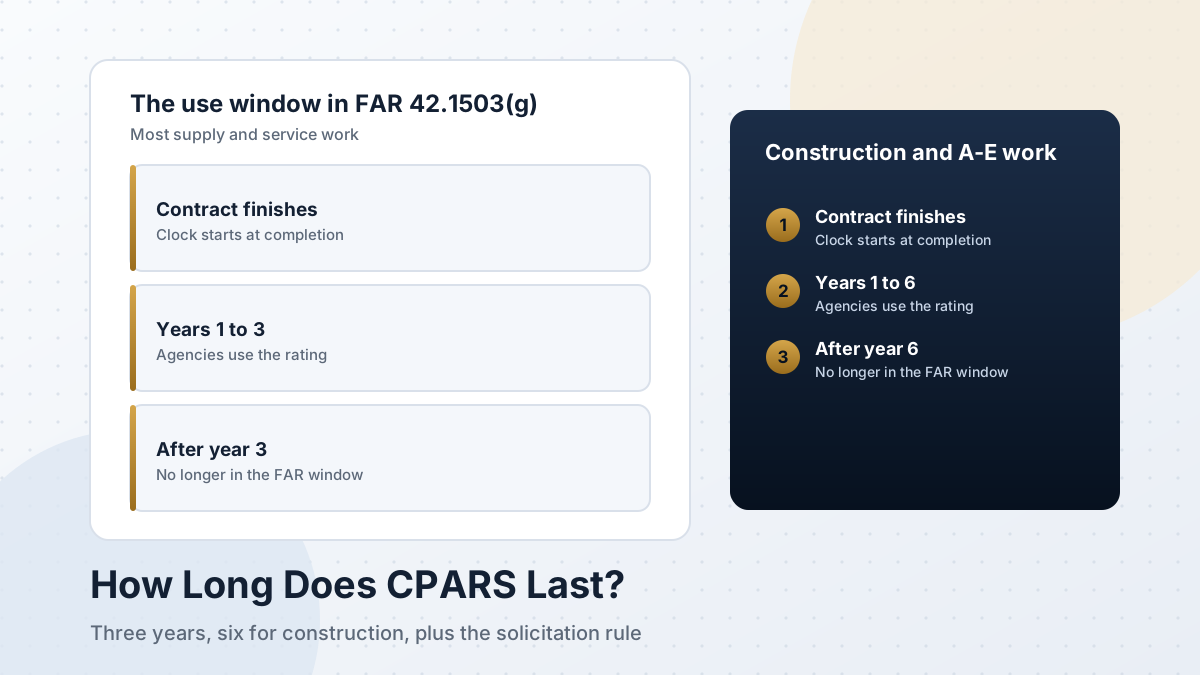
- FAR 42.1503(g) tells agencies to use CPARS information within three years of the evaluated contract's completion, and within six years for construction and architect-engineer contracts.
- The clock starts when performance is complete, not when the evaluation is signed.
- The solicitation sets how recent your work must be. Many ask for three years, and a rating outside that window may count for less or not at all, depending on the wording.
- A GAO decision reported in 2026 sustained a protest where an agency ignored older work the solicitation never excluded. Read the exact words in each solicitation.
- A weak rating does not delete itself on day one. Use the comment window now and bid where a newer, stronger record carries the evaluation.
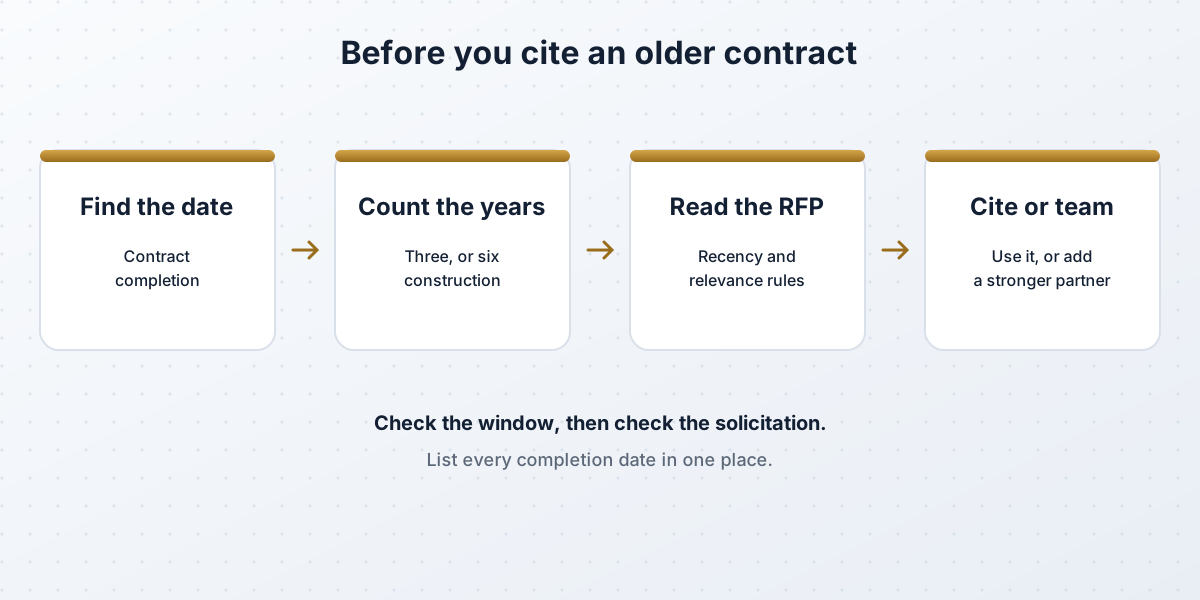
- Tip: put the completion date of every contract in one list. When a rating is about to age out, you know it before the solicitation tells you.
Short answer: agencies use a CPARS evaluation for three years after the work is complete, or six years for construction and architect-engineer contracts. After that, the FAR no longer tells them to rely on it. The longer answer has two parts that trip people up: when the clock starts, and what the solicitation says about recency.
How long can agencies use a CPARS rating?
FAR 42.1503(g) says agencies shall use the past performance information in CPARS that is within three years of the completion of performance of the evaluated contract or order, and six years for construction and architect-engineer contracts. That is the rule behind the common answer of three years.
Notice what it does and does not say. It sets how long agencies use the information. It does not promise a deletion date for the record. We do not claim one here, and the CPARS user manual is the place to check how the system handles older records.
| Type of contract | How long agencies use the rating | Clock starts |
|---|---|---|
| Most supply and service contracts | Three years | Completion of performance |
| Construction | Six years | Completion of performance |
| Architect-engineer | Six years | Completion of performance |
When does the clock start?
The text ties the window to the completion of performance of the contract or order, not to the day the evaluation was signed. A long contract can have interim evaluations along the way, and each one is read against that same completion date. If your contract ended in March 2024, a three-year window runs to March 2027.
Does a CPARS rating stop mattering after three years?
Not automatically. The FAR sets what agencies are told to use. The solicitation sets how they judge relevance and recency for that buy, and FAR 15.305 says past performance is evaluated for relevance to the work being bought. A solicitation might ask for work from the last three years, five years or some other period.
A 2026 GAO decision reported by PilieroMazza, Veterans Management Services, B-424182.2, shows why the wording matters. As that firm describes it, the agency treated three years as a hard cutoff, but the solicitation only said recent work "may be viewed more favorably" and never excluded older work. GAO sustained the protest because the agency could not ignore older performance the solicitation still allowed. That is a summary from a law firm, so read the decision itself before you rely on it.
What does that mean for you?
- Older strong ratings can still help. If the solicitation does not set a cutoff, a relevant five-year-old Exceptional rating is worth citing.
- Older weak ratings can still hurt. The same logic works against you. Do not assume a bad rating is gone because three years passed.
- Read the evaluation factor word by word. "Within the past three years" and "may be viewed more favorably" are different rules.
What should you do if a bad rating is aging out?
Do not wait it out. Three years is a long time to lose bids.
- Use the comment window on new evaluations. FAR 42.1503(d) gives you up to 14 calendar days from notification to add comments or rebuttals. Our rating scale guide shows what each rating means so you know what to push back on.
- Build a fresh record on smaller work. Each new contract produces a newer evaluation that evaluators weigh alongside the old one.
- Team with a firm whose record is stronger. A partner's relevant past performance can carry the evaluation while yours recovers.
- Explain the context. If the cause was a government delay or a one-time problem you fixed, say it briefly and factually in your proposal.
How do you check your own CPARS record?
Your contractor representative can see your evaluations in CPARS and in PPIRS, the system evaluators use to read them. Pull them before every bid/no-bid call, the same way you check set-aside status and NAICS fit. If you have no record yet, FAR 15.305 says an offeror with no relevant past performance gets a neutral rating, which is neither a penalty nor a plus. Our explainer on what CPARS stands for covers the basics, and the NAICS Code Goldmine ($17) helps you match your contracts to the right codes. To see where your record fits, browse our federal contract guides by category.
What changed for CPARS in 2027?
- The window did not change. FAR 42.1503(g) still reads three years, six for construction and architect-engineer contracts. The FAR overhaul is moving, and agencies apply it through class deviations, so cite the version your solicitation uses.
- The comment period is still up to 14 calendar days under FAR 42.1503(d).
- DoD guidance on commercial work is coming. Section 824 of the FY2026 NDAA requires DoD guidance on accepting commercial and other non-federal work as relevant past performance, due around December 2026. If you lack federal ratings, watch for it.
Frequently Asked Questions
How long does a CPARS rating stay on my record?
Agencies are told to use CPARS information for three years after the contract is complete, or six years for construction and architect-engineer contracts, under FAR 42.1503(g). That is a use window, not a promise about when the system deletes a record.
When does the three-year clock start?
At completion of performance of the evaluated contract or order, not when the evaluation is signed. A contract that ended in March 2024 has a three-year window that runs to March 2027.
Can an agency use a CPARS rating older than three years?
It depends on the solicitation. The FAR tells agencies what to use, and the solicitation sets recency and relevance. If it does not exclude older work, an agency may be required to consider it, as GAO found in a 2026 decision reported by PilieroMazza.
Do construction contracts have a longer window?
Yes. FAR 42.1503(g) gives six years for construction and architect-engineer contracts, against three years for most other work.
Can I remove or delete a bad CPARS rating?
Not on request. You can comment, rebut or ask for review at a level above the contracting officer within the FAR 42.1503(d) process, and the agency makes the final call. Dispute a rating when it misstates facts, not because you dislike it.
What if I have no CPARS record at all?
FAR 15.305 says an offeror with no relevant past performance receives a neutral rating. Commercial work, state work, subcontracts and references can help fill the gap.