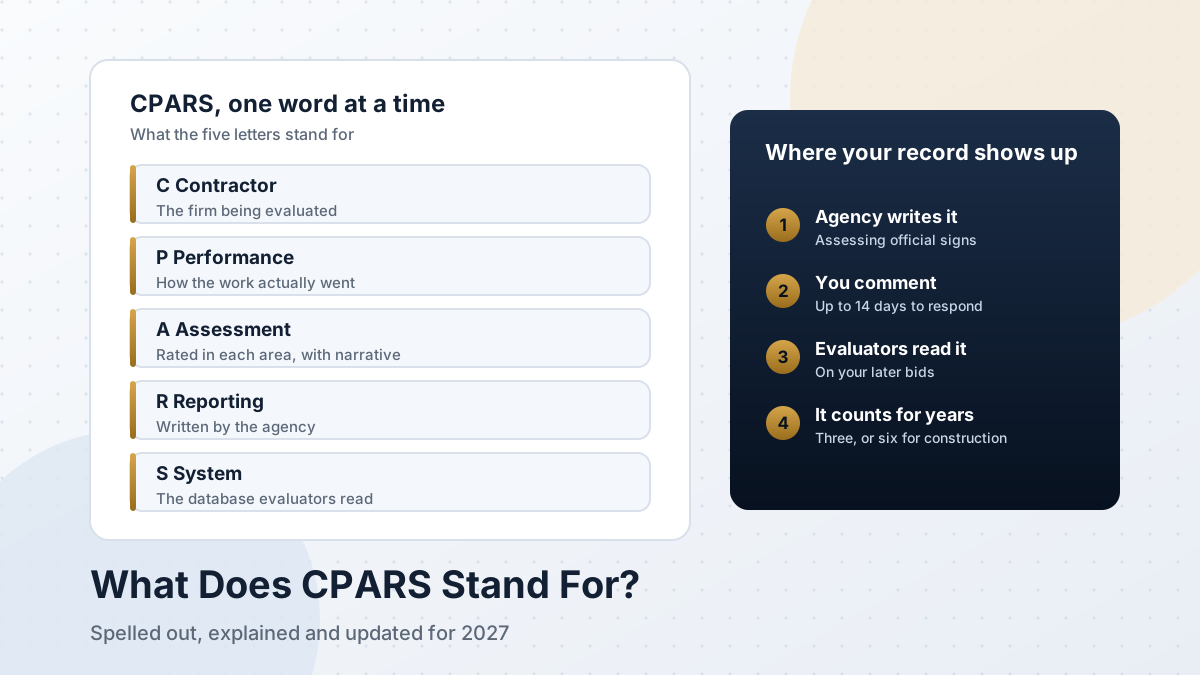
- CPARS stands for Contractor Performance Assessment Reporting System. It is the federal government's system for recording how a contractor performed on a contract.
- Ratings are words, not numbers: Exceptional, Very Good, Satisfactory, Marginal and Unsatisfactory. Each needs a narrative behind it.
- FAR 42.1503(d) gives you up to 14 calendar days to comment before the evaluation goes to source selection officials.
- Agencies use a rating for three years after the work is complete, six for construction and architect-engineer contracts, and then judge it for relevance and recency.
- Subcontractors are not rated in CPARS. A small business sub can ask its prime for a written rating under 13 CFR 125.11.
- For 2027, the five-level scale and the 14-day window did not change.
- Tip: look at your own CPARS record before every bid/no-bid call. If it is thin, team with a firm whose record fills the gap.
CPARS stands for Contractor Performance Assessment Reporting System. It is where federal agencies write and store evaluations of how a contractor performed on a contract. When you bid on your next job, the evaluators can read those evaluations as part of judging your past performance. This guide covers what the system is, who writes the report, what the ratings mean, and what you can do about a rating you disagree with.
What does CPARS stand for, and what is it?
Each letter earns its place. It is a Contractor Performance Assessment Reporting System. The government uses it to record how you did on a contract, and CPARS.gov sits beside a companion database, the Past Performance Information Retrieval System (PPIRS). The rules behind it are in FAR subpart 42.15.
Many people say CPARS when they mean one evaluation. Technically one evaluation is a CPAR, and CPARS is the system. We explain that difference in CPAR vs CPARS, and the rating levels in detail in the CPARS rating scale guide. This article is the starting point.
Who writes a CPARS report?
The government does, not you. An assessing official representative, often the contracting officer's representative (COR), drafts the evaluation, and the assessing official, often the contracting officer, signs it. The report covers how you actually performed, not what you promised in your proposal. For the COR's side of the process, read how the COR shapes your rating.
What does a CPARS report cover?
CPARS guidance lists six evaluation areas: Quality, Schedule, Cost Control, Management, Utilization of Small Business and Regulatory Compliance, and the assessing official can add other areas. FAR 42.1503 names similar factors. Each area gets its own rating and a narrative, so a Satisfactory with a detailed write-up reads very differently from one with bare text.
When is one written?
FAR 42.1502 requires evaluations at least annually and when the work is complete, for contracts above the thresholds: the simplified acquisition threshold ($350,000) for most contracts, $900,000 for construction and $45,000 for architect-engineer services. Below those lines, agencies are not required to write one, though they can.
What do the CPARS ratings mean?
The ratings are adjectival, and the scale is in FAR Table 42-1. Here is the plain-English version.
| Rating | What it means |
|---|---|
| Exceptional | Exceeded many requirements to the government's benefit. No significant weaknesses. |
| Very Good | Exceeded some requirements to the government's benefit. Minor problems were corrected well. |
| Satisfactory | Met the requirements. Any problems were minor or recovered without hurting the contract. |
| Marginal | Did not meet some requirements. A serious problem exists, and the fixes were weak or unfinished. |
| Unsatisfactory | Did not meet most requirements. Recovery is unlikely, and the fixes were ineffective or missing. |
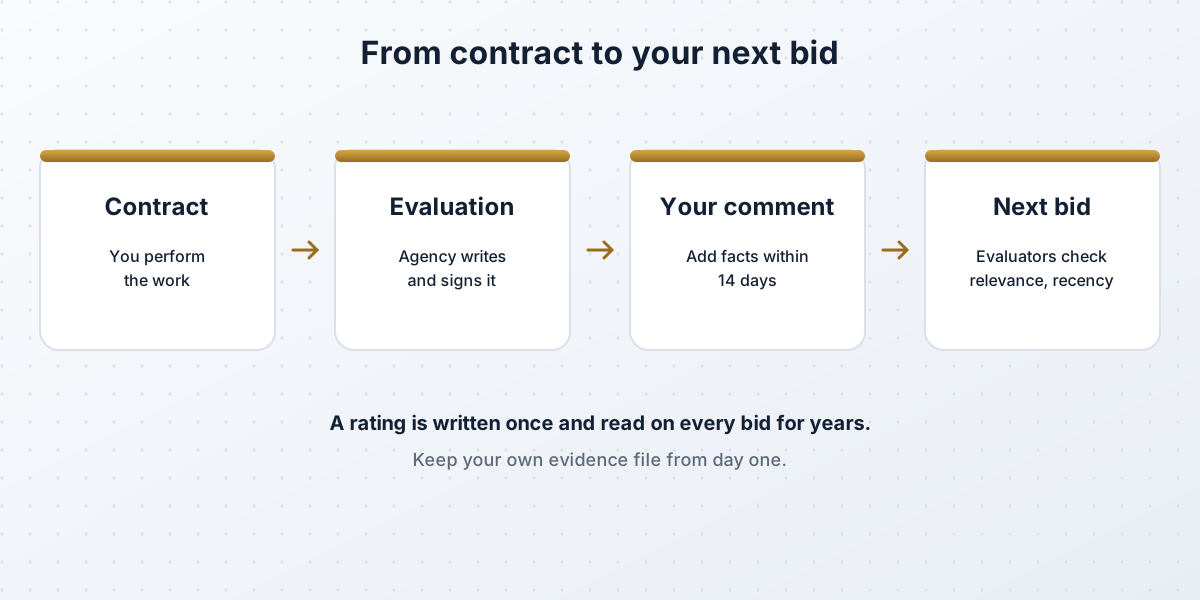
The narrative matters as much as the adjective. FAR 42.1503 expects the evaluation to be factual and supported, so a rating without evidence behind it is a good reason to use your comment window.
How do evaluators use CPARS on your next bid?
Past performance is a standard evaluation factor in competitive buys. FAR 15.305 tells the evaluator to judge it for relevance to the work being bought, so a great rating on the wrong kind of work does not carry over. Evaluators can use other sources beside CPARS, such as references and questionnaires, and each solicitation says what it will consider.
Many evaluators turn all of it into a confidence rating for your offer. Inside the Department of Defense, the Source Selection Procedures use Substantial Confidence, Satisfactory Confidence, Neutral, Limited Confidence and No Confidence. Civilian agencies set their own scales, so read the evaluation section of every solicitation. A weak record on relevant work can sink a bid even when your price is sharp, and one strong record on similar work can help a lot.
What if you have no CPARS record?
FAR 15.305 says an offeror with no relevant past performance receives a neutral rating, which is neither a penalty nor a plus. Other evidence can fill the gap: commercial or state work, subcontracts and references. Teaming with an established firm helps too. See how to build past performance from nothing and our teaming agreement basics.
How can you see, comment on or dispute a rating?
When the assessing official signs the evaluation, CPARS notifies your contractor representative. FAR 42.1503(d) gives you up to 14 calendar days to comment, and after that the evaluation is available to source selection officials. CPARS does not lock at day 14. Its August 2026 user manual (version 9.0.0) says contractor representatives can keep commenting until day 60, and late comments are added to the record. But evaluators can see the rating from day 15, so treat day 14 as your deadline.
- Stick to facts. Dates, deliverables, contract numbers and documents. Calm and specific beats angry.
- Quote the contract. Put the exact PWS line next to each statement you dispute.
- Agree briefly when you agree. A two-line "reviewed, no objection" comment puts you on the record.
If comments do not settle it, FAR 42.1503(d) requires the agency to offer a review at a level above the contracting officer, and the agency makes the final call. Dispute a rating when it misstates facts or ignores documented performance, not because you dislike a Satisfactory.
How long does a CPARS rating count?
Under FAR 42.1503(g), agencies use past performance information for three years after the contract is complete, and six years for construction and architect-engineer contracts. That is the window evaluators are told to use, and the solicitation can set how recent the work must be. Recent, relevant work carries the most weight, so a rocky contract from years ago matters less than a strong one from last year.
What should you do after a poor rating?
- Answer inside the comment window with evidence, not emotion: delivery records, correspondence, contract modifications and customer emails.
- Fix the root cause on the contract you still hold. Document corrective actions in writing, such as a revised quality control plan, a new key hire or a schedule recovery baseline. The next evaluation period shows the improvement.
- Bid where your record is not the only story. Team with a firm whose past performance covers the gap, answer sources sought notices to shape requirements, and start with smaller work while the record recovers.
How should CPARS fit into your bid/no-bid process?
Before you spend a week on a proposal, check your own record the same way you check set-aside status and NAICS fit. If you have prior federal work, your ratings are already part of what an evaluator can read. If you are new, evaluators lean on whatever relevant evidence you can show from subcontracts, commercial or state work. A weak or missing record is not an automatic pass, but it points toward teaming. GovScout reads each SAM.gov opportunity against your NAICS codes and returns GO, TEAM or PASS with reasons. See how it works for small business bid decisions, and browse federal contract guides by category.
- Match your NAICS codes to the work. Past performance is read against what you say you do. Our NAICS code guide explains how, and the NAICS Code Goldmine ($17) shows which codes your target agencies buy under.
- Keep SAM.gov current. Your registration and contract history need to match your story. See SAM.gov registration tips.
What changed for CPARS in 2027?
- The scale and the window did not change. Five levels in FAR Table 42-1 and up to 14 calendar days to comment under FAR 42.1503(d). The CPARS user manual, version 9.0.0 (August 2026), still gives 60 days to comment with release to source selection at day 15.
- The "negative-only" DoD model was dropped. Draft FY2026 NDAA language would have moved DoD to recording only negative events. The NDAA signed December 18, 2025 did not include it, so positive ratings still count.
- DoD guidance on commercial work is coming. Section 824 of the FY2026 NDAA requires DoD to issue guidance on accepting commercial and other non-federal work as relevant past performance, due around December 2026. That helps firms with thin federal records.
- The FAR rewrite is still moving. A second round of proposed rules under the Revolutionary FAR Overhaul came out September 18, 2026, and agencies apply it through class deviations. Cite the version your contract cites.
Frequently Asked Questions
What does CPARS stand for?
CPARS stands for Contractor Performance Assessment Reporting System. It is the federal system where agencies record how a contractor performed on a contract.
Does CPARS apply to small business set-asides and small contracts?
Yes for set-asides. Work on an 8(a), SDVOSB or HUBZone set-aside is evaluated the same way as any other contract. Agencies must write evaluations above the FAR 42.1502 thresholds ($350,000 for most contracts, $900,000 for construction, $45,000 for architect-engineer services). Below those lines they are not required to, though they can.
Can a prime contractor see a subcontractor's CPARS report?
There is no subcontractor CPARS report to see. CPARS rates the prime on the contract. Under 13 CFR 125.11, a first-tier small business subcontractor can request a written rating of its performance from the prime. Keep your own delivery records either way.
Is CPARS the same as SAM.gov registration or a responsibility determination?
No. SAM.gov registration makes you eligible to bid and receive awards. A responsibility determination is the contracting officer's judgment that you are capable before award. CPARS is a record of how you performed on past contracts. All three can feed an award decision, but they do different jobs.
What happens if I never check my CPARS report?
The evaluation becomes available to source selection officials after the comment period, without your side of the story. CPARS accepts late comments until day 60 under its August 2026 manual, but evaluators can see the rating from day 15. Check every report, even a good one.
Do CPARS ratings follow my firm if I change my CAGE code or form a joint venture?
CPARS ties records to the contracting entity, identified through numbers such as the CAGE code and UEI, so a new code does not simply erase history. How a joint venture's past performance is evaluated depends on the solicitation and the SBA rules, so read the evaluation section and ask the contracting officer.
Did anything about CPARS change for 2027?
The five-level scale and the 14-day comment period in the FAR did not change. The negative-only DoD change was not in the NDAA signed December 18, 2025.