Use it for outreach
Send a tighter version to small business specialists, contracting officers, and prime contractors.
Build a first draft you can clean up, save, and bring into Marcus. This runs in your browser and gives you a practical one-page structure for contracting officers, small business specialists, primes, and teaming partners.
Quick answer: a federal capability statement is a one-page summary of what your company does, who you have done it for, your NAICS codes, UEI, CAGE code and certifications, and how to reach you. Fill in the boxes below for a draft, or jump to the samples and the FAQ.
Review before sending. A good capability statement should be specific, truthful, and tailored to the buyer.
Send a tighter version to small business specialists, contracting officers, and prime contractors.
Compare the draft against a notice to see whether your proof matches the requirement.
Paste the draft into Marcus and ask for a buyer-specific version with a 72-hour action plan.
A strong capability statement should include core services, NAICS codes, certifications, differentiators, past performance proof, contact details, and the buyer lane you want to pursue.
Do not overload the page with every possible service, unsupported claims, generic slogans, or certifications that are not active. Federal buyers need quick proof, not brochure fluff.
After the draft is clean, build a SAM.gov search plan, score your readiness, and use Marcus to tailor the statement to a specific opportunity.
Create one master draft, then make a separate version for each agency, prime, or opportunity. The strongest version uses the buyer's language and moves the most relevant proof to the top.
If you claim cybersecurity, maintenance, staffing, construction, or professional services capability, add proof: project type, customer type, result, tools, certifications, location, or team capacity.
Revisit the statement after every serious pursuit. New past performance, better NAICS evidence, certifications, and agency targets should improve the document over time.
Read the draft like a contracting officer with one minute to decide whether you belong in the conversation. The services, proof, and contact path should be clear without a sales call.
When sending to a prime contractor, emphasize the work package you can support, certifications that help their subcontracting plan, and the low-risk proof that makes you easy to team with.
When sending to an agency, connect your capabilities to mission need, contract vehicle, location, NAICS, or previous government-style work. Keep it factual and easy to scan.
These are made-up companies so you can see what "good" looks like. Notice that every line has a number, a name, or a credential. That's what a contracting officer skims for.
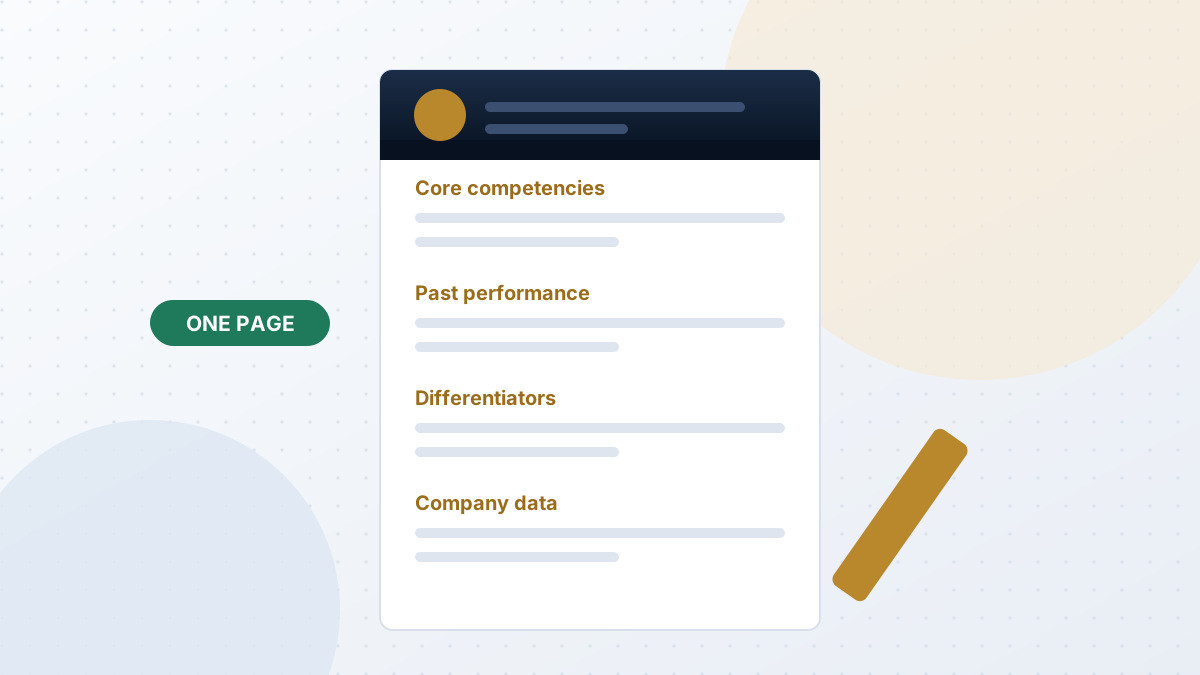
Five things: core competencies, past performance, differentiators, company data (UEI, CAGE, NAICS codes, certifications), and contact information. Keep it to one page.
No. SAM.gov replaced the DUNS number with the Unique Entity ID (UEI) in April 2022. List your UEI and CAGE code instead.
Yes, if you can. Keep one master version, then move the most relevant past performance and NAICS codes to the top for each agency or prime you send it to.
Yes. The generator builds a draft from your details at no cost. Edit it in your own words before you send it.
One page. Contracting officers skim, so lead with your core competencies and one or two strong pieces of past performance.
Yes. A PDF keeps the formatting intact and is easy to attach. Name the file with your company name and NAICS focus so it is easy to find later.
Not government past performance. Commercial projects count, as long as you describe the scope, the customer type and the result. Never invent proof.
Need the full walkthrough? Read how to write a capability statement.