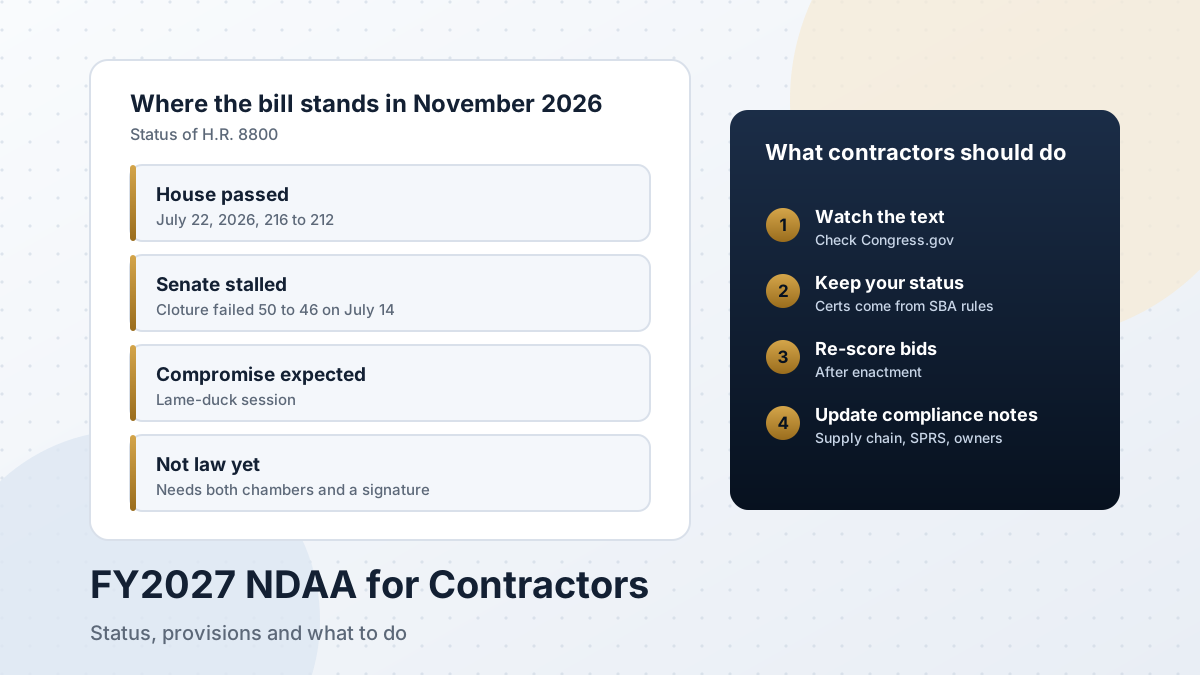
- The FY2027 NDAA is not law. The House passed H.R. 8800 on July 22, 2026, 216 to 212. The Senate has not passed it, and a lame-duck compromise is the expected path.
- Your SDVOSB, WOSB, 8(a) or HUBZone certification comes from SBA regulations, not the defense bill.
- The House bill adds supply chain and cyber rules, including limits on covered critical materials and vendor vulnerability disclosure. Section numbers can change before the final text.
- CMMC Phase 2 is suspended, so the draft claim that CMMC is a condition of award is out of date. DFARS 252.204-7012, NIST SP 800-171 and SPRS scoring still apply.
- The micro-purchase threshold is $15,000 and the simplified acquisition threshold is $350,000, set in the FAR since October 1, 2025.
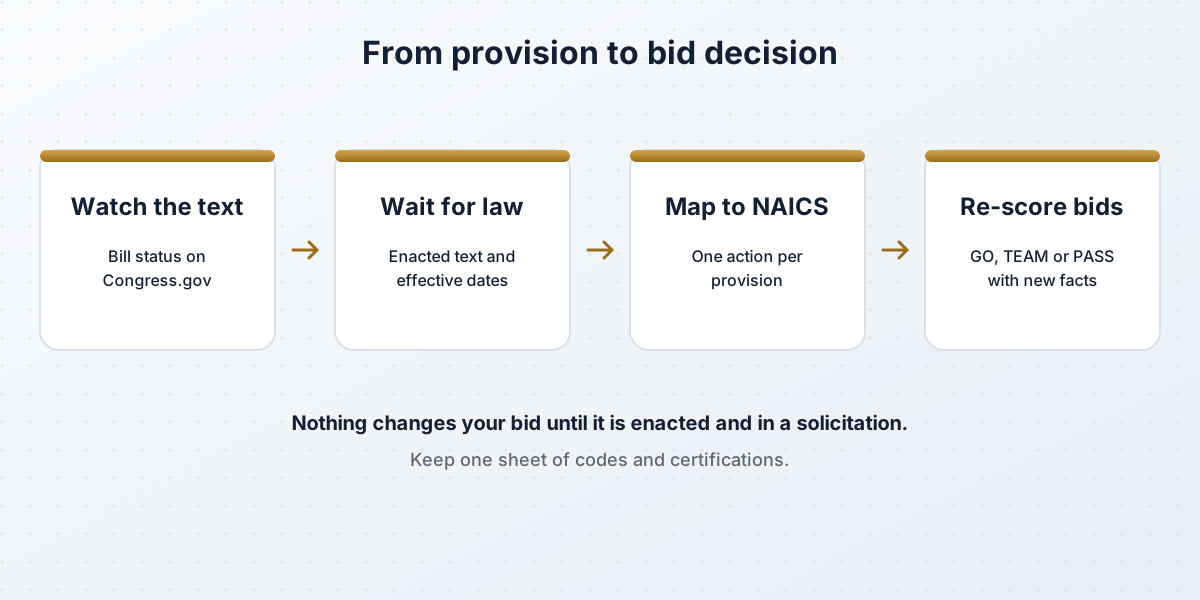
- Tip: keep a one-page sheet of your NAICS codes and certifications. The day text is final, you only check each provision against that sheet.
Short version: the FY2027 National Defense Authorization Act (NDAA) is not law. It is still moving, and the final text will not match any one draft. Until it passes, treat every provision as something to watch, not something to bid on.
Where does the FY2027 NDAA stand?
The House passed H.R. 8800 on July 22, 2026, by a vote of 216 to 212, with a topline of about $1.15 trillion. The Senate Armed Services Committee approved its own version, S. 4784, in June. A July 14 cloture vote to start Senate debate failed 50 to 46, and a motion to reconsider is pending. The Senate took up H.R. 8800 on September 14 but has not passed it.
Fiscal year 2027 started October 1 with no NDAA. Congress came back the week of November 9, and the expected path is a compromise text from the four Armed Services committee leaders, followed by votes in both chambers and the President's signature. Government funding runs out December 11, and that fight competes for floor time. Check Congress.gov for the current status before you act, because this can move in days.
| Step | Status as of mid-November 2026 |
|---|---|
| House passes H.R. 8800 | Done, July 22, 2026, 216 to 212 |
| Senate Armed Services Committee approves S. 4784 | Done, June 2026 |
| Senate floor passage | Not done. Cloture on the motion to proceed failed 50 to 46 on July 14 |
| Final compromise text | Expected in the lame-duck session |
| Both chambers pass, President signs | Not done |
Which provisions could affect contractors?
Section numbers below come from law firm coverage of the House-passed bill and can change in conference. Read them as a list of themes to watch.
- Supply chain exclusions (Sec. 1812). Companies added to the 1260H list would be referred for possible government-wide exclusion orders that can reach subsidiaries and affiliates.
- Due process on exclusions (Sec. 1801). Agencies would give 30 days' notice and a chance to respond before excluding a domestic source on supply chain risk grounds, unless there is an imminent threat.
- Critical materials (Sec. 1803). DoD could not buy covered critical materials sourced from China, Russia, Iran or North Korea at any tier, with a phased-in share for tier 2 materials.
- Vendor vulnerability disclosure (Sec. 1526). IT vendors that sell or operate in those countries would have to disclose security vulnerabilities to DoD first to win or renew contracts.
- Ownership visibility (Sec. 1816). A DoD office would assess foreign capital risk and identify beneficial ownership of subcontractors and suppliers at any tier.
If you are a small firm, the practical point is that primes may ask you to prove where parts and materials come from, and who owns you, earlier than before. Start keeping those records now. The coverage I reviewed did not address small business set-asides in the House bill, so do not assume it moves them.
Does the NDAA change my SDVOSB, WOSB, 8(a) or HUBZone certification?
No. Eligibility and certification come from SBA regulations: 13 CFR Part 128 for veteran-owned programs, Part 127 for WOSB, Part 124 for 8(a) and Part 126 for HUBZone. A defense bill can change how DoD buys and counts, but your status, NAICS codes and SAM.gov registration stay the same. If you hold SDVOSB status, our SDVOSB contract guide has the current set-aside picture.
What about CMMC and cybersecurity?
Some drafts, including the one that prompted this guide, say CMMC 2.0 is a condition of award. That is out of date. DoD suspended CMMC Phase 2 on July 13, 2026, and a September 2026 class deviation told contracting officers to remove third-party assessment requirements from active solicitations. DFARS 252.204-7012, NIST SP 800-171 and SPRS self-assessment scoring still apply. Our CMMC Phase 2 guide tracks it.
- Keep your SPRS score current. It is still the self-assessment evidence primes ask for.
- Inventory your software and foreign-made components. The supply chain themes above make this a teaming question, not just a compliance one.
- Do not buy a third-party assessment because a blog said so. Wait for the solicitation to require it.
Do the micro-purchase and simplified acquisition thresholds change?
Those numbers are set in the FAR, not the NDAA. Since October 1, 2025 the micro-purchase threshold is $15,000 and the simplified acquisition threshold is $350,000. The FY2026 NDAA did raise the certified cost or pricing data threshold to $10 million for DoD, NASA and the Coast Guard on contracts entered after June 30, 2026. I found no FY2027 threshold changes in the coverage I reviewed. See our thresholds guide for every current number.
How should you turn the NDAA into bid decisions?
- Wait for enacted text. A provision in a House or Senate draft is not a reason to PASS on a bid.
- Map each enacted provision to your NAICS codes. Write one action per row: re-check eligibility, add a cost line, or ask a prime a question.
- Re-score live bids. A GO that now needs a compliance cost you cannot price becomes a TEAM or a PASS until you can.
- Watch DoD guidance that follows. The FY2026 NDAA already requires DoD guidance on counting commercial work as past performance by December 18, 2026. See how long CPARS counts if you lack federal ratings.
Browse federal contract guides by category to see where your codes line up with current buying.
Frequently Asked Questions
Is the FY2027 NDAA law yet?
No. The House passed H.R. 8800 on July 22, 2026, but the Senate has not passed it. A compromise text negotiated by the Armed Services leaders is expected in the lame-duck session, and both chambers must pass it and the President must sign it.
Where can I read the NDAA text for free?
Congress.gov publishes bill text, summaries and status for H.R. 8800 and S. 4784. The House and Senate Armed Services Committee websites post summaries that are easier to read than the bill itself.
Does the NDAA change my SDVOSB or HUBZone certification?
No. Certification and eligibility come from SBA regulations, such as 13 CFR Part 128 for veteran-owned firms and Part 126 for HUBZone, not from the defense bill.
Is CMMC required on DoD contracts after the FY2027 NDAA?
Not under the Phase 2 rules. DoD suspended CMMC Phase 2 on July 13, 2026. DFARS 252.204-7012, NIST SP 800-171 and SPRS self-assessment scoring still apply, so keep them current.
What are the micro-purchase and simplified acquisition thresholds now?
The micro-purchase threshold is $15,000 and the simplified acquisition threshold is $350,000 since October 1, 2025. They are set in the FAR. I found no FY2027 NDAA change to them in the coverage I reviewed.
What should I do the day the NDAA passes?
Map each enacted provision to your NAICS codes and certifications, write one action for each, and re-score any bid in your pipeline. Wait for solicitations to cite the new requirement before you spend money on it.