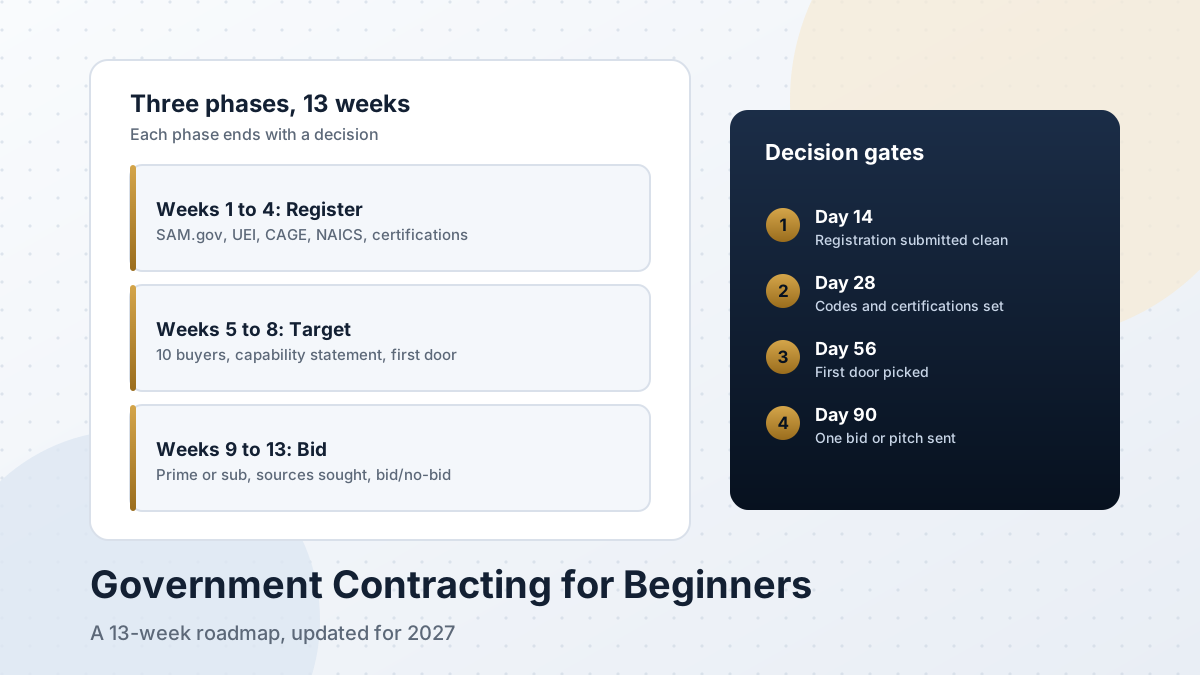
- Spend weeks 1 and 2 on SAM.gov, your UEI and your CAGE code. Name and bank mismatches are the most common reason validation drags on.
- Pick one primary NAICS code based on where agencies actually spend, plus two or three backups, and start any set-aside certifications at the same time.
- Micro-purchases under $15,000 do not need past performance, so they are the fastest way to a first federal dollar and a first reference.
- Subcontracting first lets a prime's track record cover the work while you build your own history. Primes need certified SDVOSB, WOSB, 8(a) and HUBZone teammates.
- Run a written bid/no-bid check before every solicitation. A deliberate PASS protects the week you need for the one bid worth writing.
- Tip: put your UEI, CAGE code and NAICS codes in one note on day one. You will paste them into SAM.gov, capability statements, emails and bids for the next year, and typos in them cause real delays.
Most beginners lose their first year learning set-asides, NAICS codes and past performance one at a time, as each problem blows up. A sequenced plan fixes that. Each phase below ends with a decision, so you always know what to do next week. The steps are in the order that saves you the most time.
What does your first 90 days of government contracting look like?
Think of it as three phases: register, target, bid. The first four weeks get your registrations and codes right. Weeks 5 to 8 find the agencies that buy what you sell and pick your first door. Weeks 9 to 13 choose prime or sub and answer one real opportunity.
What "done" looks like at day 90
You have an active SAM.gov registration, a one-page capability statement, a short list of agencies and NAICS codes, and one submitted bid, sources sought response or subcontracting pitch. If you are veteran-owned, your certification work should be started too. Nothing more is expected of you at day 90, and trying to do more is how people burn out in week six.
Weeks 1 and 2: How do you get SAM.gov, UEI and CAGE right the first time?
These two weeks are paperwork. Do it once and do it carefully, because a record stuck in validation keeps you out of every opportunity while you wait.
UEI, CAGE and NAICS in one pass
Create your SAM.gov account, get your UEI, then finish the full entity registration. The CAGE code comes out of that registration, so the three steps chain together. DLA says CAGE processing can take up to 10 business days, and entity validation can take 5 days for simple cases and several weeks for complicated ones. While you wait, use the NAICS code lookup to draft your code list.
The mistakes that freeze your record
- Your legal business name has to match your IRS records exactly. "Inc." or "LLC" mismatches are a classic stall.
- Use a physical street address, not a PO box.
- Answer the financial and bank questions before you submit, not after.
- Check your status weekly. SAM.gov emails you when something needs fixing, and ignored emails are how beginners lose a month.
- If validation bounces your documents, fix them completely before resubmitting. DLA notes that incorrect documents delay resolution.
Weeks 3 and 4: Which NAICS code and certifications should you lock in?
Pick your primary NAICS by money, not identity
Your primary NAICS code should be where agencies actually spend on your service, not the code that sounds most like you. Search USAspending.gov for awards in your space and see which codes carry the dollars. Pick one primary and two or three secondaries. Listing a dozen tells a contracting officer you are not sure what you sell. If you want a head start on the codes that pay, the NAICS Code Goldmine ($17) walks through them.
Start SDVOSB, WOSB, 8(a) and HUBZone paperwork now
SAM.gov registration does not make you eligible for set-asides by itself. SDVOSB, WOSB, 8(a) and HUBZone certifications run through the SBA, and some take weeks because of document reviews. Start them in parallel so your status is live before a set-aside solicitation shows up. If you are service-disabled, our SDVOSB contracts guide covers the details.
Check your size before you bid
Your size standard depends on your NAICS code. SBA proposed an overhaul of its size standards on August 20, 2026, moving from 995 standards to 338, and extended the comment period to November 20, 2026. It is a proposal, not final, but re-check your size whenever your code list changes.
Weeks 5 and 6: Who buys what you sell, and how do you find them?
Build a 10-agency target list
Pick 10 agencies or offices that buy your product or service. Search USAspending.gov for your NAICS code, note who awarded contracts in the last two fiscal years, and rank them by award size and frequency. For each one, write down the contracting office, the usual vehicle (GSA schedule, open market or set-aside) and the incumbent names. Ten buyers you know beat 200 you skimmed.
The one-page capability statement
One page: who you are, your certifications, your NAICS and CAGE codes, three to five past performance bullets and one contact. A contracting officer should see what you sell and whether you can deliver in under a minute. Use the free capability statement generator for a first draft, then tighten it with our one-page capability statement guide.
Send it when you have a real opportunity in mind, not cold. If you are not sure an opportunity is worth your week, run it through the bid/no-bid scorecard first.
Weeks 7 and 8: Micro-purchase or full bid, which door do you enter first?
Selling under $15,000: the fast first dollar
The micro-purchase threshold is $15,000, effective October 1, 2025. Purchases under it can go to any responsive vendor with an active SAM.gov registration, without the usual competition steps, and past performance is not required. That makes it the quickest route to a first dollar and a first reference. Find the people who buy your kind of work through the offices you listed in weeks 5 and 6 and each agency's small business office, then send a short capability statement with your CAGE code. Our email templates for contracting officers cover what to write.
When a full solicitation is worth your week
A set-aside solicitation is worth a week when three things line up: the requirement fits your NAICS code, you have relevant past performance or a strong teaming partner, and the timing makes sense. If one is missing, you are donating a proposal to the government's paper pile. More on reading notices before you commit is in our top 20 government contracting tips.
Your micro-purchase versus bid test
| Question | Micro-purchase | Full bid |
|---|---|---|
| Past performance? | Not required | Usually scored |
| Time to first dollar? | Often days or weeks | Often months |
| Proposal effort? | A short email and a quote | A compliance matrix and about a week |
| Relationship built? | Direct with the buyer | Through a posted solicitation |
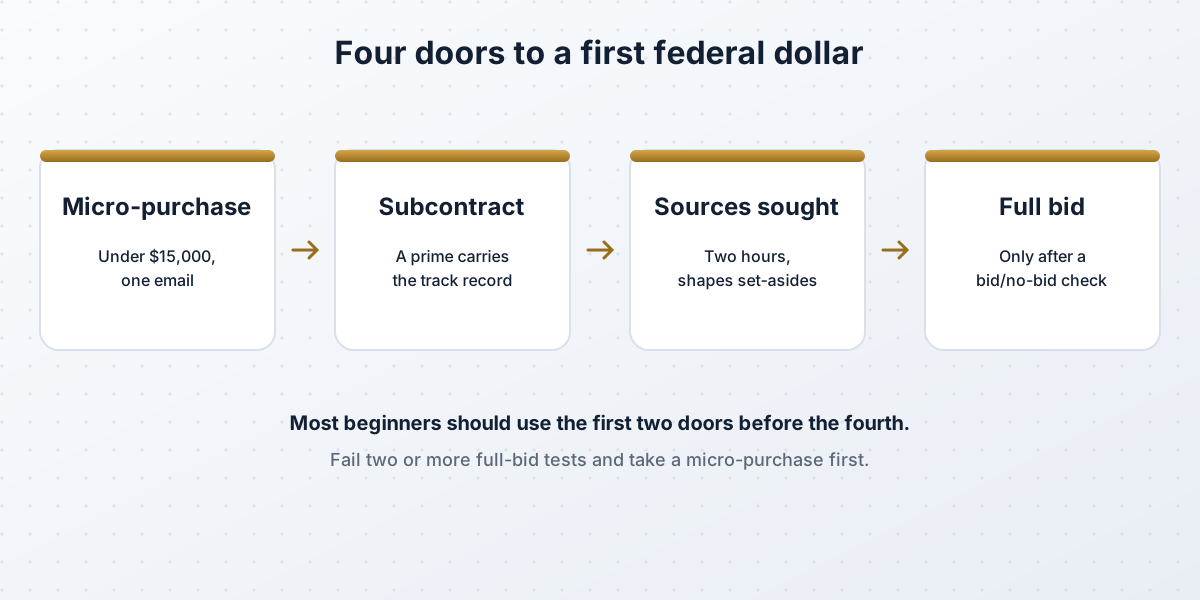
If you fail two or more of the full-bid rows, take the micro-purchase door first. It is not a lesser option. It is the one that gets you a reference.
Weeks 9 and 10: Should you prime or sub on your first pursuit?
Why past performance pushes most beginners to sub first
Contracting officers score past performance, and a firm with no federal history competes against firms with years of ratings. Subbing first lets the prime's record cover the work while you build yours. Your certifications still matter, because primes chasing set-aside work need SDVOSB, WOSB, 8(a) or HUBZone teammates. Read our subcontracting tips before your first call.
Getting on a prime's subcontractor list
Primes find subs through their own SAM.gov searches, the SBA SubNet listings and teaming conversations at agency industry days. Send a prime your one-page capability statement with your CAGE code, NAICS codes and certifications, and ask which upcoming solicitations need your skill set. Get a written teaming agreement before you share pricing or past performance details.
Weeks 11 to 13: How do you respond to a sources sought or solicitation without wasting a week?
Answer a sources sought in two hours
A sources sought notice is market research, not a bid. The agency wants to know whether capable vendors exist, so a two-page response covering your NAICS code, certifications and relevant past performance is enough. Send it even if you are not ready to bid: it can shape the set-aside decision and puts your name in front of the contracting officer. Use our sources sought response template, and see the sources sought guide for how these notices work.
The compliance matrix and the bid/no-bid check
When a full solicitation drops, do not start writing. Read the PWS once for scope, then build a compliance matrix: every "shall" and "must" in one column, your response location in the other. That tells you whether you can comply, and it becomes your outline.
Then run the bid/no-bid check before you write a word. Score the requirement against your past performance, your capacity and whether the set-aside matches your certification. If the agency wants three past performance references and you have one, that is a PASS, not a fix-it-later. GovScout Pro runs this check against your profile and returns GO, TEAM or PASS with the reasoning attached. A TEAM verdict means subcontract or partner. Save the prime bid for when your matrix comes back clean.
What changed for beginners in 2026 and 2027?
| Change | Status | What it means for you |
|---|---|---|
| Micro-purchase and simplified acquisition thresholds | $15,000 and $350,000, effective Oct. 1, 2025 | Your first awards likely sit under these. See the thresholds post |
| SAM.gov reps and certs | Modernized March 24, 2026 | Check that your representations are current before you bid |
| FPDS and eSRS | Retired February 2026 and folded into SAM.gov | Contract award data and subcontract reports now live in one place |
| SBA size standards | Overhaul proposed Aug. 20, 2026, comments to Nov. 20, 2026 | Not final. Re-check your size when it is |
| FAR overhaul | Second round of proposed rules issued Sept. 18, 2026 | Rules for solicitations may shift. Read the clauses in each notice |
Which tools carry you through the 90 days?
The free tools cover weeks 1 to 4: the readiness assessment, the NAICS code lookup and the capability statement generator. After that, you need a way to filter opportunities fast.
GovScout Pro's Beginner plan is $29 a month. Marcus scores opportunities against your certifications and profile and returns GO, TEAM or PASS with the reasoning shown, so you stop spending evenings on solicitations you were never going to win. Broader research platforms such as GovTribe, HigherGov, GovWin IQ and GovSpend suit teams with dedicated business development staff. See pricing for the plans.
Where GovScout Pro is not the right fit
If you are past your first award and need historical pricing, competitor award data or agency spend analytics, GovScout Pro will feel thin, and the research platforms above do that work better. It also does not replace SAM.gov alerts, and it assumes you have already registered.
What are the most common ways beginners blow the 90 days?
- Registration purgatory. Your name or bank details do not match, validation stalls, and you spend six weeks on paperwork instead of finding buyers. Start in week 1 and check status often.
- Chasing every solicitation. A solo firm answering five PWS documents a week writes five weak proposals and learns nothing from any of them.
- Skipping the no-bid discipline. Decide your GO, TEAM and PASS rules in writing before week 7: relevant past performance, set-aside fit and a scope you can deliver.
Frequently Asked Questions
How long does SAM.gov registration take before I can bid?
There is no fixed number. DLA says CAGE code processing can take up to 10 business days, and entity validation takes about 5 days for simple cases and several weeks for complicated ones. Name and bank mismatches are the usual cause of delays, so submit everything correctly in week 1 and check your status often.
Can I win a federal contract with no past performance?
Yes, but usually not as a prime on a full solicitation, where past performance is scored. Micro-purchases under $15,000 do not require it, and subcontracting lets a prime's track record cover the work while you build your own. Both routes give you your first reference.
Do I need a GSA Schedule to get started?
No. Micro-purchases and open-market solicitations do not require one. A schedule is one sales vehicle among several, and chasing one before you know which agencies buy your service can burn months. Build your 10-agency target list first, then decide. Our GSA schedule guide for beginners explains when it makes sense.
What is the difference between a sources sought notice and a solicitation?
A sources sought notice is market research. The agency is asking whether capable vendors exist, and your response can influence the set-aside decision. A solicitation is an actual competition scored against stated requirements. Answer sources sought notices even when you are not ready to bid, and answer a solicitation only after a bid/no-bid check.
How much money do I need before my first federal bid?
Almost nothing. SAM.gov registration, the UEI and the CAGE code are free, and the NAICS lookup and capability statement generator are free too. The real cost is about 13 weeks of focused evenings. Paid tools like the $29 a month Beginner plan are optional.
What is the fastest way to a first federal dollar?
A micro-purchase under $15,000, or a small subcontract with a prime. Both avoid the past performance scoring that slows a first prime bid. Pick the door that fits your service and your certifications, and expect weeks, not days.