Structured software
The workspace keeps the moving parts organized.
- Profile
- Searches
- Pipeline
- Documents
GovScout Pro checks a SAM.gov opportunity against your NAICS codes, certifications, and past performance, then tells you GO, TEAM, or PASS and why. Marcus, the built-in adviser, reads the solicitation with you and flags the deal-breakers before you sink a week into a proposal you were never going to win.
GovScout combines structured SaaS workflow with Marcus adviser judgment so a small business can move from raw opportunity data to a reviewable pursuit decision. The workspace stores the company profile, saved SAM.gov searches, pipeline records, and solicitation documents in one place, and Marcus turns them into a written verdict with risks, evidence gaps, and next actions.
The workspace keeps the moving parts organized.
Marcus reviews facts, evidence gaps, risk, and next actions.
The owner keeps control before a pursuit moves forward.
GovScout connects opportunity analysis, evidence review, document intelligence, and capture planning so a small business can decide what deserves proposal time. Each step feeds the next: a SAM.gov notice becomes an opportunity record, the record gets a Marcus fit review, the review produces a go, team, hold, or pass call, and the call drives the pursuit package.
Marcus helps review opportunities like a serious GovCon adviser: fit, risk, teaming path, proof gaps, and next actions.
Free and paid tools help organize the work before you spend time chasing a solicitation that does not fit.
Plain-English training helps beginners and growing firms understand the federal market before they pay for heavier support.
GovScout Pro follows four steps for every new user: assess the business, find relevant opportunities, make a decision, and build the pursuit package. Free tools cover the first steps, so a first-time federal contractor can confirm SAM.gov registration, NAICS codes, and certifications before paying for anything or spending hours on SAM.gov searches.
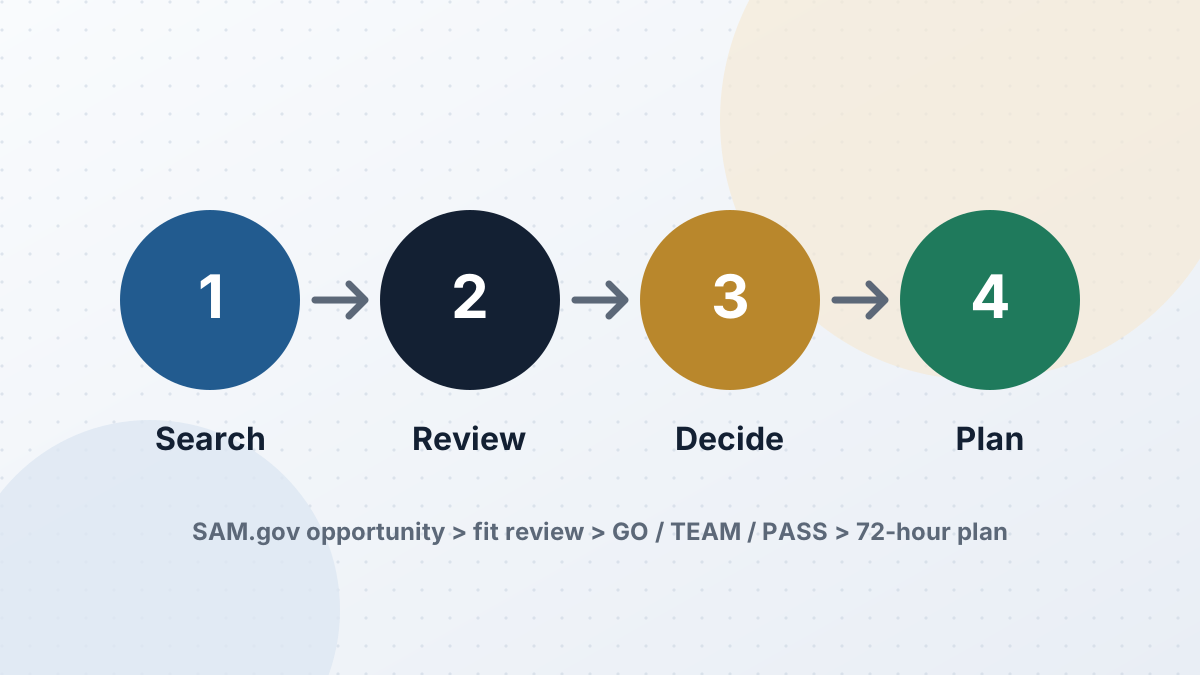
Confirm SAM.gov, NAICS, certifications, proof, and pursuit gaps before searching heavily.
Use focused search planning instead of broad keyword hunting through SAM.gov noise.
Marcus helps call GO, TEAM, HOLD, or PASS based on the facts available.
Turn the decision into capability statements, outreach, task lists, and bid package structure.
The highest-intent path for new buyers is simple: define the lane, build the search plan, review pre-solicitation signals, and pressure-test whether the work deserves proposal time. Sources sought notices and requests for information are the earliest public signals on SAM.gov, and answering them well is how small businesses get noticed before a set-aside decision is made.
Start with scope, NAICS, and buyer targeting before you chase alerts.
Use educational pages that explain how to search and what sources sought notices actually tell you.
Turn search activity into a go, team, hold, or pass decision before proposal time expands.
GovScout does not stop at a chat answer. The workflow is designed to produce reviewable work products a business owner can use for a real pursuit decision. A Marcus review can end in documents you can save, share with a teaming partner, or hand to a proposal writer: a case file, a compliance checklist, and a 72-hour capture plan.
Opportunity facts, assumptions, evidence gaps, risks, verdict, and next actions in one review record.
Instructions, attachments, submission items, and evaluation factors converted into a checklist.
72-hour actions, teaming path, proof packet needs, outreach targets, and decision gates.
GovScout Pro reduces scattered work before a small business commits proposal time. The goal is not to replace official systems or expert judgment. SAM.gov, the solicitation, and the contracting officer remain the authority; GovScout organizes those sources into one decision record so the owner can see the facts, the gaps, and the risk before committing staff hours.
GovScout Pro publishes free guides by certification, agency, and industry. These guides help visitors move from general interest into a specific buyer, certification, or service lane instead of bouncing after the homepage. The guides cover who buys the work, which set-aside programs apply, current dollar thresholds, and how to find matching opportunities on SAM.gov.
GovScout is built as decision-support software. It helps organize evidence and next actions, but it does not invent company facts, replace official solicitation instructions, or guarantee awards. Marcus flags missing proof instead of filling gaps with assumptions, and every recommendation shows the facts it used so the owner can check them against the original solicitation and SAM.gov record.
Small-business owners ask four questions before trusting an AI-assisted federal-contracting workflow: whether Marcus is a person, whether GovScout replaces SAM.gov, which documents it can review, and who is responsible for the final submission. The answers below are short and direct, and the official sources they point to, such as SAM.gov and the solicitation itself, stay the final authority.
No. Marcus is the AI adviser inside GovScout, not a human consultant. The product is designed to apply consultant-style discipline while keeping final decisions with the business owner. Marcus reviews fit, risk, teaming options, and proof gaps, then recommends go, team, hold, or pass. The owner decides whether to pursue, and nothing is submitted on their behalf.
No. SAM.gov remains an official source for federal contract opportunities and entity registration. GovScout helps organize opportunity facts, documents, evidence gaps, and pursuit decisions around that source material. Users still register in SAM.gov, still submit through the method the solicitation requires, and should confirm notice details and amendments on SAM.gov before acting.
GovScout reviews solicitation packages, statements of work, performance work statements, amendments, and related pursuit documents. Document Intelligence turns those files into requirement lists, evaluation factors, and submission checklists. Users should verify output against the original files, because the solicitation and its amendments always control over any summary GovScout produces.
The customer is responsible for reviewing and using their own pursuit materials. GovScout does not claim contract awards, company experience, or customer facts. Capability statements, past performance write-ups, and proposals built in GovScout use only the facts the owner enters, and the owner must confirm accuracy before sending anything to a contracting officer or prime contractor.
"Small businesses do not need more noise. They need a disciplined way to know what is worth pursuing."
Founder note from Steven Harriman, GovScout ProStart with a free readiness assessment, then bring your strongest opportunity into Marcus for a structured review. The assessment checks SAM.gov status, NAICS codes, certifications, and proof before you spend money. The 3-day limited trial then lets you run Marcus on a real notice before choosing a plan, starting at $29 per month.